


Initiation of DNA repair mediated by a stalled RNA polymerase IIO
- PMID: 16407975
- PMCID: PMC1383516
- DOI: 10.1038/sj.emboj.7600933
Initiation of DNA repair mediated by a stalled RNA polymerase IIO
Abstract
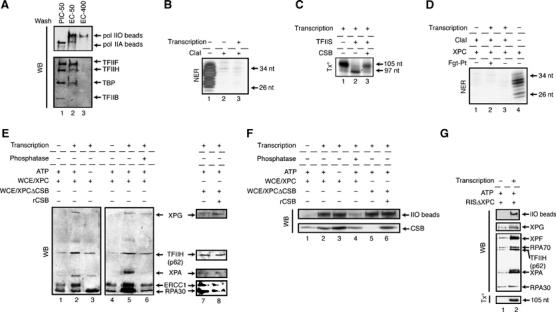
The transcription-coupled repair (TCR) pathway preferentially repairs DNA damage located in the transcribed strand of an active gene. To gain insight into the coupling mechanism between transcription and repair, we have set up an in vitro system in which we isolate an elongating RNA pol IIO, which is stalled in front of a cisplatin adduct. This immobilized RNA pol IIO is used as 'bait' to sequentially recruit TFIIH, XPA, RPA, XPG and XPF repair factors in an ATP-dependent manner. This RNA pol IIO/repair complex allows the ATP-dependent removal of the lesion only in the presence of CSB, while the latter does not promote dual incision in an XPC-dependent nucleotide excision repair reaction. In parallel to the dual incision, the repair factors also allow the partial release of RNA pol IIO. In this 'minimal TCR system', the RNA pol IIO can effectively act as a loading point for all the repair factors required to eliminate a transcription-blocking lesion.
Figures



References
-
- Aboussekhra A, Biggerstaff M, Shivji MK, Vilpo JA, Moncollin V, Podust VN, Protic M, Hubscher U, Egly JM, Wood RD (1995) Mammalian DNA nucleotide excision repair reconstituted with purified protein components. Cell 80: 859–868 - PubMed
-
- Asahina H, Kuraoka I, Shirakawa M, Morita EH, Miura N, Miyamoto I, Ohtsuka E, Okada Y, Tanaka K (1994) The XPA protein is a zinc metalloprotein with an ability to recognize various kinds of DNA damage. Mutat Res 315: 229–237 - PubMed
-
- Bohr VA, Smith CA, Okumoto DS, Hanawalt PC (1985) DNA repair in an active gene: removal of pyrimidine dimers from the DHFR gene of CHO cells is much more efficient than in the genome overall. Cell 40: 359–369 - PubMed
Publication types
MeSH terms
Substances
LinkOut - more resources
Full Text Sources
Research Materials
