


Incidence of diagnosed polymyalgia rheumatica and temporal arteritis in the United Kingdom, 1990-2001
- PMID: 16414971
- PMCID: PMC1798240
- DOI: 10.1136/ard.2005.046912
Incidence of diagnosed polymyalgia rheumatica and temporal arteritis in the United Kingdom, 1990-2001
Abstract
Objective: To investigate time trends, geographical variation, and seasonality in the incidence of diagnosis of polymyalgia rheumatica (PMR) and temporal arteritis (TA) in the United Kingdom.
Methods: Analysis of computerised medical records from UK general practices. Participants were registered with a practice contributing to the General Practice Research Database during the period 1990-2001. The main outcome measures were rates of diagnosis by year, age, sex, geographical region, and calendar month.
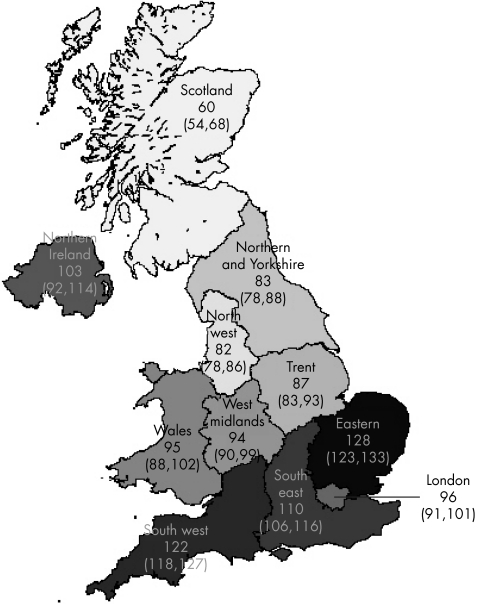
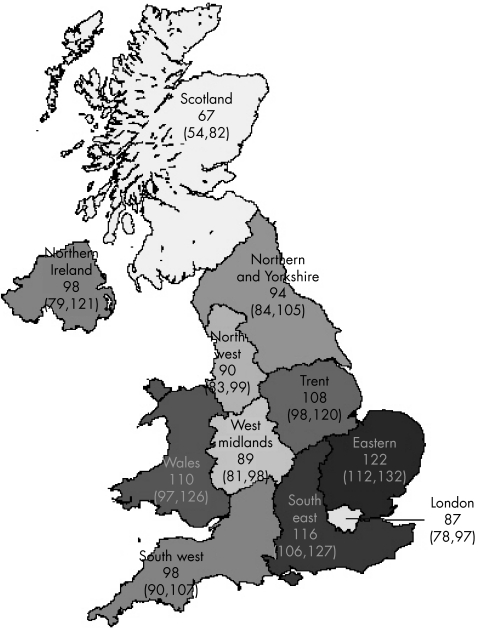
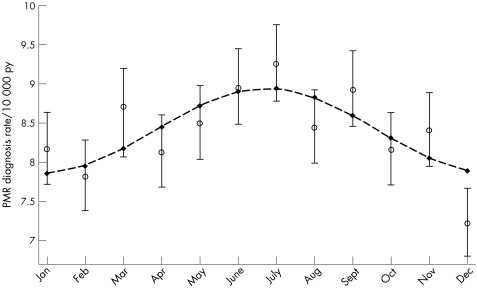
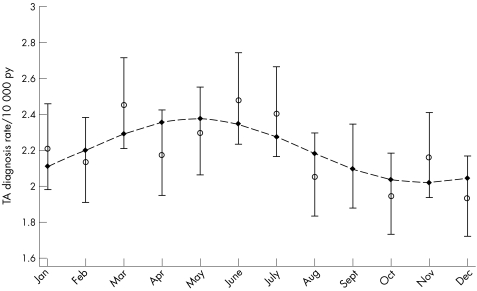
Results: 15 013 people had a first diagnosis of PMR and 3928 a first diagnosis of TA during 17 830 028 person-years of observation. The age adjusted incidence rate of PMR was 8.4/10 000 person-years (95% CI 8.3 to 8.6), rising from 6.9/10 000 person-years in 1990 to 9.3/10 000 in 2001. The age adjusted incidence rate of TA was 2.2/10 000 person-years (95% CI 2.1 to 2.3) with no increase observed. Both PMR and TA were more common in the south than in the north of the UK, and both were more commonly diagnosed in the summer months.
Conclusions: The explanation for the findings is unclear. Variations in diagnostic practice and accuracy are likely to have contributed in part to the patterns seen. However, the findings are also likely to reflect, at least in part, variations in the incidence of disease. The striking geographical pattern may be partly attributable to a risk factor which is more prevalent in the south and east of the United Kingdom.
References
-
- Salvarani C, Cantini F, Boiardi L, Hunder G G. Polymyalgia rheumatica and giant‐cell arteritis. N Engl J Med 2002347261–271. - PubMed
-
- Silman A J. Polymyalgia rheumatica and giant cell arteritis. In: Silman A, Hochberg MC, eds. Epidemiology of the rheumatic diseases. Oxford: Oxford University Press, 2001188–189.
-
- Cantini F, Niccoli L, Storri L, Nannini C, Olivieri I, Padula A.et al Are polymyalgia rheumatica and giant cell arteritis the same disease? Semin Arthritis Rheum 200433294–301. - PubMed
