Dose-response relation between sulfonylurea drugs and mortality in type 2 diabetes mellitus: a population-based cohort study
- PMID: 16415461
- PMCID: PMC1329454
- DOI: 10.1503/cmaj.050748
Dose-response relation between sulfonylurea drugs and mortality in type 2 diabetes mellitus: a population-based cohort study
Abstract
Background: Over the past 30 years, the relation between use of sulfonylureas to treat type 2 diabetes and the risk of cardiovascular events has been vigorously debated. The purpose of this study was to determine if the risk of death changes with level of exposure to sulfonylurea drugs.
Methods: This was a retrospective, inception cohort study using administrative data from Saskatchewan Health (1991-1999). The 5795 subjects, identified by their first-ever dispensation for an oral antidiabetic agent, were grouped according to their use of such agents during follow-up. Potential subjects using insulin or combination therapy were excluded. Exposure level was defined by daily dose and degree of adherence. Separate multivariate Cox proportional-hazard models were constructed for each monotherapy group and used to calculate the risk of death associated with higher versus lower exposure category. Disease severity indicators were identified among the administrative data and entered as covariates in each model. The main outcomes were all-cause mortality and death from an acute ischemic event.
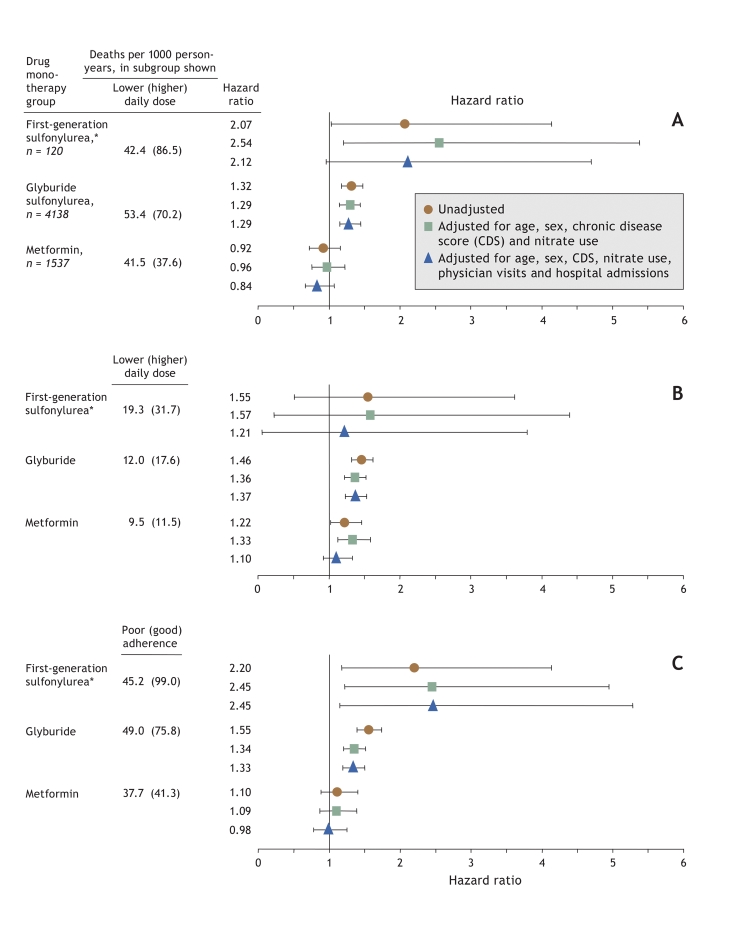
Results: The mean age of the cohort members was 66.3 (standard deviation [SD] 13.4) years; 43.4% were female; and their mean duration of follow-up was 4.6 (SD 2.1) years. First-generation sulfonylureas were used exclusively by 120 subjects; glyburide, by 4138; and metformin, by 1537. A greater risk of death was associated with higher daily doses of the first-generation sulfonylureas (adjusted hazard ratio [HR] 2.1, 95% confidence interval [CI] 1.0-4.7) and glyburide (HR 1.3, 95% CI 1.2-1.4), but not metformin (HR 0.8, 95% CI 0.7-1.1). Similar associations were observed for death caused by an acute ischemic event.
Interpretation: Higher exposure to sulfonylureas was associated with increased mortality among patients newly treated for type 2 diabetes. The same relation was not observed with metformin. This implies that the manner in which blood glucose concentration is lowered may be as important as achieving recommended glucose targets.
Figures
Comment in
-
Do sulfonylurea drugs increase the risk of cardiac events?CMAJ. 2006 Jan 17;174(2):185-6. doi: 10.1503/cmaj.051237. CMAJ. 2006. PMID: 16415463 Free PMC article. No abstract available.
-
Patient characteristics not described.CMAJ. 2006 Jun 20;174(13):1874. doi: 10.1503/cmaj.1060078. CMAJ. 2006. PMID: 16785468 Free PMC article. No abstract available.
References
-
- Health Canada Centre for Chronic Disease Prevention and Control. Diabetes in Canada. 2nd ed. Ottawa: The Centre; 2002.
-
- Wild S, Roglic G, Green A, et al. Global prevalence of diabetes: estimates for the year 2000 and projections for 2030. Diabetes Care 2004;27:1047-53. - PubMed
-
- Inzucchi SE. Oral antihyperglycemic therapy for type 2 diabetes: scientific review. JAMA 2002;287:360-72. - PubMed
-
- Meinert CL, Knatterud GL, Prout TE, et al. A study of the effects of hypoglycemic agents on vascular complications in patients with adult-onset diabetes. II. Mortality results. Diabetes 1970;19(Suppl):789-830. - PubMed
-
- Groop LC. Sulfonylureas in NIDDM. Diabetes Care 1992;15:737-54. - PubMed
Publication types
MeSH terms
Substances
LinkOut - more resources
Full Text Sources
Other Literature Sources
Medical
Miscellaneous