. 2006 Apr;147(7):815-24.
doi: 10.1038/sj.bjp.0706644.

A role for voltage-gated, but not Ca2+-activated, K+ channels in regulating spontaneous contractile activity in myometrium from virgin and pregnant rats

Affiliations

A role for voltage-gated, but not Ca2+-activated, K+ channels in regulating spontaneous contractile activity in myometrium from virgin and pregnant rats

Philip Irving Aaronson et al. Br J Pharmacol. 2006 Apr.

Abstract

The roles of voltage-gated (K(V)) and large conductance Ca2+-activated K+ (BK(Ca)) channels in regulating basal contractility in myometrial smooth muscle are unresolved. The aim of this study was to determine the effects of inhibition of these channels on spontaneous rhythmic contraction in myometrial strips from four groups of rats: nonpregnant and during early (day 7), mid- (day 14), and late (day 21) pregnancy. BK(Ca) channels were inhibited using iberiotoxin (1-100 nM), paxilline (1-10 microM) or penitrem A (1-500, or 3000 nM); K(V) channels were inhibited using tetraethylammonium (TEA; 1-10 mM) and/or 4-aminopyridine (4-AP; 1-5 mM). Contractility was assessed as mean integral tension (MIT). Time/vehicle controls were also performed. None of the selective BK(Ca) channel inhibitors significantly affected contractility in myometrial strips from either nonpregnant or pregnant animals. 4-AP caused concentration-dependent increases in MIT in myometrium in all four groups. TEA (5 and 10 mM) significantly increased MIT in myometrium from nonpregnant, and mid- and late pregnant rats, but not in myometrium from early pregnant rats. TEA and 4-AP still caused an increase in MIT following treatment with 3000 nM penitrem A or a combination of propranolol, phentolamine, atropine (all 1 microM) and capsaicin (10 microM) in myometrial strips from nonpregnant rats. These results indicate that whereas BK(Ca) channels play little or no part in controlling basal rhythmicity in rat myometrium, K(V) channels appear to play a crucial role in this regard, especially during mid- and late pregnancy.


Figures
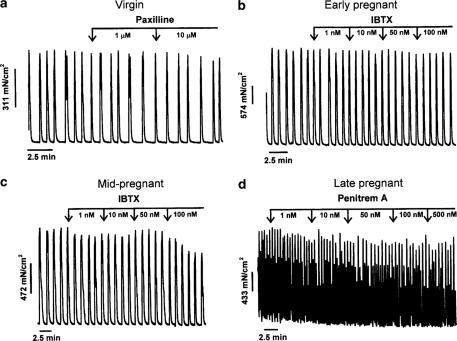
Figure 1
Figure 1
Experimental protocol and representative traces illustrating the lack of effect of application of progressively higher concentrations of BKCa channel inhibitors on spontaneous myometrial contractions in strips from virgin nonpregnant (a), early pregnant (b), mid-pregnant (c) and late pregnant (d) animals. Each concentration of inhibitor was applied for 5 min.
Figure 2
Figure 2
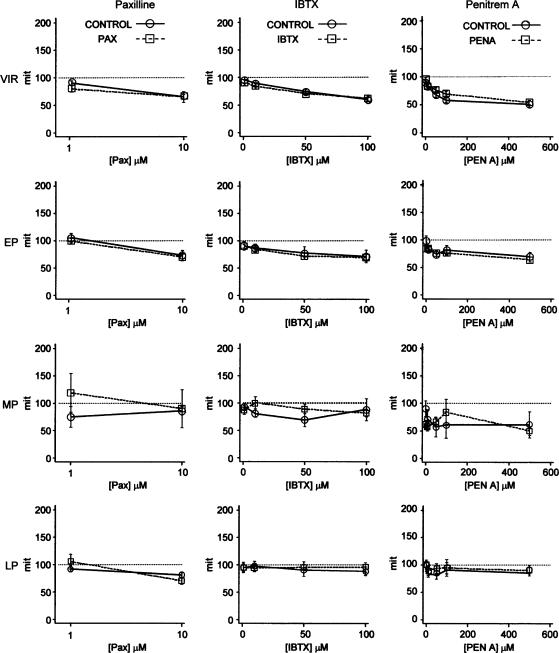
Effects of paxilline (Pax, left panels), iberiotoxin (IBTX, center panels) and penitrem A (Pen A, right panels) on MIT in myometrial strips from virgin nonpregnant (VIR), early pregnant (EP), mid-pregnant (MP) and late pregnant (LP) rats. Each panel illustrates MIT during the period of addition of the drug concentrations shown on the abscissa, normalized to that recorded during a 15 min control period just prior to addition of the first concentration of drug (open circles). Also illustrated is the MIT, expressed in the same way, in strips exposed during the same time intervals to drug vehicle. In no case was MIT significantly affected by BKCa channel inhibitor (n=4–22 strips, each from a different animal), P>0.05.
Figure 3
Figure 3
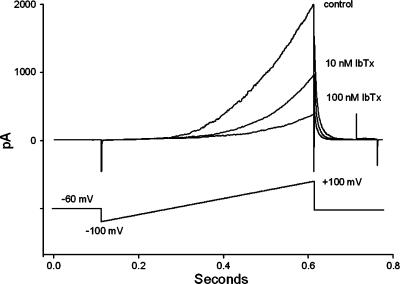
An example of the effect of IBTX on the outward (K+ current) elicited by voltage ramps in an isolated myometrial smooth muscle cell. Each trace is the average of five to 10 individual current traces recorded under control conditions (upper trace), and when the current had stabilised following addition of 10 nM (middle trace) and then 100 nM IBTX.
Figure 4
Figure 4
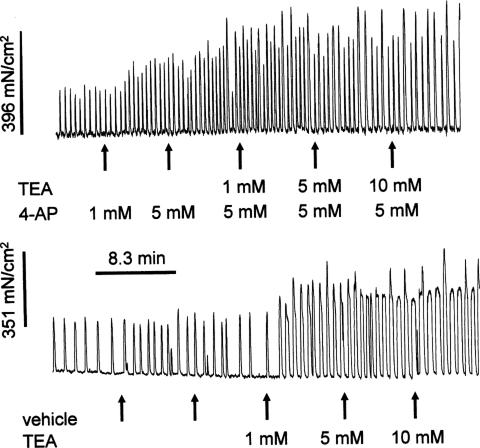
Experimental protocol and representative traces showing the effect of 4-AP and TEA on myometrial contractions, in this case obtained in strips from late pregnant myometrium. Each concentration of drug was applied for 7.5 min.
Figure 5
Figure 5
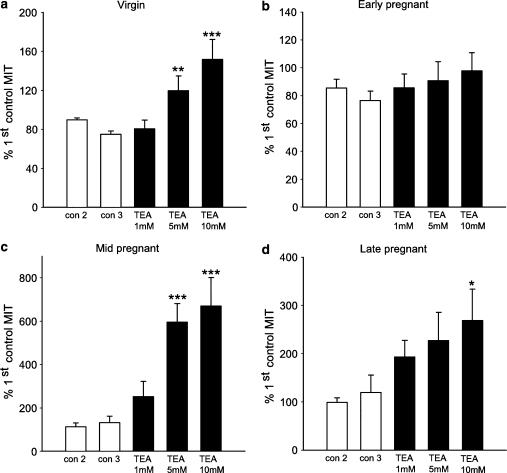
Effects of TEA on MIT in muscle strips from virgin nonpregnant (a), early pregnant (b), mid-pregnant (c) and late pregnant (d) myometrium. MIT is normalized to the activity observed during an initial 7.5 min control period. The white bars illustrate activity during two preceding control periods, and the black bars show the effects of subsequent cumulative addition of TEA (1, 5 and 10 mM) (n=6, 6, 9 and 8 for virgin, early, mid- and late pregnant strips, each from a different animal). *P<0.05; **P<0.001; ***P<0.001.
Figure 6
Figure 6
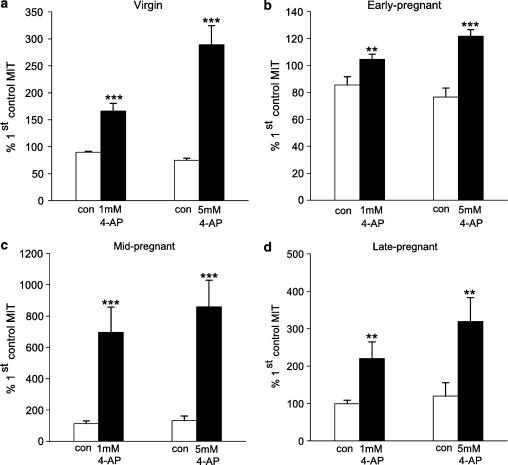
Effects of 4-AP on MIT in muscle strips from virgin nonpregnant (a), early pregnant (b), mid-pregnant (c) and late pregnant (d) myometrium. In each case, MIT during 7.5 min applications of first 1 and then 5 mM 4-AP is normalized to the activity observed during a prior 7.5 min control (drug-free) period. The white bars illustrate activity during the second and third 7.5 min periods observed in strips exposed only to drug vehicle (water); again MIT is normalized to a prior (first) control period (controls, n=6, 6, 9 and 8; 4-AP treatment, n=7, 5, 9 and 8, for virgin, early, mid- and late pregnant strips, respectively, each from a different animal). **P<0.01; ***P<0.001.
Figure 7
Figure 7
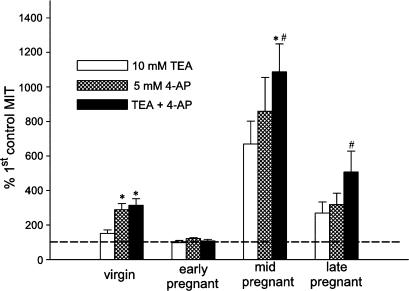
Comparison of the effects of 10 mM TEA (open bars), 5 mM 4-AP (hatched bars) and their combination (black bars) on MIT in myometrial strips from nonpregnant and pregnant rats. MIT is normalized to the response obtained in the absence of drug, which is represented by the dashed line. Note that the response to 10 mM TEA was significantly higher than the control response in all but the strips from the early pregnant animals (see Figure 4; 10 mM TEA treatment, n=6, 6, 9 and 8; 5 mM 4-AP and combined treatment, n=7, 5, 9 and 8, for virgin, early, mid- and late pregnant strips, respectively, each from a different animal). *Response significantly different from 10 mM TEA, P<0.05. #Response significantly different from 5 mM 4-AP, P<0.05.
Figure 8
Figure 8
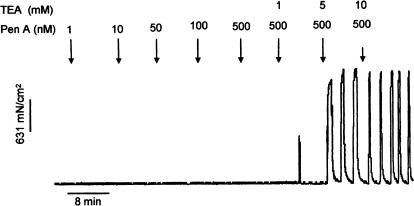
Experimental protocol and representative traces showing the effect of cumulative addition of a selective BKCa channel inhibitor, in this case penitrem A, followed by application of ascending concentrations of TEA (1, 5 and 10 mM) on activity in quiescent mid-pregnant myometrial strips. Each concentration of drug was applied for 7.5 min.
Figure 9
Figure 9
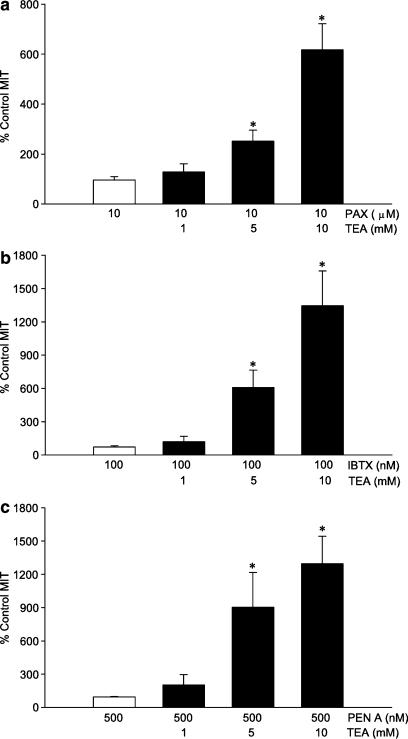
Effects of ascending concentrations of TEA (1, 5 and 10 mM) on MIT in the continuing presence of paxilline (10 μM, panel a; n=4), IBTX (100 nM, panel b; n=7) and penitrem A (500 nM, panel c; n=5) on activity in quiescent mid-pregnant myometrial strips. MIT is normalized to that measured during an initial 7.5 min control period prior to application of the selective BKCa channel inhibitor; this essentially reflected basal tone during these periods, as spontaneous contractions were rare. *P<0.05.
Figure 10
Figure 10
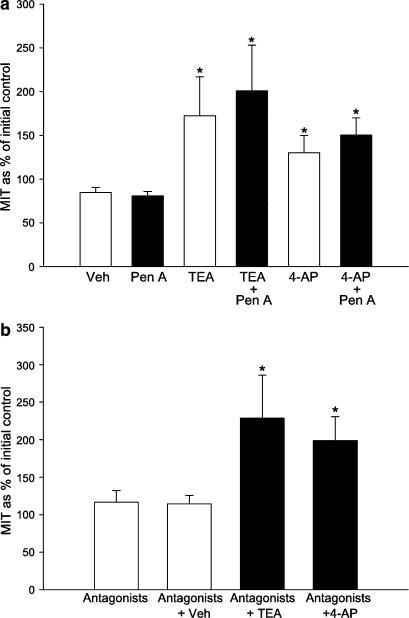
Effects of TEA (10 mM) and 4-AP (5 mM) on MIT following treatment with a high concentration of penitrem A (3 μM; a) or a combination of drugs designed to suppress possible effects of transmitter release from nerve endings (b). (a) Penitrem A applied over 15 min (Pen A; n=21 strips from 16 animals) had no significant effect on MIT when compared to the effect of 0.6% DMSO (Veh; n=18 strips from 15 animals). In the presence of penitrem A, both TEA (TEA+Pen A; n=7 strips from seven animals) and 4-AP (4-AP+Pen A; n=10 strips animals from nine animals) caused increases in MIT, which were similar to those recorded in tissues in the presence of TEA (TEA; n=4 strips from four animals) and 4-AP (4-AP; n=4 from four animals) alone, respectively. *MIT during treatment with TEA or 4-AP was significantly different (P<0.05) compared with time/vehicle controls. (b) Following treatment with capsaicin (10 μM) for 20 min, tissues were washed in PSS for 15 min, and then phentolamine, propranolol and atropine (all 1 μM) were added to the bath. MIT during the next 15 min was not significantly different from that recorded prior to capsaicin addition (bar labelled ‘antagonists', n=17 strips from 13 animals). Subsequent addition of either TEA (antagonists+TEA; n=4 strips from n=4 animals) or 4-AP (antagonists+4-AP; n=4 strips from n=4 animals) caused increases in MIT similar to that observed in tissue strips which had not been pretreated (compare with, for example, Figure 10a). *MIT during treatment with TEA or 4-AP was significantly different (P<0.05) compared with time/vehicle controls (antagonists+Veh, n=9 strips from n=4 animals).

References

    1. ADEAGBO A.S.O. 1-Ethyl-2-benzimidazolinone stimulates endothelial KCa channels and nitric oxide formation in rat mesenteric vessels. Eur. J. Pharmacol. 1999;379:151–159. - PubMed
    1. ANWER K., OBERTI C., PEREZ G.J., PEREZ-REYES N., MCDOUGALL J.K., MONGA M., SANBORN B.M., STEFANI E., TORO L. Calcium-activated K+ channels as modulators of human myometrial contractile activity. Am. J. Physiol. 1993;265:C976–C985. - PubMed
    1. ANWER K., TORO L., OBERTI C., STEFANI E., SANBORN B.M. Ca2+-activated K+ channels in pregnant rat myometrium: modulation by a beta-adrenergic agent. Am. J. Physiol. 1992;263:C1049–C1056. - PubMed
    1. BAI X., BUGG G.J., GREENWOOD S.L., GLAZIER J.D., SIBLEY C.P., BAKER P.N., TAGGART M.J., FYFE G.K. Expression of TASK and TREK, two-pore domain K+ channels, in human myometrium. Reproduction. 2005;129:525–530. - PubMed
    1. BRADLEY K.K., BUXTON I.L., BARBER J.E., MCGAW T., BRADLEY M.E. Nitric oxide relaxes human myometrium by a cGMP-independent mechanism. Am. J. Physiol. 1998;275:C1668–C1673. - PubMed

Publication types

MeSH terms

Substances