Comparative Study
. 2006 Apr 7;281(14):9200-4.
doi: 10.1074/jbc.M512529200. Epub 2006 Jan 17.

Significant redox insensitivity of the functions of the SARS-CoV spike glycoprotein: comparison with HIV envelope

Affiliations
Comparative Study

Significant redox insensitivity of the functions of the SARS-CoV spike glycoprotein: comparison with HIV envelope

Dimitri Lavillette et al. J Biol Chem. .

Abstract

The capacity of the surface glycoproteins of enveloped viruses to mediate virus/cell binding and membrane fusion requires a proper thiol/disulfide balance. Chemical manipulation of their redox state using reducing agents or free sulfhydryl reagents affects virus/cell interaction. Conversely, natural thiol/disulfide rearrangements often occur during the cell interaction to trigger fusogenicity, hence the virus entry. We examined the relationship between the redox state of the 20 cysteine residues of the SARS-CoV (severe acute respiratory syndrome coronavirus) Spike glycoprotein S1 subdomain and its functional properties. Mature S1 exhibited approximately 4 unpaired cysteines, and chemically reduced S1 displaying up to approximately 6 additional unpaired cysteines still bound ACE2 and enabled fusion. In addition, virus/cell membrane fusion occurred in the presence of sulfhydryl-blocking reagents and oxidoreductase inhibitors. Thus, in contrast to various viruses including HIV (human immunodeficiency virus) examined in parallel, the functions of the SARS-CoV Spike glycoprotein exhibit a significant and surprising independence of redox state, which may contribute to the wide host range of the virus. These data suggest clues for molecularly engineering vaccine immunogens.


Figures

FIGURE 1
FIGURE 1
Thiol content of mature S1.A, purity. The S1 recombinant antigen was incubated with MPB prior to 8% SDS-PAGE and Western blotting. The filter was incubated with Amido Black (Protein labeling) or streptavidin-peroxidase/diaminobenzidine (Thiol labeling). B, thiol content. S1 (two batches, S1a and S1b) and HIVCN54 Env were dot-blotted and labeled with MPB. The thiol content per molecule was quantified by densitometry using a standard curve; β-mercaptoethanol (ME) treatment produced fully reduced antigens (n = 4; means are shown).
FIGURE 2
FIGURE 2
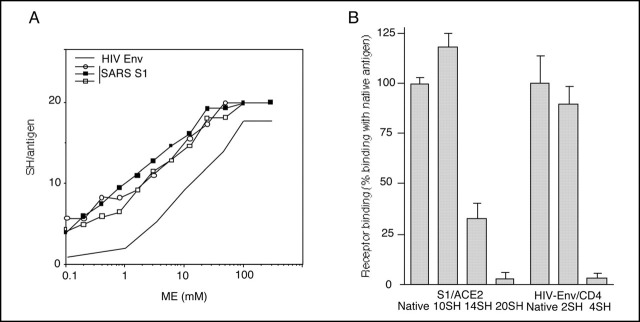
Thiol content and ACE2 binding.A, chemical reduction. S1 and HIV SU were treated using increasing concentrations of β-mercaptoethanol (ME). The thiol content was determined as described for Fig. 1B (S1, n = 3; HIV SU, mean of n = 2). B, receptor binding. S1 was either mock-treated (Native; ∼4 SH/antigen) or chemically reduced as described in A to induce ∼6 - 16 additional SH/antigen. ACE2 binding was assessed using an enzyme-linked immunosorbent assay based on soluble ACE2 for coating. HIV SU was either mock-treated (native; 0 SH) or chemically reduced (∼2–4 SH/antigen); 125I-recombinant soluble CD4 binding was assessed. Processing of the samples enabled to reach nonactive concentrations of reducing agent during the binding reaction (26, 30).
FIGURE 3
FIGURE 3
Thiol content and Spike-mediated fusion. DTT treatment at indicated concentrations was performed during infection of VeroE6 cells with SARS-CoV pseudovirus (CoTRT). Alternatively, virions (PTRT virus) or cells (PTRT cells) were pretreated using DTT prior to dilution and subsequent infection. For infection, cells and virions carrying the GFP gene were coincubated for 4 h before washing and culture for 72 h. Cell expression of GFP resulting from virus entry was quantified using flow cytometry. The capacity of the assay to detect inhibition of virus entry was measured using anti-SARS neutralizing antisera. The infectivity in each condition was compared with the infectivity of untreated pseudotypes standardized to 100% (n = 3–5; duplicates were performed; one experiment is shown). NAbs, neutralizing antibodies; CAbs, control antibodies.
FIGURE 4
FIGURE 4
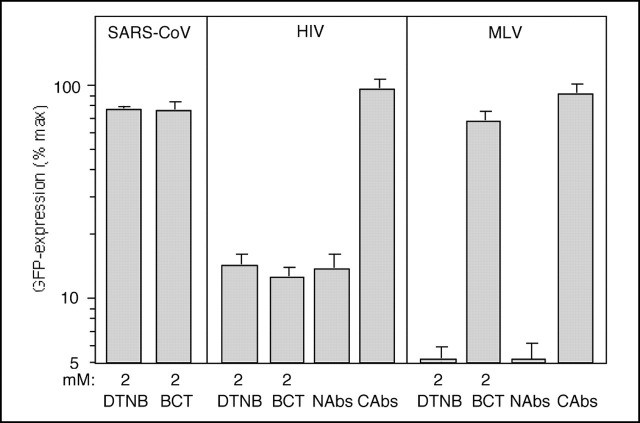
Redox shuffling and fusion. Infections were performed essentially as described for Fig. 3. VeroE6 cells were used for SARS-CoV and MLV pseudotype infection. HeLaP4 CD4+ cells were used for HIVNL4-3 pseudotype infection. Efficient, noncytotoxic, concentrations of DTNB and bacitracin (BCT) were added during the coincubation step of cells and vectors (15, 19). NAbs, neutralizing antibodies; CAbs, control antibodies.

References

    1. Temperton N.J., Chan P.K., Simmons G., Zambon M.C., Tedder R.S., Takeuchi Y., Weiss R.A. Emerg. Infect. Dis. 2005;11:411–416. - PMC - PubMed
    1. Xiao X., Dimitrov D.S. CMLS Cell. Mol. Life Sci. 2004;61:2428–2430. - PMC - PubMed
    1. Petit C.M., Melancon J.M., Chouljenko V.N., Colgrove R., Farzan M., Knipe D.M., Kousoulas K.G. Virology. 2005;341:215–230. - PMC - PubMed
    1. Bisht H., Roberts A., Vogel L., Subbarao K., Moss B. Virology. 2005;334:160–165. - PMC - PubMed
    1. Faber M., Lamirande E.W., Roberts A., Rice A.B., Koprowski H., Dietzschold B., Schnell M.J. J. Gen. Virol. 2005;86:1435–1440. - PMC - PubMed

Publication types