Discriminative and predictive power of an informant report in mild cognitive impairment
- PMID: 16421116
- PMCID: PMC2077604
- DOI: 10.1136/jnnp.2005.069765
Discriminative and predictive power of an informant report in mild cognitive impairment
Abstract
Background: The Informant Questionnaire on Cognitive Decline in the Elderly (IQCODE) requires caregivers to rate decline in patients' cognitive and functional performance and has never been used for mild cognitive impairment (MCI).
Methods: We contrasted the discriminative and predictive power of the IQCODE with that of the Mini Mental State Examination (MMSE) and a verbal episodic memory measure, the Rey's Auditory Verbal Learning Test (RAVLT), in 45 patients with MCI (mean (SD) age at baseline: 71.6 (4.7) years) and 30 outpatients with dementia (70.5 (6.3) years) attending the Neuropsychology Service, St Gerardo Hospital, and compared them with 55 cognitively intact elderly people (70.7 (7.1) years). Patients with MCI were followed up for at least 2 years or until conversion to dementia.
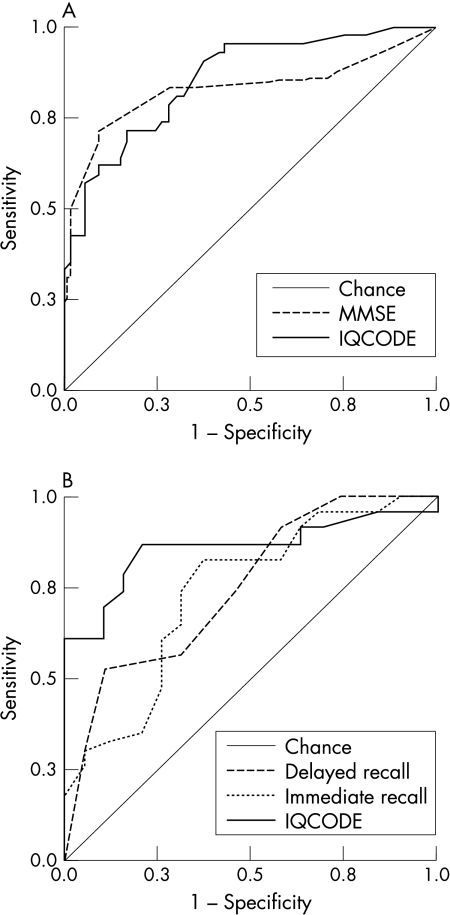
Results: In total, 24 patients with MCI (53.3%) had converted to dementia at follow up (mean (SD) duration of follow up 17.0 (7.3) months for converters and 35.0 (7.1) months for non-converters). At baseline, the ability to differentiate patients with MCI from healthy controls was similar for the IQCODE (area under the curve (AUC) 0.86) and the MMSE (AUC 0.84; z = 0.53, not significant). As predictors of conversion to dementia, a trend favouring the IQCODE (AUC 0.86) with respect to immediate (AUC 0.74) and delayed (AUC 0.75) recall on the RAVLT was apparent (z = 1.36, p = 0.087 versus immediate recall, z = 1.51, p = 0.064 versus delayed recall). The independent predictive ability of IQCODE and memory scores was evaluated through logistic regression, and the questionnaire alone yielded the best correct classification of 81%.
Conclusions: The IQCODE is an informant based measure of cognitive decline that may provide a relevant contribution to the diagnostic and prognostic investigation of patients with MCI.
Conflict of interest statement
Competing interests: none
References
-
- Nestor P J, Scheltens P, Hodges J R. Advances in the early detection of Alzheimer's disease. Nat Rev Neurosci 200410(suppl)S34–S41. - PubMed
-
- Arnaiz E, Almkvist O. Neuropsychological features of mild cognitive impairment and preclinical Alzheimer's disease. Acta Neurol Scand 2003107(suppl 179)34–41. - PubMed
-
- Jorm A F. Methods of screening for dementia: a meta‐analysis of studies comparing informant questionnaire with a brief cognitive test. Alz Dis Associat Dis 199711158–162. - PubMed
MeSH terms
LinkOut - more resources
Full Text Sources
Medical
Research Materials