. 2006 Feb 8;25(3):565-74.
doi: 10.1038/sj.emboj.7600952. Epub 2006 Jan 19.

Telomere length homeostasis requires that telomerase levels are limiting

Affiliations

Telomere length homeostasis requires that telomerase levels are limiting

Gaël Cristofari et al. EMBO J. .

Abstract

Stabilization of telomere length in germline and highly proliferative human cells is required for long-term survival and for the immortal phenotype of cancer-derived cells. This is achieved through expression of telomerase reverse transcriptase (TERT), which synthesizes telomeric repeats through reverse transcription of its tightly associated RNA template (TR). The telomeric repeat binding factor TRF1 inhibits telomerase at telomeres in cis in a length-dependent manner to achieve telomere length homeostasis. Here we manipulate telomerase activity over a wide range in cancer and primary cells. Concomitant overexpression of TERT and TR was necessary and sufficient to substantially increase telomerase activity. Upon overexpression, more telomerase associated with telomeres and telomeres elongated at a constant rate (up to 0.8 kb/population doubling (PD)) in a length-independent manner. Thus, in less than 50 PDs, the length of telomeres increased 3-8-fold beyond physiological size, while telomere-bound TRF1 and TRF2 increased proportionally to telomere length. Thus, long telomeres do not permanently adopt a structural state that is non-extendible. A low cellular concentration of telomerase is critical to achieve preferential elongation of short telomeres and telomere length homeostasis.


Figures
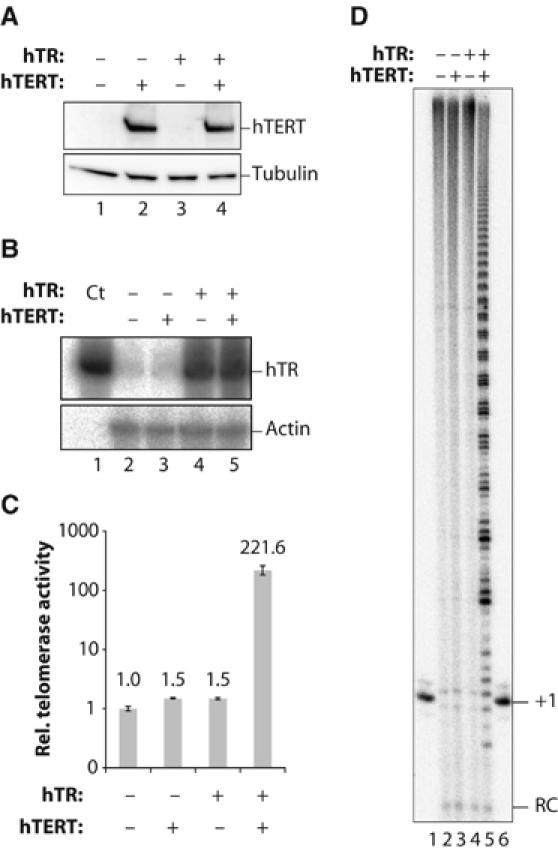
Figure 1
Figure 1
Massive increase of telomerase activity upon transient coexpression of hTR and hTERT in HEK293T cells. (A) Immunoblot with anti-hTERT R484 antibody (upper panel) or with anti-tubulin antibody (lower panel) as a loading control. (B) Northern blot with an anti-hTR probe (upper panel) or actin probe as a loading control (lower panel). Ct contains in vitro transcribed hTR. (C) Telomerase activity measured by RQ-TRAP. RNase treatment of extracts reduced the signal to below the detection limit (not shown). Values indicate mean telomerase activity and standard deviation obtained from three parallel transfections. Transfection efficiency was >90%, as estimated from a separate transfection performed with a GFP-encoding plasmid. (D) Telomerase activity was determined in a direct telomerase assay using (TTAGGG)3 as a telomerase substrate. Lanes 1 and 6, 32P-ddATP 3′-labeled primer as +1 marker. RC, recovery control (see Materials and methods). The periodicity is somewhat irregular, presumably due to the presence of nucleases in the crude extract that may attack extended and nonextended primers from both ends. Upon enrichment of this telomerase over one column, we obtained a very clear and regular six-nucleotide pattern (unpublished results).
Figure 2
Figure 2
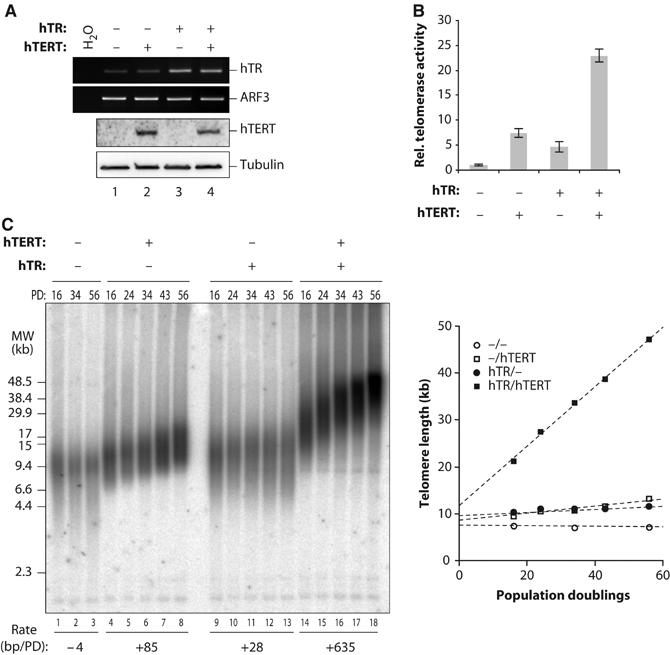
Massive telomere elongation upon long-term super-telomerase expression in HeLa cells. HeLa cells were transduced with retroviral vectors encoding hTR or hTERT or the respective empty vectors. Cell populations were analyzed after double selection. (A) Overexpression of telomerase core components. RT–PCR amplification (upper panels) of hTR or ARF3 as a loading control. RT–PCR conditions were ensured to be in the dynamic range and RT-dependent (not shown). Immunoblot (lower panels) with anti-hTERT antibody or with anti-tubulin antibody as a loading control. (B) Telomerase activity was determined by RQ-TRAP. RNase treatment of extracts reduced the signal to below the detection limit (not shown). Each bar represents the mean±s.d. of at least three measurements. (C) Genomic blot of transduced HeLa cell populations at the indicated PDs. TRFs were separated by PFGE. The rate of elongation is indicated below in bp/PD for this gel. The graph shows the median telomere lengths at the indicated cell PD. Telomere lengths were deduced by subtracting 2 kb for subtelomeric sequences from the median TRF length obtained from the gel.
Figure 3
Figure 3
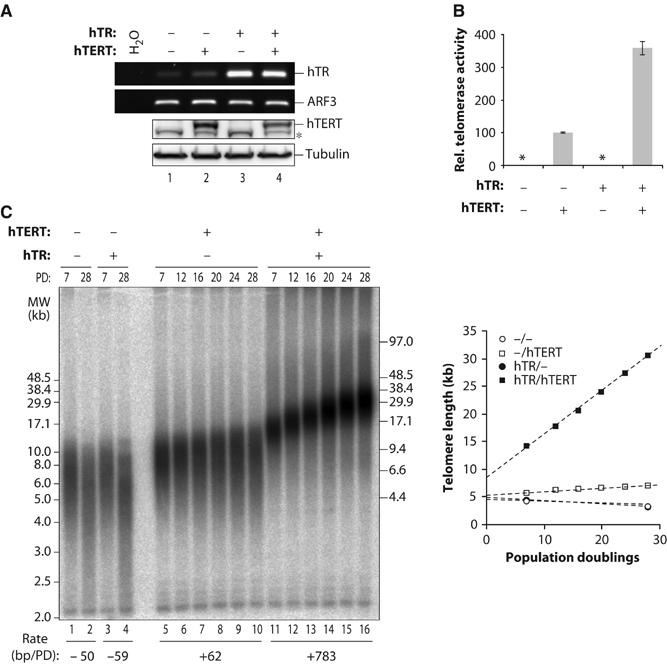
Cooperative effects on the telomere length of long-term hTR and hTERT overexpression in HLF. Cells were transduced with retroviral vectors encoding hTR or hTERT or empty vectors. Cell populations were analyzed after double selection. (A) Overexpression of telomerase core components. RT–PCR amplification (upper panels) of hTR or ARF3 as a loading control. RT–PCR conditions were ensured to be in the dynamic range and RT-dependent (not shown). Immunoblot (lower panels) with anti-hTERT R484 antibody or with anti-tubulin antibody as a loading control. The asterisk indicates a band that crossreacts with the R484 antibody. (B) Telomerase activity as determined by RQ-TRAP. The activity for hTERT-transduced cells was arbitrarily set to 100. RNase treatment of extracts reduced the signal to below the detection limit (not shown). Stars indicate signal below the detection limit. Each bar represents the mean±s.d. of at least three measurements. (C) Genomic blot of TRFs in transduced HLF cell populations at the indicated PDs separated by PFGE. The rate of elongation is indicated below in bp/PD for this gel. The graph shows median telomere length at the indicated cell PD. Telomere length was deduced by subtracting 2 kb for subtelomeric sequences from the median TRF length obtained from the gel.
Figure 4
Figure 4
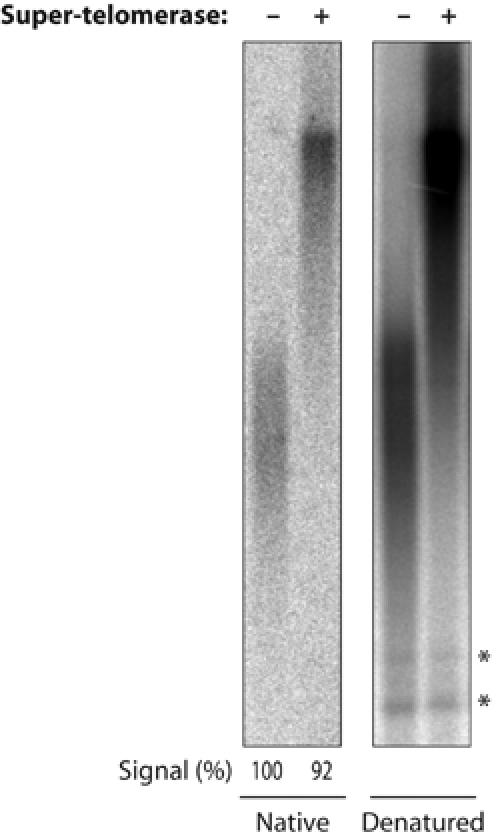
The G- and C-strands are both elongated in super-telomerase cells. Telomeric overhang was analyzed by in-gel hybridization of TRFs from control- or super-telomerase-expressing HeLa cells (same as in Figures 2 and 5). Hybridization to native DNA (left) detecting telomeric overhang or to denatured DNA (right) detecting the total telomeric DNA in the same gel re-hybridized with the same probe after denaturation. The signal of internal restriction fragments containing telomeric repeats (asterisks) shows equal loading of DNA.
Figure 5
Figure 5
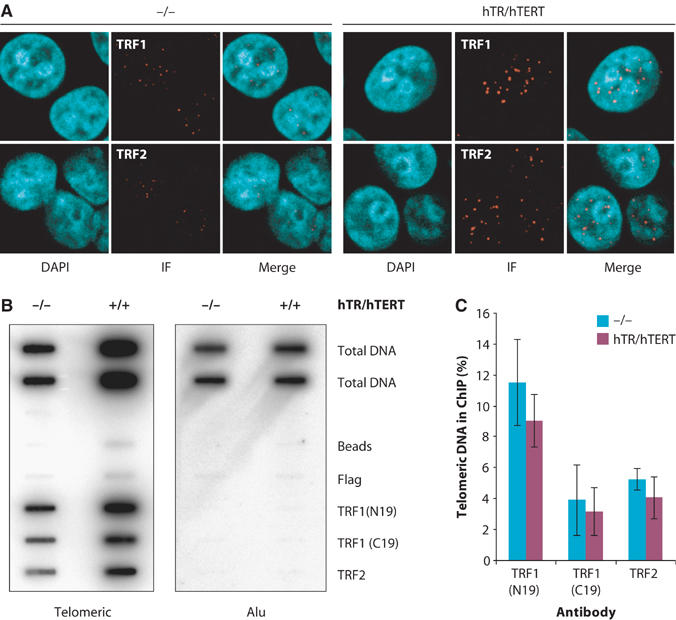
Telomere length sensing by TRF1 and TRF2 is operating in super-telomerase cells. (A) Confocal IF to detect TRF1 and TRF2 in control (−/−) and super-telomerase (hTR/hTERT) cells. Staining and image acquisition of the two cell populations were executed in parallel and IF pictures are presented without any adjustment. During acquisition, the laser beam was set such that the signal in super-telomerase cells was not saturating the CCD camera. (B) ChIP of telomeric DNA by TRF1 and TRF2 in control cells (−/−) or super-telomerase cells (+/+). The antibodies used for IP are indicated on the right. Duplicate dot blots were probed for telomeric or Alu repeats. (C) Quantification of the data in (B) representing per cent TTAGGG repeat DNA recovered in each ChIP. Averaged duplicate signals obtained with total DNA samples were used as 100% value for the quantification. As the histograms represent the percentage of input telomeric DNA, they are corrected for telomere length changes.
Figure 6
Figure 6
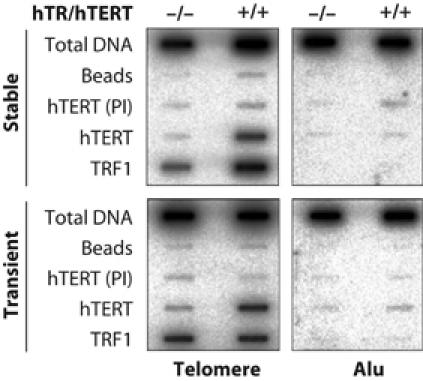
Enhanced, telomere length independent association of telomerase with telomeres in super-telomerase cells. ChIP with hTERT and hTR (+) or empty vector (−) stably transduced (upper) or transiently transfected (lower) HeLa cell populations. Transiently transfected cells were analyzed 72 h post-transfection (bottom panels). The used antibodies or preimmuneserum (PI) are indicated on the left. Duplicate dot blots were probed for telomeric (left) or Alu repeats (right).
Figure 7
Figure 7
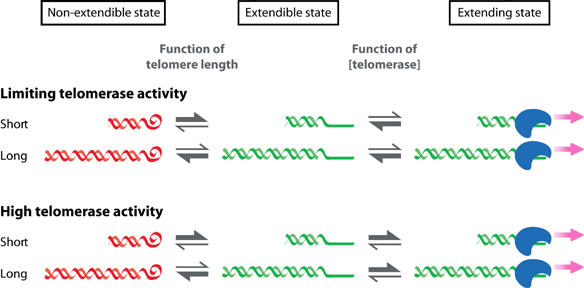
A three-state model for telomere length homeostasis. Telomeres are proposed to switch between non-extendible (red, curly end), extendible (green, straight end, middle) and extending states (green straight end associated with telomerase, right). The equilibrium between non-extendible and extendible states is a function of telomere length, while the equilibrium between extendible and extending state is a function of telomerase concentration. The top panel shows a situation where telomerase concentration is limiting, corresponding to the here-analyzed telomerase-positive cell lines. The bottom panel indicates the situation in super-telomerase cells.

References

    1. Adams Martin A, Dionne I, Wellinger RJ, Holm C (2000) The function of DNA polymerase alpha at telomeric G tails is important for telomere homeostasis. Mol Cell Biol 20: 786–796 - PMC - PubMed
    1. Ancelin K, Brunori M, Bauwens S, Koering CE, Brun C, Ricoul M, Pommier JP, Sabatier L, Gilson E (2002) Targeting assay to study the cis functions of human telomeric proteins: evidence for inhibition of telomerase by TRF1 and for activation of telomere degradation by TRF2. Mol Cell Biol 22: 3474–3487 - PMC - PubMed
    1. Avilion AA, Piatyszek MA, Gupta J, Shay JW, Bacchetti S, Greider CW (1996) Human telomerase RNA and telomerase activity in immortal cell lines and tumor tissues. Cancer Res 56: 645–650 - PubMed
    1. Baur JA, Zou Y, Shay JW, Wright WE (2001) Telomere position effect in human cells. Science 292: 2075–2077 - PubMed
    1. Beattie TL, Zhou W, Robinson MO, Harrington L (1998) Reconstitution of human telomerase activity in vitro. Curr Biol 8: 177–180 - PubMed

Publication types

MeSH terms