Comparative Study
. 2006 Feb 3;1071(1):197-207.
doi: 10.1016/j.brainres.2005.11.097. Epub 2006 Jan 19.

Specialization of phonological and semantic processing in Chinese word reading

Affiliations
Comparative Study

Specialization of phonological and semantic processing in Chinese word reading

James R Booth et al. Brain Res. .

Abstract

The purpose of this study was to examine the neurocognitive network for processing visual word forms in native Chinese speakers using functional magnetic resonance imaging (fMRI). In order to compare the processing of phonological and semantic representations, we developed parallel rhyming and meaning association judgment tasks that required explicit access and manipulation of these representations. Subjects showed activation in left inferior/middle frontal gyri, bilateral medial frontal gyri, bilateral middle occipital/fusiform gyri, and bilateral cerebella for both the rhyming and meaning tasks. A direct comparison of the tasks revealed that the rhyming task showed more activation in the posterior dorsal region of the inferior/middle frontal gyrus (BA 9/44) and in the inferior parietal lobule (BA 40). The meaning task showed more activation in the anterior ventral region of the inferior/middle frontal gyrus (BA 47) and in the superior/middle temporal gyrus (BA 22,21). These findings are consistent with previous studies in English that suggest specialization of inferior frontal regions for the access and manipulation of phonological vs. semantic representations, but also suggest that this specialization extends to the middle frontal gyrus for Chinese. These findings are also consistent with the suggestion that the left middle temporal gyrus is involved in representing semantic information and the left inferior parietal lobule is involved in mapping between orthographic and phonological representations.


Figures
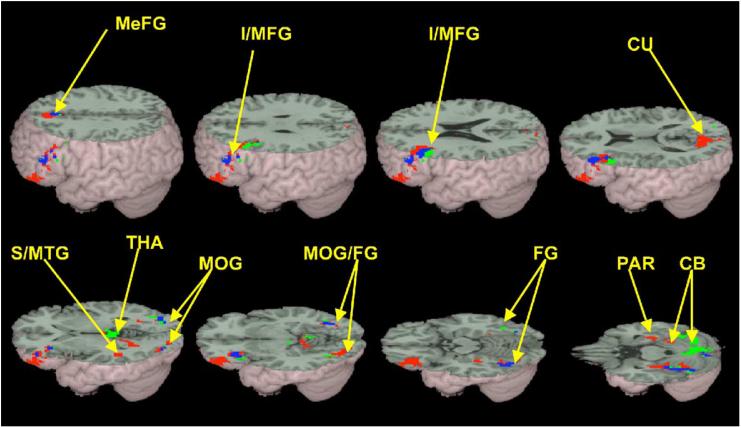
Fig. 1
Fig. 1
Brain activations for rhyming minus control (green) vs. meaning minus control (red). The overlap between the tasks is represented in blue. Rhyming minus control activated left inferior/middle frontal gyri (I/MFG), bilateral medial frontal gyri (MeFG), bilateral middle occipital gyri/fusiform gyri/cerebella (MOG/FG/CB), and bilateral thalamus (THA). Meaning minus control activated left inferior/middle frontal gyri (I/MFG), bilateral medial frontal gyri (MeFG), left middle occipital gyrus/fusiform gyrus/cerebellum (MOG/FG/CB), right middle occipital gyrus/fusiform gyrus (MOG/FG), left cuneus (CU), left superior/middle temporal gyri (S/MTG), right parahippocampus (PAR), and right cerebellum (CB).
Fig. 2
Fig. 2
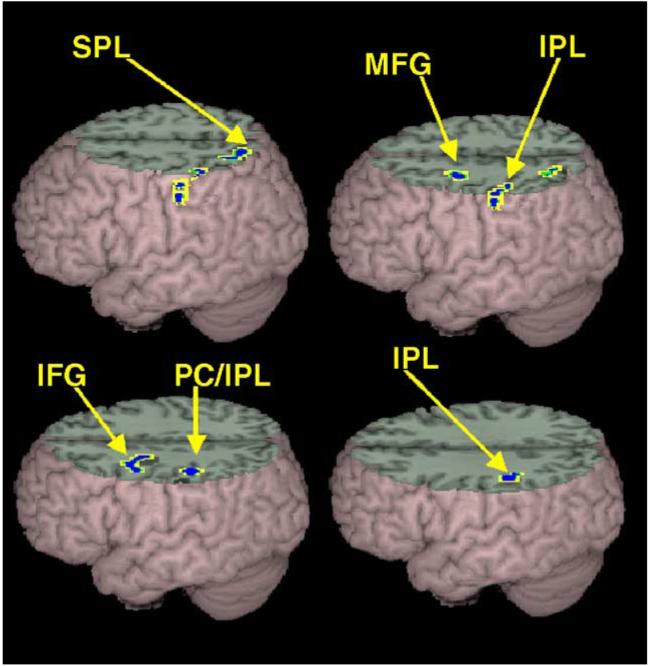
Significantly greater activation for rhyming than for meaning task included left inferior/superior parietal lobule (I/SPL), left postcentral gyrus/inferior parietal lobule (PC/IPL), and left inferior/middle frontal gyrus (I/MFG).
Fig. 3
Fig. 3
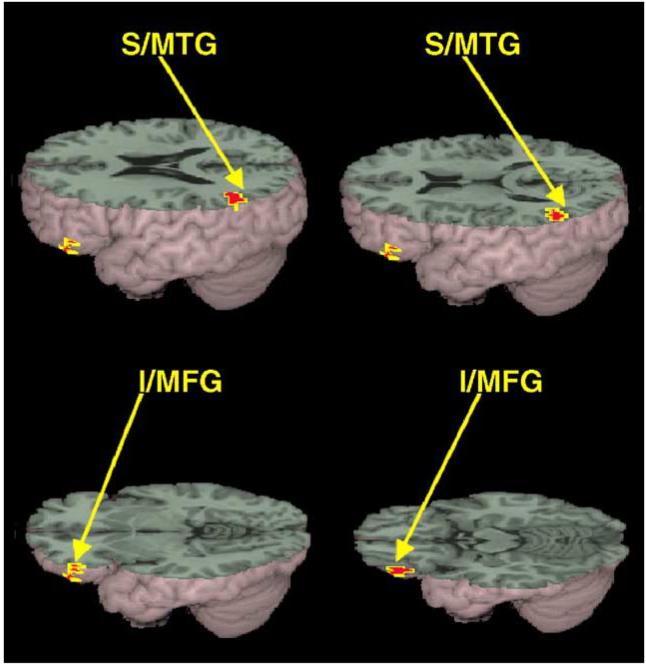
Significantly greater activation for meaning than for the rhyming task included left superior/middle temporal gyrus (S/MTG), and left inferior/middle frontal gyrus (I/MFG).
Fig. 4
Fig. 4
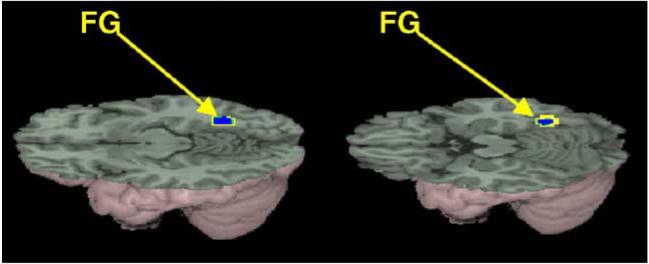
Brain activations significantly correlated with performance. Activation in right fusiform gyrus (FG) decreases with increasing accuracy in the rhyming task.
Fig. 5
Fig. 5
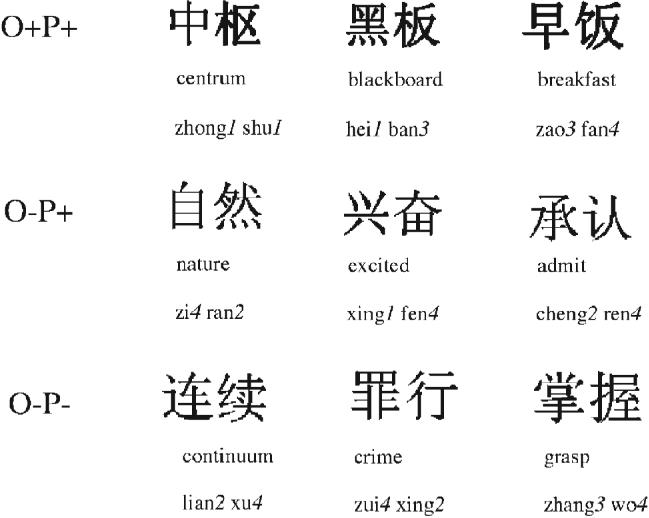
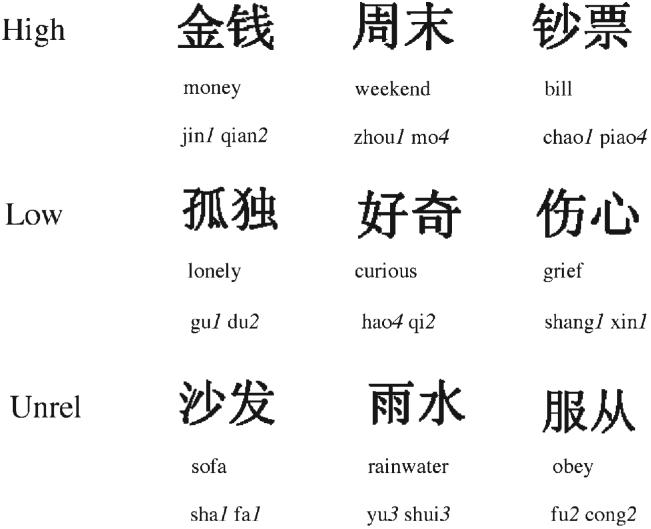
Examples of Chinese stimuli used for the rhyming tasks with their English interpretation and their pronunciation in pinyin. Numbers for the pinyin translations indicate tone. There are four different tones including the high level tone (first tone), the rising tone (second tone), the falling rising tone (third tone) and the falling tone (fourth tone).
Fig. 6
Fig. 6
Examples of Chinese stimuli used for the meaning tasks with their English interpretation and their pronunciation in pinyin. See Fig. 5 caption.

References

    1. Bitan T, Booth JR, Choy J, Burman DD, Gitelman DR, Mesulam MM. Shifts of effective connectivity within a language network during rhyming and spelling. J. Neurosci. 2005;25:5397–5403. - PMC - PubMed
    1. Blumenfeld HK, Booth JR, Burman DD. Differential prefrontal-temporal neural correlates of semantic processing in children. Brain Lang. in press. - PMC - PubMed
    1. Booth JR, Burman DD, Van Santen FW, Harasaki Y, Gitelman DR, Parrish TR, et al. The development of specialized brain systems in reading and oral-language. Child. Neuropsychol. 2001;7(3):119–141. - PubMed
    1. Booth JR, Burman DD, Meyer JR, Gitelman DR, Parrish TR, Mesulam MM. Functional anatomy of intra- and cross-modal lexical tasks. NeuroImage. 2002a;16:7–22. - PubMed
    1. Booth JR, Burman DD, Meyer JR, Gitelman DR, Parrish TR, Mesulam MM. Modality independence of word comprehension. Hum. Brain Mapp. 2002b;16:251–261. - PMC - PubMed

Publication types

LinkOut - more resources