Impact of Helicobacter pylori eradication on dyspepsia, health resource use, and quality of life in the Bristol helicobacter project: randomised controlled trial
- PMID: 16428249
- PMCID: PMC1352048
- DOI: 10.1136/bmj.38702.662546.55
Impact of Helicobacter pylori eradication on dyspepsia, health resource use, and quality of life in the Bristol helicobacter project: randomised controlled trial
Abstract
Objective: To determine the impact of a community based Helicobacter pylori screening and eradication programme on the incidence of dyspepsia, resource use, and quality of life, including a cost consequences analysis.
Design: H pylori screening programme followed by randomised placebo controlled trial of eradication.
Setting: Seven general practices in southwest England.
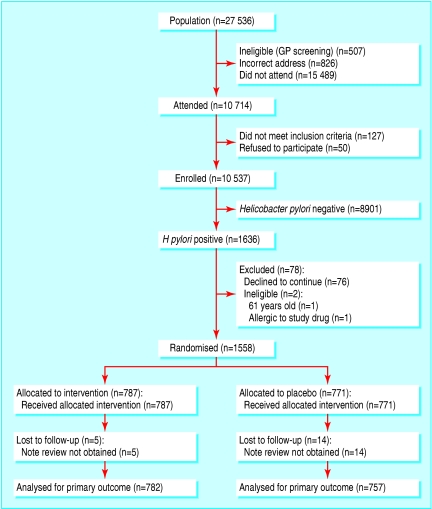
Participants: 10,537 unselected people aged 20-59 years were screened for H pylori infection (13C urea breath test); 1558 of the 1636 participants who tested positive were randomised to H pylori eradication treatment or placebo, and 1539 (99%) were followed up for two years.
Intervention: Ranitidine bismuth citrate 400 mg and clarithromycin 500 mg twice daily for two weeks or placebo.
Main outcome measures: Primary care consultation rates for dyspepsia (defined as epigastric pain) two years after randomisation, with secondary outcomes of dyspepsia symptoms, resource use, NHS costs, and quality of life.
Results: In the eradication group, 35% fewer participants consulted for dyspepsia over two years compared with the placebo group (55/787 v 78/771; odds ratio 0.65, 95% confidence interval 0.46 to 0.94; P = 0.021; number needed to treat 30) and 29% fewer participants had regular symptoms (odds ratio 0.71, 0.56 to 0.90; P = 0.05). NHS costs were 84.70 pounds sterling (74.90 pounds sterling to 93.91 pounds sterling) greater per participant in the eradication group over two years, of which 83.40 pounds sterling (146 dollars; 121 euro) was the cost of eradication treatment. No difference in quality of life existed between the two groups.
Conclusions: Community screening and eradication of H pylori is feasible in the general population and led to significant reductions in the number of people who consulted for dyspepsia and had symptoms two years after treatment. These benefits have to be balanced against the costs of eradication treatment, so a targeted eradication strategy in dyspeptic patients may be preferable.
Comment in
-
Who benefits from Helicobacter pylori eradication?BMJ. 2006 Jan 28;332(7535):187-8. doi: 10.1136/bmj.332.7535.187. BMJ. 2006. PMID: 16439372 Free PMC article. No abstract available.
References
-
- Talley NJ. Dyspepsia: how to manage and how to treat? Aliment Pharmacol Ther 2005;16: 95-104. - PubMed
-
- Asante MA, Lord J, Mendall M, Northfield T. Endoscopy for Helicobacter pylori sero-negative young dyspeptic patients: an economic evaluation based on a randomised trial. Eur J Gastroenterol Hepatol 1999;11: 851-6. - PubMed
-
- Moayyedi P, Feltbower R, Brown J, Mason S, Mason J, Nathan J, et al. Effect of population screening and treatment for Helicobacter pylori on dyspepsia and quality of life in the community: a randomised controlled trial. Lancet 2000;355: 1665-9. - PubMed
Publication types
MeSH terms
Substances
LinkOut - more resources
Full Text Sources
Other Literature Sources
Medical