


Transcriptome analysis applied to survival of Shewanella oneidensis MR-1 exposed to ionizing radiation
- PMID: 16428429
- PMCID: PMC1347324
- DOI: 10.1128/JB.188.3.1199-1204.2006
Transcriptome analysis applied to survival of Shewanella oneidensis MR-1 exposed to ionizing radiation
Abstract
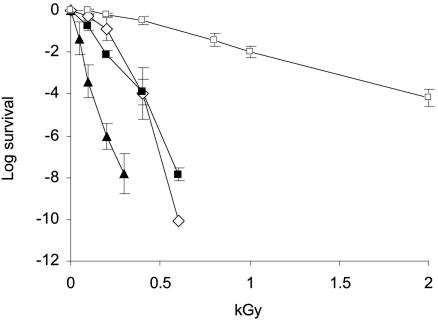
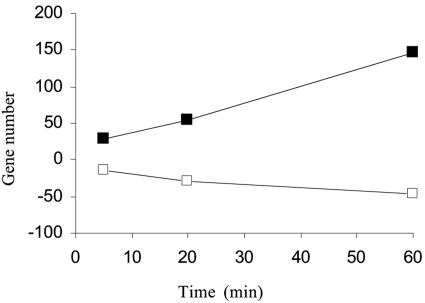
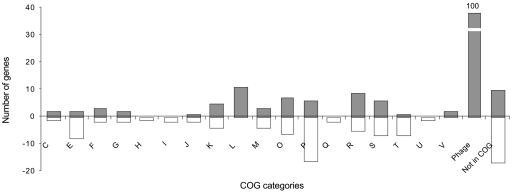
The ionizing radiation (IR) dose that yields 20% survival (D20) of Shewanella oneidensis MR-1 is lower by factors of 20 and 200 than those for Escherichia coli and Deinococcus radiodurans, respectively. Transcriptome analysis was used to identify the genes of MR-1 responding to 40 Gy (D20). We observed the induction of 170 genes and repression of 87 genes in MR-1 during a 1-h recovery period after irradiation. The genomic response of MR-1 to IR is very similar to its response to UV radiation (254 nm), which included induction of systems involved in DNA repair and prophage synthesis and the absence of differential regulation of tricarboxylic acid cycle activity, which occurs in IR-irradiated D. radiodurans. Furthermore, strong induction of genes encoding antioxidant enzymes in MR-1 was observed. DNA damage may not be the principal cause of high sensitivity to IR, considering that MR-1 carries genes encoding a complex set of DNA repair systems and 40 Gy IR induces less than one double-strand break in its genome. Instead, a combination of oxidative stress, protein damage, and prophage-mediated cell lysis during irradiation and recovery might underlie this organism's great sensitivity to IR.
Figures
References
-
- Archibald, F. S., and I. Fridovich. 1982. The scavenging of superoxide radical by manganous complexes: in vitro. Arch. Biochem. Biophys. 214:452-463. - PubMed
-
- Blattner, F. R., G. Plunkett III, C. A. Bloch, N. T. Perna, V. Burland, M. Riley, J. Collado-Vides, J. D. Glasner, C. K. Rode, G. F. Mayhew, J. Gregor, N. W. Davis, H. A. Kirkpatrick, M. A. Goeden, D. J. Rose, B. Mau, and Y. Shao. 1997. The complete genome sequence of Escherichia coli K-12. Science 277:1453-1474. - PubMed
-
- Carmel-Harel, O., and G. Storz. 2000. Roles of the glutathione- and thioredoxin-dependent reduction systems in the Escherichia coli and Saccharomyces cerevisiae response to oxidative stress. Annu. Rev. Microbiol. 54:439-461. - PubMed
-
- Daly, M. J., E. K. Gaidamakova, V. Y. Matrosova, A. Vasilenko, M. Zhai, A. Venkateswaran, M. Hess, M. V. Omelchenko, H. M. Kostandarithes, K. S. Makarova, L. P. Wackett, J. K. Fredrickson, and D. Ghosal. 2004. Accumulation of Mn(II) in Deinococcus radiodurans facilitates gamma-radiation resistance. Science 306:1025-1028. - PubMed
-
- Das, K. C., and C. K. Das. 2000. Thioredoxin, a singlet oxygen quencher and hydroxyl radical scavenger: redox independent functions. Biochem. Biophys. Res. Commun. 277:443-447. - PubMed
Publication types
MeSH terms
Substances
LinkOut - more resources
Full Text Sources
Molecular Biology Databases
