. 2006 Jun;141(2):465-74.
doi: 10.1104/pp.105.070490. Epub 2006 Jan 20.

Chloroplastic NAD(P)H dehydrogenase in tobacco leaves functions in alleviation of oxidative damage caused by temperature stress

Affiliations

Chloroplastic NAD(P)H dehydrogenase in tobacco leaves functions in alleviation of oxidative damage caused by temperature stress

Peng Wang et al. Plant Physiol. 2006 Jun.

Abstract

In this study, the function of the NAD(P)H dehydrogenase (NDH)-dependent pathway in suppressing the accumulation of reactive oxygen species in chloroplasts was investigated. Hydrogen peroxide accumulated in the leaves of tobacco (Nicotiana tabacum) defective in ndhC-ndhK-ndhJ (DeltandhCKJ) at 42 degrees C and 4 degrees C, and in that of wild-type leaves at 4 degrees C. The maximum quantum efficiency of PSII decreased to a similar extent in both strains at 42 degrees C, while it decreased more evidently in DeltandhCKJ at 4 degrees C. The parameters linked to CO(2) assimilation, such as the photochemical efficiency of PSII, the decrease of nonphotochemical quenching following the initial rise, and the photosynthetic O(2) evolution, were inhibited more significantly in DeltandhCKJ than in wild type at 42 degrees C and were seriously inhibited in both strains at 4 degrees C. While cyclic electron flow around PSI mediated by NDH was remarkably enhanced at 42 degrees C and suppressed at 4 degrees C. The proton gradient across the thylakoid membranes and light-dependent ATP synthesis were higher in wild type than in DeltandhCKJ at either 25 degrees C or 42 degrees C, but were barely formed at 4 degrees C. Based on these results, we suggest that cyclic photophosphorylation via the NDH pathway might play an important role in regulation of CO(2) assimilation under heat-stressed condition but is less important under chilling-stressed condition, thus optimizing the photosynthetic electron transport and reducing the generation of reactive oxygen species.


Figures
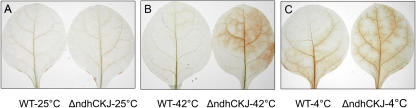
Figure 1.
Figure 1.
Effects of heat (42°C) or chilling (4°C) temperature on the accumulation of H2O2 in the leaves of wild-type (WT) and ΔndhCKJ tobacco plants. Petioles were steeped in solutions containing 1 mg mL−1 DAB (pH 3.8) at 25°C in the dark for 1 h to take up the stain. Samples were then incubated at 25°C, 42°C, or 4°C, under illumination at 100 μmol photons m−2 s−1. H2O2 accumulation was detected as brown areas after 3 h (A and B) and after 1 h (C) of treatment.
Figure 2.
Figure 2.
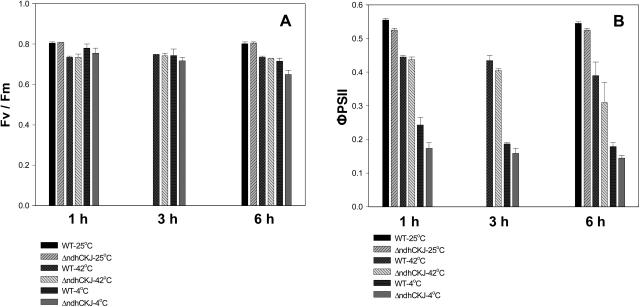
Changes of Chl fluorescence parameters during temperature treatment. Leaf discs were floated on the surface of temperature-controlled cyclic water bath with the epidermal side upward, and treated at indicated temperatures (25°C, 42°C, or 4°C) for the indicated time (1 h, 3 h, or 6 h) under illumination of about 100 μmol photons m−2 s−1. They were dark adapted at the corresponding temperatures for 10 min. Chl fluorescence was then measured at the same temperature using a PAM emitter-detector unit 101 ED as described in “Materials and Methods.” Values for Fv/Fm = (FmF0)/Fm (A) and ΦPSII = (Fm′ − F)/Fm′ (B) are the averages of four independent measurements. Standard errors are indicated by the vertical bars.
Figure 3.
Figure 3.
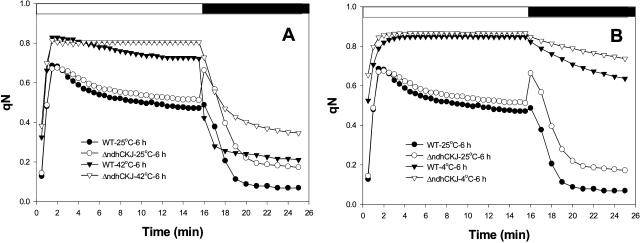
Effects of heat (42°C) and chilling (4°C) treatments on the kinetics of qN. Leaf discs were treated for 6 h and dark adapted as in Figure 2. qN was measured as described in “Materials and Methods.” The AL was turned on at 0 min and off at 15 min, but saturating pulses lasted for another 10 min. qN was calculated as 1 − (Fm′−F0′)/(FmF0).
Figure 4.
Figure 4.
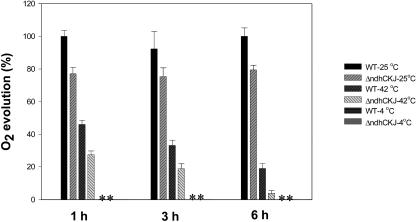
Effects of heat (42°C) and chilling (4°C) treatments on photosynthetic oxygen evolution. Leaf discs were treated as in Figure 2, cut into fragments of 1 mm2, and stirred in a 1.8-mL suspension (0.11 mg Chl mL−1) containing 0.1 m NaHCO3 and 0.05 m Tris (pH 7.5) in the thermostated glass vessel of a Clark-type oxygen electrode. O2 evolution was normally detected several minutes after the start of illumination (800 μmol photons m−2 s−1) at 25°C or 42°C, but was not detectable at 4°C (indicated with asterisks [*]). Values are the averages of four independent measurements. Standard errors are indicated by the vertical bars. The control rate of O2 evolution (wild type, 25°C, 1 h) was 67.2 μmol O2 mg Chl−1 h−1.
Figure 5.
Figure 5.
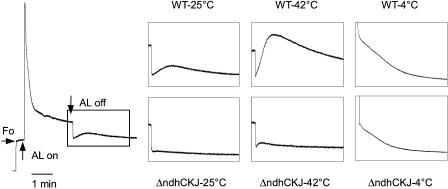
Effects of heat (42°C) and chilling (4°C) on postillumination increase of Chl fluorescence in the leaves of wild type and ΔndhCKJ. F0, Dark fluorescence level; and AL, white actinic light (200 μmol photons m−2 s−1, lasted for 2 min). Insets show transient increase in Chl fluorescence following light-to-dark transition. Leaf discs were dark adapted on a temperature-controlled plate at indicated temperatures for 10 min and then the fluorescence was measured at the same temperature.
Figure 6.
Figure 6.
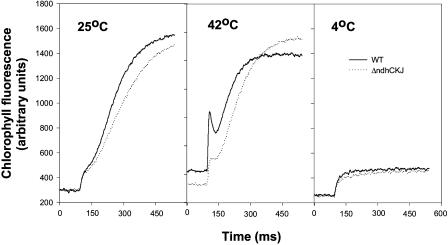
Effects of heat (42°C) and chilling (4°C) treatments on the kinetics of fluorescence induction curve. Leaf discs were treated for 6 h and dark adapted as in Figure 2. Chl fluorescence was measured and recorded as described in “Materials and Methods.”
Figure 7.
Figure 7.
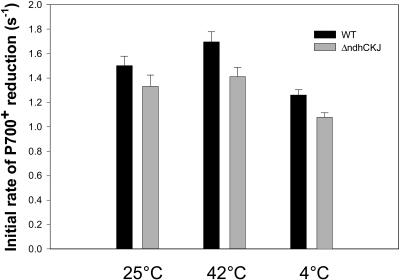
Effects of heat (42°C) and chilling (4°C) on the initial rates (0–1 s) of P700+ rereduction following far-red light in wild type and ΔndhCKJ. Leaf discs were treated as in Figure 5. Dark reduction of P700+ was measured by turning off of the far-red light (>705 nm, 5.2 μmol photons m−2 s−1) after a 30-s illumination that allowed the oxidation of P700 to a steady state. Each experiment was repeated four times. Standard errors are indicated by the vertical bars.
Figure 8.
Figure 8.
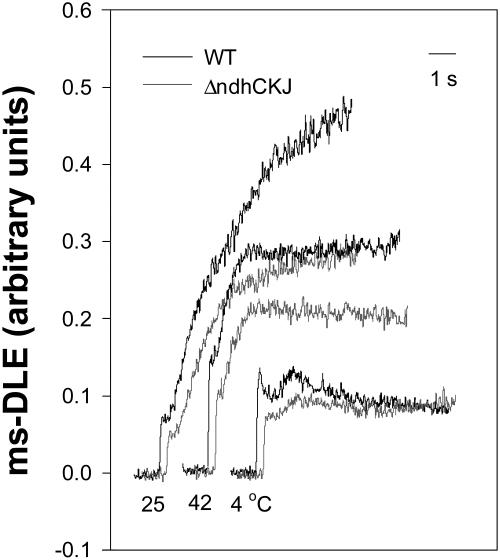
Effects of heat (42°C) and chilling (4°C) treatments on ms-DLE. Leaf discs were treated for 6 h and dark adapted as in Figure 2. The ms-DLE was measured as described in “Materials and Methods.”
Figure 9.
Figure 9.
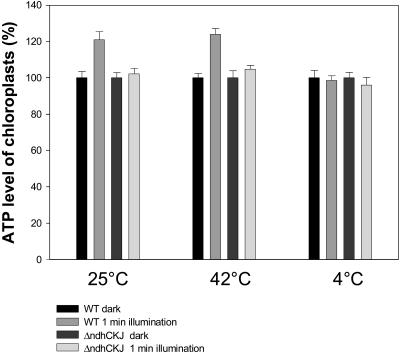
Light-induced ATP synthesis of chloroplasts. The 1-mL reaction mixture contained 0.4 m Suc, 50 mm Tris-HCl (pH 7.6), 10 mm NaCl, 5 mm MgCl2, 2 mm ADP, 10 mm Na2HPO4, and intact chloroplasts with 30 μg of Chl. After illumination (800 μmol photons m−2 s−1) for 1 min at 25°C, 42°C, or 4°C, ATP contents of the illuminated and dark-controlled sample were analyzed using the Luciferin-luciferase method. Values are the averages of six independent measurements. Standard errors are indicated by the vertical bars. The control value of ATP contents (100%) was about 31.4 nmol ATP mg Chl−1.

References

    1. Allen DJ, Ort DR (2001) Impacts of chilling temperatures on photosynthesis in warm-climate plants. Trends Plant Sci 6: 36–42 - PubMed
    1. Arnon DI, Allen MB, Whatley FR (1954) Photosynthesis by isolated chloroplasts. Nature 174: 394–396 - PubMed
    1. Asada K (1992) Ascorbate peroxidase: a hydrogen peroxide scavenging enzyme in plants. Physiol Plant 85: 235–241
    1. Asada K (1999) The water-water cycle in chloroplasts: scavenging of active oxygens and dissipation of excess photons. Annu Rev Plant Physiol Plant Mol Biol 50: 601–639 - PubMed
    1. Asada K, Kiso K (1973) Initiation of aerobic oxidation of sulfite by illuminated spinach chloroplasts. Eur J Biochem 33: 253–257 - PubMed

Publication types

LinkOut - more resources