


doi: 10.1128/IAI.74.2.869-875.2006.
Importance of heat-labile enterotoxin in colonization of the adult mouse small intestine by human enterotoxigenic Escherichia coli strains
Affiliations
- PMID: 16428729
- PMCID: PMC1360293
- DOI: 10.1128/IAI.74.2.869-875.2006
Item in Clipboard
Importance of heat-labile enterotoxin in colonization of the adult mouse small intestine by human enterotoxigenic Escherichia coli strains
Infect Immun.
2006 Feb.
Abstract
Enterotoxigenic Escherichia coli (ETEC) infections are a significant cause of diarrheal disease and infant mortality in developing countries. Studies of ETEC pathogenesis relevant to vaccine development have been greatly hampered by the lack of a suitable small-animal model of infection with human ETEC strains. Here, we demonstrate that adult immunocompetent outbred mice can be effectively colonized with the prototypical human ETEC H10407 strain (colonization factor antigen I; heat-labile and heat-stable enterotoxin positive) and that production of heat-labile holotoxin provides a significant advantage in colonization of the small intestine in this model.
Figures
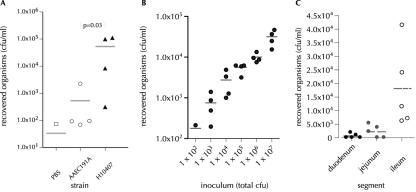
Intestinal colonization of mice with human ETEC strain H10407. (A) Intestinal colonization of mice with WT ETEC (H10407) or a nonpathogenic afimbriate E. coli strain (AAEC191A). Mice were pretreated with oral streptomycin solution to eradicate colonization and cimetidine to reduce gastric acidity and then inoculated with the strains by gavage using ∼1 × 10⁸ CFU. After 24 h, bacteria were recovered from segments of small intestine in PBS containing saponin (5%). The recovered organisms were diluted in PBS and plated onto Luria agar. (The data are adjusted for CFU/inoculum.) (B) Dose-ranging study of colonization using a streptomycin-resistant isolate (H10407-S). For these studies, mice were maintained on streptomycin-treated water throughout the experiment, and at the end of 72 h, the mice were sacrificed and recovered organisms were plated onto Luria agar plates containing 25 μg/ml streptomycin. (C) Localization of ETEC within the murine small intestine 24 h after challenge with 6 × 10⁵ CFU of H10407. The horizontal lines within each group reflect geometric means.
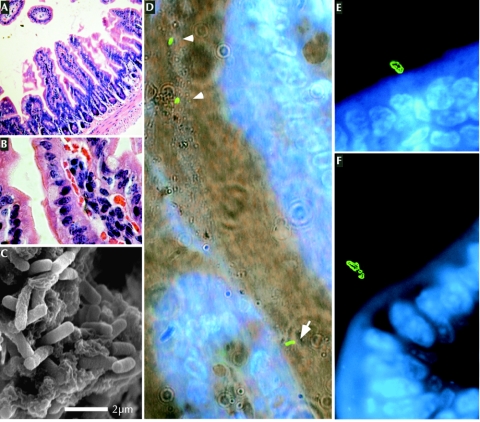
Microscopy of mouse intestine colonized with human ETEC H10407. Low-power (A) and ×100 (B) images of HE-stained mouse ileum following colonization with 108 CFU of ETEC H10407. (C) Scanning electron microscopy image of ETEC H10407 adherent to mouse small-intestinal mucosa. (D) Immunofluorescence image of ETEC H10407 (serotype O78:H11) colonization of mouse ileum. Intraluminal (arrowheads) and enterocyte-associated (arrow) bacteria were detected using rabbit polyclonal anti-O78 primary antibodies and secondary goat anti-rabbit immunoglobulin G (heavy and light chains) labeled with Alexa Fluor 488 (Molecular Probes). Eukaryotic cells were stained with DAPI. The image represents the overlay of two layers obtained using (i) simultaneous differential interference contrast microscopy to obtain the light image coupled with UV activation of DAPI (blue) and (ii) a 485-nm band pass filter to detect fluorescent bacteria (green). (E and F) reassembled Z-stack images of H10407 adherent or in close proximity to enterocytes of mouse ileal mucosa.
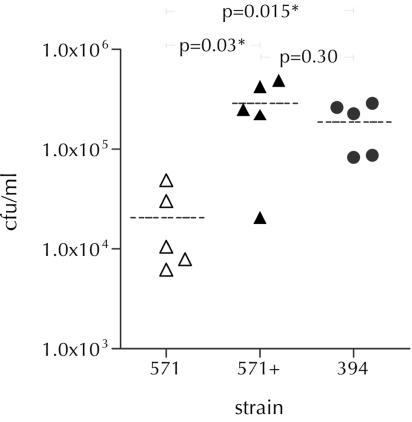
LT-negative mutants exhibit defective colonization relative to the WT in a murine model. The LT-negative strain jf571 (571), jf571 complemented with a FLAG epitope-tagged version of LT (571+), and WT H10407 (394) were used to colonize groups of five mice each. The numbers of recovered organisms (CFU/ml) are adjusted for the inoculum. The P values reflect comparisons of two groups using a two-tailed Student's t test: 571 versus 571+ (P = 0.03), 571 versus 394 (P = 0.015), and 571+ versus 394 (P = 0.30).
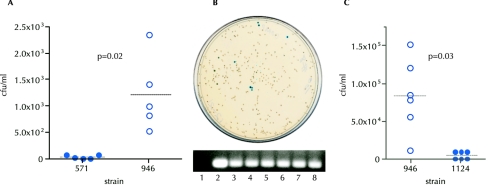
Secretion of LT holotoxin promotes colonization. (A) Summary of competition experiments in which five individual mice were simultaneously inoculated with ∼1 × 10⁴ CFU of both the LT+ and LT− strains. The closed blue circles represent the numbers of recovered blue CFU (jf571 eltA eltB+ lacZYA+), and the open circles represent the numbers of white CFU (jf946 eltA+ eltB+ lacZYA). (B) A representative X-Gal plate containing bacteria recovered from one mouse. Shown below the plate are representative colony PCR results from the experiment in panel A performed to confirm the identities of ETEC strains. Primers jf030204.1 (5′-CCCCAGTCTATTACAGAA-3′) and jf030204.2 (5′-CTAGTTTTCCATACTGAT-3′) were used to amplify the terminal 308 bp of the eltB gene from six randomly chosen blue and white colonies recovered from three different animals. Lane 1, negative control (water); lane 2, positive control (H10407 genomic DNA); lane 3, white colony plate A (mouse 1); lane 4, blue colony plate A; lane 5, white colony plate B (mouse 3); lane 6, blue colony plate B; lane 7, white colony plate C (mouse 5); lane 8 blue colony plate C. (C) Competition between jf946 and a derivative of H10407 (jf1124) bearing a deletion in gspM required for secretion of the heat-labile toxin. Six mice were challenged with ∼107 CFU of both strains.
References
-
- Berberov, E. M., Y. Zhou, D. H. Francis, M. A. Scott, S. D. Kachman, and R. A. Moxley. 2004. Relative importance of heat-labile enterotoxin in the causation of severe diarrheal diseases in the gnotobiotic piglet model by a strain of enterotoxigenic Escherichia coli that produces multiple enterotoxins. Infect. Immun. 72:3914-3924. - PMC - PubMed
-
- Black, R. 1990. Epidemiology of traveler's diarrhea and relative importance of various pathogens. Rev. Infect. Dis. 12:S73-S79. - PubMed
-
- Blomfield, I. C., M. S. McClain, and B. I. Eisenstein. 1991. Type 1 fimbriae mutants of Escherichia coli K12: characterization of recognized afimbriate strains and construction of new fim deletion mutants. Mol. Microbiol. 5:1439-1445. - PubMed
Publication types
MeSH terms
Substances
Grants and funding
LinkOut - more resources
Full Text Sources
Other Literature Sources
Medical
