


Comment
doi: 10.1073/pnas.0510714103.
Epub 2006 Jan 23.
Teaching an old dog new tricks: SINEs of canine genomic diversity
Affiliations
- PMID: 16432182
- PMCID: PMC1360598
- DOI: 10.1073/pnas.0510714103
Item in Clipboard
Comment
Teaching an old dog new tricks: SINEs of canine genomic diversity
Proc Natl Acad Sci U S A.
.
No abstract available
Figures
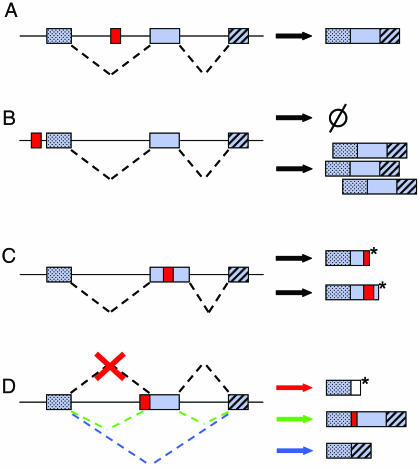
The impact of SINEs on gene structure and expression. A hypothetical gene constituted of three exons (gray boxes with and without patterns) along with its splicing pattern (dashed lines) is shown on the left; the resulting protein products are shown on the right. (A) A SINE element (red box) inserted within an intron essentially induces no damage. (B) A SINE inserts at or near a regulatory region of the gene and may decrease (dashed circle) or increase (as indicated by multiple protein products) gene expression levels. (C) A SINE inserts within an exon and may disrupt the open reading frame, thus introducing a premature stop codon (asterisks), resulting in a truncated and possibly nonfunctional protein. (D) A SINE inserts at an intron/exon boundary and may alter splicing patterns. This may result in intron sequence (white box) integrated to the protein product (red cross and arrow) with consequences analogous to C, exon skipping (blue splice variant and arrow) or the use of a cryptic splice site located within the SINE element (green splice variant and arrow), that may lead to SINE exonization if the open reading frame is preserved.
Comment on
-
Retrotransposon insertion in SILV is responsible for merle patterning of the domestic dog.Proc Natl Acad Sci U S A. 2006 Jan 31;103(5):1376-81. doi: 10.1073/pnas.0506940103. Epub 2006 Jan 9. Proc Natl Acad Sci U S A. 2006. PMID: 16407134 Free PMC article.
References
-
- Sutter, N. B. & Ostrander, E. A. (2004) Nat. Rev. Genet. 5, 900–910. - PubMed
-
- Lindblad-Toh, K., Wade, C. M., Mikkelsen, T. S., Karlsson, E. K., Jaffe, D. B., Kamal, M., Clamp, M., Chang, J. L., Kulbokas, E. J., Zody, M. C., et al. (2005) Nature 438, 803–819. - PubMed
-
- Nayak, C. S. & Isaacson, G. (2003) Ann. Otol. Rhinol. Laryngol. 112, 817–820. - PubMed
Publication types
MeSH terms
Substances
Grants and funding
LinkOut - more resources
Full Text Sources
Other Literature Sources
