. 2006 Jan 31;103(5):1244-7.
doi: 10.1073/pnas.0509217103. Epub 2006 Jan 23.

Protein structure by mechanical triangulation

Affiliations

Protein structure by mechanical triangulation

Hendrik Dietz et al. Proc Natl Acad Sci U S A. .

Abstract

Knowledge of protein structure is essential to understand protein function. High-resolution protein structure has so far been the domain of ensemble methods. Here, we develop a simple single-molecule technique to measure spatial position of selected residues within a folded and functional protein structure in solution. Construction and mechanical unfolding of cysteine-engineered polyproteins with controlled linkage topology allows measuring intramolecular distance with angstrom precision. We demonstrate the potential of this technique by determining the position of three residues in the structure of green fluorescent protein (GFP). Our results perfectly agree with the GFP crystal structure. Mechanical triangulation can find many applications where current bulk structural methods fail.


Figures

Fig. 1.
Fig. 1.
Principle of mechanical triangulation. (a) Grabbing a folded protein of unknown structure but known sequence exactly at amino acids i and j and forcing it into a completely stretched conformation. The folded distance di, j is given by the difference between predetermined length Li, j of the stretched amino acid chain and the recorded length gain ΔLi, j during transition. (b) Subsequent determination of pair distances dn, j and dn,i to obtain all pair distances for a certain amino acid triple i, j, and n. (c) The such-obtained pair distances allow reconstruction of the absolute spatial positions of the triangulated amino acids i, j, and n. Reconstruction of a detailed three-dimensional protein structure is straightforward by triangulating a sufficient number of pair distances.
Fig. 2.
Fig. 2.
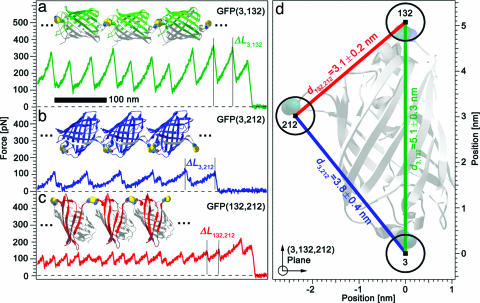
Mechanical triangulation of GFP. (ac) Force-extension traces of single GFP(3, 132), GFP(3, 212), and GFP(132, 212) polyproteins (green, blue, and red solid lines, respectively). The gain in length ΔLi, j between peaks reflects unfolding and subsequent stretching of the number of amino acids located between linkage points in each module (colored in green, blue, and red in the structures). ΔLi, j was determined for the three polyproteins: ΔL3,132 = 41.6 ± 0.04 nm (n = 524), ΔL3,212 = 72.08 ± 0.03 (n = 500), and ΔL132,212 = 26.06 ± 0.05 nm (n = 500). (d) Intramolecular pair distances d3,132, d3,212, and d132,212 and absolute positions of residues 3, 132, and 212 in the folded GFP structure as determined from our data. Circles indicate total errors. Light gray, GFP crystal structure (PDB ID code 1EMB) (17). Backbone atoms of residues 3, 132, and 212 are shown space filling.
Fig. 3.
Fig. 3.
Instrumentation schematics. (a) Schematics of an atomic force microscope. (b) Blue solid line represents a sample force-extension trace obtained on a polyprotein consisting of Ig27 domains from human cardiac titin that are covalently linked by cysteines at positions 3 and 88 in protein sequence. We used PolyIg27(3, 88) for calibration of our system (see Materials and Methods). The length gain ΔL3,88 is measured by fitting the worm-like chain model to the data, represented by black solid lines.

References

    1. Ban, N., Nissen, P., Hansen, J., Moore, P. B. & Steitz, T. A. (2000) Science 289, 905–920. - PubMed
    1. Wider, G. & Wuthrich, K. (1999) Curr. Opin. Struct. Biol. 9, 594–601. - PubMed
    1. Ishima, R. & Torchia, D. A. (2000) Nat. Struct. Biol. 7, 740–743. - PubMed
    1. Liu, H. L. & Hsu, J. P. (2005) Proteomics 5, 2056–2068. - PubMed
    1. Kurner, J., Frangakis, A. S. & Baumeister, W. (2005) Science 307, 436–438. - PubMed

Publication types

LinkOut - more resources