


Socio-economic and climate change impacts on agriculture: an integrated assessment, 1990-2080
- PMID: 16433094
- PMCID: PMC1569572
- DOI: 10.1098/rstb.2005.1744
Socio-economic and climate change impacts on agriculture: an integrated assessment, 1990-2080
Abstract
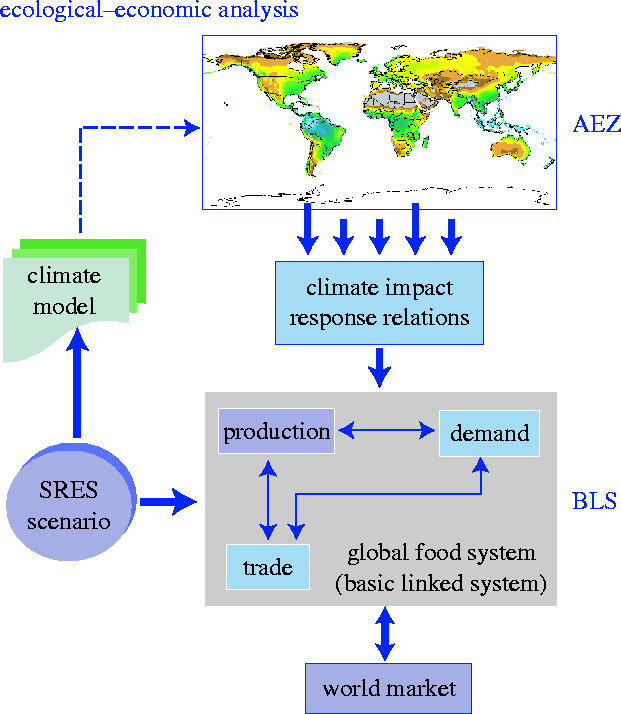
A comprehensive assessment of the impacts of climate change on agro-ecosystems over this century is developed, up to 2080 and at a global level, albeit with significant regional detail. To this end an integrated ecological-economic modelling framework is employed, encompassing climate scenarios, agro-ecological zoning information, socio-economic drivers, as well as world food trade dynamics. Specifically, global simulations are performed using the FAO/IIASA agro-ecological zone model, in conjunction with IIASAs global food system model, using climate variables from five different general circulation models, under four different socio-economic scenarios from the intergovernmental panel on climate change. First, impacts of different scenarios of climate change on bio-physical soil and crop growth determinants of yield are evaluated on a 5' X 5' latitude/longitude global grid; second, the extent of potential agricultural land and related potential crop production is computed. The detailed bio-physical results are then fed into an economic analysis, to assess how climate impacts may interact with alternative development pathways, and key trends expected over this century for food demand and production, and trade, as well as key composite indices such as risk of hunger and malnutrition, are computed. This modelling approach connects the relevant bio-physical and socio-economic variables within a unified and coherent framework to produce a global assessment of food production and security under climate change. The results from the study suggest that critical impact asymmetries due to both climate and socio-economic structures may deepen current production and consumption gaps between developed and developing world; it is suggested that adaptation of agricultural techniques will be central to limit potential damages under climate change.
Figures
References
-
- Ainsworth E.A, Long S.P. What have we learned from 15 years of free-air CO2 enrichment (FACE)? A meta-analysis of the responses of photosynthesis, canopy properties and plant production to rising CO2. New Phytol. 2005;165:351–372. doi:10.1111/j.1469-8137.2004.01224.x - DOI - PubMed
-
- FAO 2001 The State of Food Insecurity in the World, 2001 Food and Agriculture Organization of the United Nations, Rome, Italy, ISBN 92-5-104628-X.
-
- FAO . World Agriculture: Towards 2015/1030. In: Bruinsma Jelle., editor. A FAO perspective. Food and Agricultural Organization of the United Nations; Rome: 2003. p. 432.
-
- Felzer B, Kicklighter D.W, Melillo J.M, Wang C, Zhuang Q, Prinn R. Effects of ozone on net primary production and carbon sequestration in the conterminous United States using a biogeochemistry model. Tellus. 2004;56B:230–248.
-
- Fischer G, Sun L. Model-based analysis of future land-use development in China. Agr. Ecosyst. Environ. 2001;85:163–176. doi:10.1016/S0167-8809(01)00182-7 - DOI
Publication types
MeSH terms
LinkOut - more resources
Full Text Sources
Medical
