. 2006 Jan 24:4:6.
doi: 10.1186/1479-5876-4-6.

Disaggregation and invasion of ovarian carcinoma ascites spheroids

Affiliations

Disaggregation and invasion of ovarian carcinoma ascites spheroids

Kathryn M Burleson et al. J Transl Med. .

Abstract

Background: Malignant ascites often develops in advanced stages of ovarian carcinoma, consisting of single and aggregated tumor cells, or spheroids. Spheroids have commonly been used as tumor models to study drug efficacy, and have shown resistance to some chemotherapies and radiation. However, little is known about the adhesive or invasive capabilities of spheroids, and whether this particular cellular component of the ascites can contribute to dissemination of ovarian cancer. Here, we examined the invasive ability of ascites spheroids recovered from seven ovarian carcinoma patients and one primary peritoneal carcinoma (PPC) patient.

Methods: Ascites spheroids were isolated from patients, purified, and immunohistochemical analyses were performed by a pathologist to confirm diagnosis. In vitro assays were designed to quantify spheroid disaggregation on a variety of extracellular matrices and dissemination on and invasion into normal human mesothelial cell monolayers. Cell proliferation and viability were determined in each assay, and statistical significance demonstrated by the student's t-test.

Results: Spheroids from all of the patients' ascites samples disaggregated on extracellular matrix components, with the PPC spheroids capable of complete disaggregation on type I collagen. Additionally, all of the ascites spheroid samples adhered to and disaggregated on live human mesothelial cell monolayers, typically without invading them. However, the PPC ascites spheroids and one ovarian carcinoma ascites spheroid sample occasionally formed invasive foci in the mesothelial cell monolayers, suggestive of a more invasive phenotype.

Conclusion: We present here in vitro assays using ascites spheroids that imitate the spread of ovarian cancer in vivo. Our results suggest that systematic studies of the ascites cellular content are necessary to understand the biology of ovarian carcinoma.


Figures
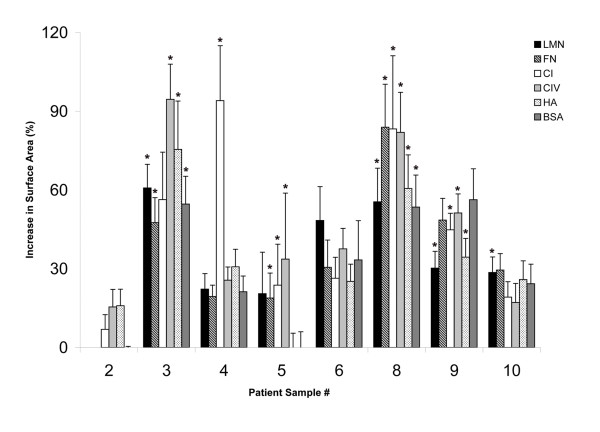
Figure 1
Figure 1
Disaggregation of ascites spheroids on ECM components. Ascites spheroids from eight patients were plated on laminin (black bars), fibronectin (striped), type I collagen (white), type IV collagen (light gray), hyaluronan (stippled), or BSA (dark gray) for 24 hours. Values represent the average percent increase in area of spheroids from triplicate experiments, ± standard error; * designates p-values < 0.05.
Figure 2
Figure 2
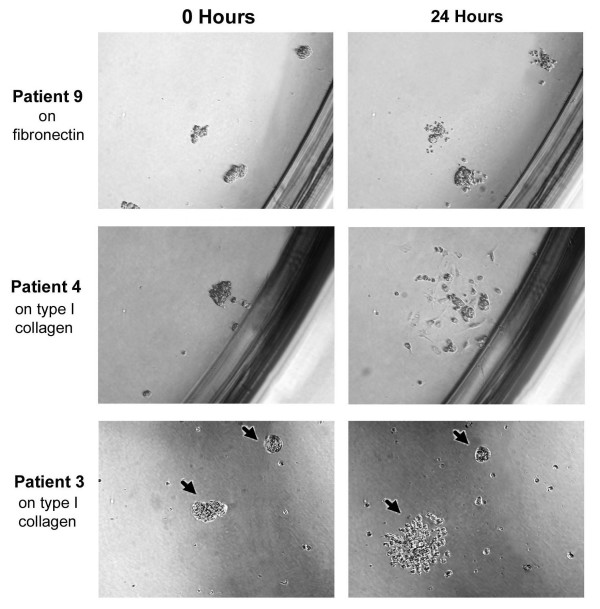
Ascites spheroids demonstrate variable disaggregation on ECM components. Patient ascites spheroids were photographed on various ECM components at t = 0 and 24 hours later. Ascites spheroids demonstrated variable migration in response to ECM components. The top panels show outgrowth of patient 9 spheroids on fibronectin, which is representative of the extent of disaggregation for most patient spheroid samples. The middle panels show a spheroid from patient 4 totally disaggregating on type I collagen. The bottom panels show two spheroids, indicated by arrows, from patient 3 on type I collagen, with one spheroid completely disaggregated (left) and one unaltered (right). Magnification = 400×.
Figure 3
Figure 3
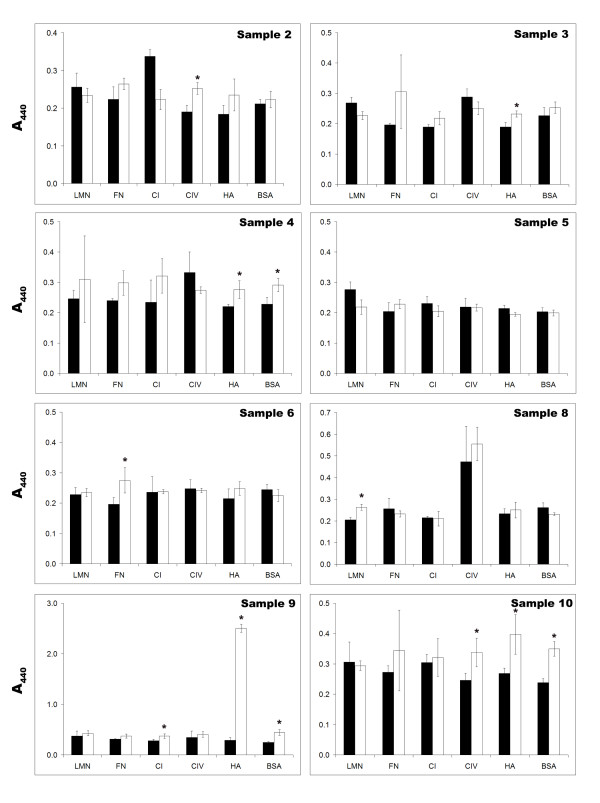
Ascites spheroids show low levels of proliferation on ECM components in 24 hours. Patient ascites spheroid samples were added to 96 well plates coated with laminin (LMN), fibronectin (FN), type I collagen (CI), type IV collagen (CIV), hyaluronan (HA), or BSA. At 0 hours (black bars) and 24 hours (white bars), WST-1 was added for 3 hours and then the plates were read on a microplate reader at A440. Values represent the average of four wells ± standard deviation; * designates p-values < 0.05.
Figure 4
Figure 4
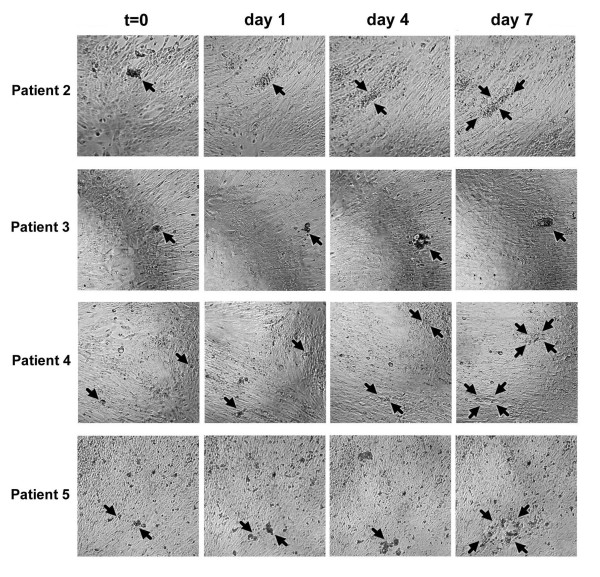
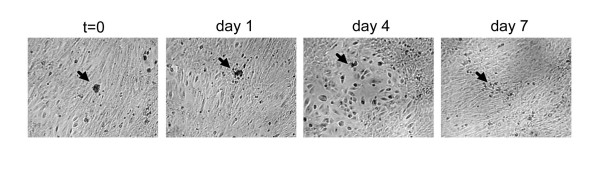
Patient ascites spheroids #2–5 disaggregate on or invade mesothelial cell monolayers. Patient ascites spheroids were added to confluent mesothelial monolayers for 7 days to determine their invasive potential. Photos show representative examples of patient samples 2, 3, 4, and 5 at t = 0, and days 1, 4, and 7. Arrows delineate the perimeters of disaggregating or invading spheroids. Magnification = 100×.
Figure 5
Figure 5
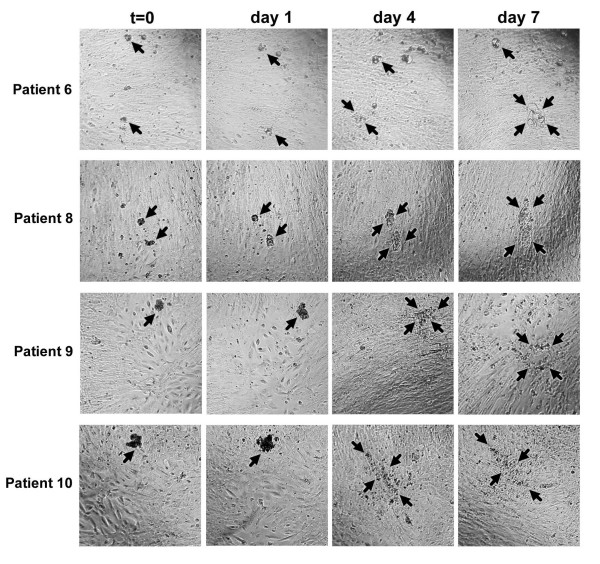
Patient ascites spheroids #6–10 disaggregate on mesothelial cell monolayers. Patient ascites spheroids were added to confluent mesothelial monolayers for 7 days to determine their invasive potential. Photos show representative examples of patient samples 6, 8, 9, and 10 at t = 0, and days 1, 4, and 7. Arrows delineate the perimeters of disaggregating spheroids. Magnification = 100×.
Figure 6
Figure 6
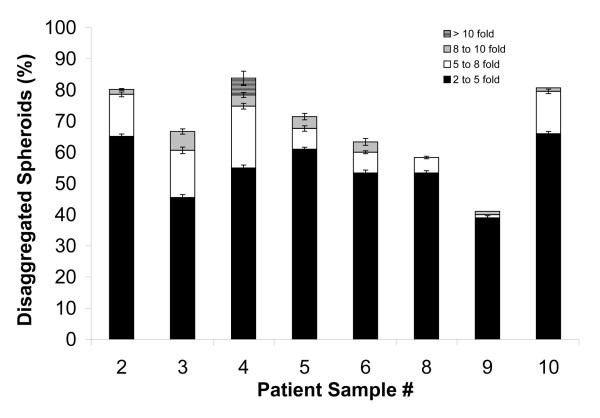
Ascites spheroids disaggregate on mesothelial cell monolayers. Ascites spheroids from eight patients were plated on confluent mesothelial cell monolayers for seven days. The fold change in spheroid area was calculated at day 7. Bars represent the percentage of the total number of spheroids that disaggregated 2.0 to 4.9 fold (black), 5.0 to 7.9 fold (white), 8.0 to 10.9 fold (gray), or greater than 11.0 fold (striped) in area over seven days. P-values were < 0.05 for all samples at all time points, with the exception of samples 8 and 10 at day 1.
Figure 7
Figure 7
Ascites spheroids affect the confluence of mesothelial cell monolayers. (A) The ascites spheroids added to the invasion assays frequently caused areas of sparseness to develop in the area of the mesothelial cell monolayer upon which they were attached. This usually increased up to day 4, but disappeared by day 7. Arrows indicate ascites spheroids. Magnification = 100×.
Figure 8
Figure 8
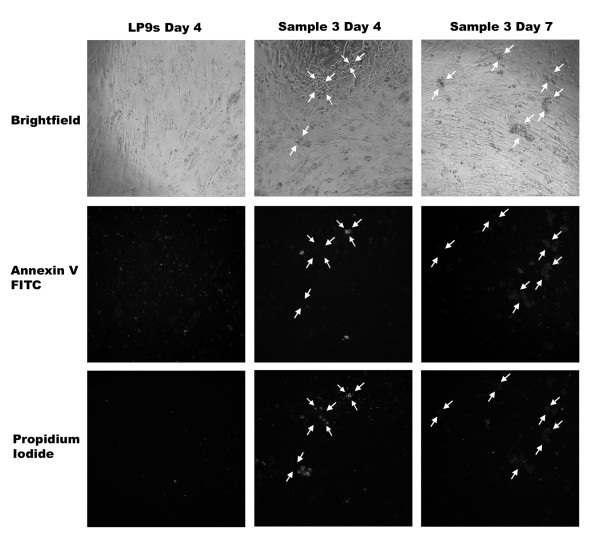
Ascites spheroids and mesothelial cell monolayers are viable for 7 days. Ascites spheroids from eight patients were plated on confluent mesothelial cell monolayers in 96-well plates for seven days. At days 0, 1, 4, and 7, wells were stained with Annexin V-FITC and propidium iodide. Panels shows confluent mesothelial monolayers alone (lef column) or with patient ascites sample 3 at day 4 (middle column) or day 7 (right column) with a bright-field image (row 1), Annexin V-FITC staining (row 2), and propidium iodide staining (row 3). Arrows delineate the perimeters of ascites spheroids that have attached and spread on the mesothelial cell monolayer. Magnification = 100×.
Figure 9
Figure 9
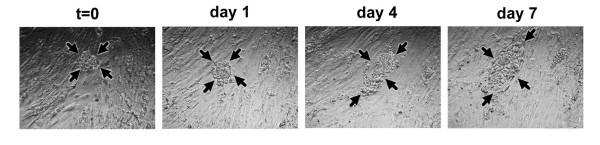
Patient ascites spheroids are capable of invading a live human mesothelial cell monolayer. An ascites spheroid from patient 5 is shown invading into a mesothelial cell monolayer. The arrows delineate the area of spheroid invasion and proliferation within the mesothelial cell monolayer. Magnification = 400×.

References

    1. Cannistra SA. Cancer of the ovary. New England Journal of Medicine. 1993;329:1550–1559. doi: 10.1056/NEJM199311183292108. - DOI - PubMed
    1. Feldman GB, Knapp RC, Order SE, Hellman S. The role of lymphatic obstruction in the formation of ascites in a murine ovarian carcinoma. Cancer Research. 1972;32:1663–1666. - PubMed
    1. Feldman GB, Knapp RC. Lymphatic drainage of the peritoneal cavity and its significance in ovarian cancer. American Journal of Obstetrics and Gynecology. 1974;119:991–994. - PubMed
    1. Olson TA, Mohanraj D, Carson LF, Ramakrishnan S. Vascular permeability factor gene expression in normal and neoplastic human ovaries. Cancer Research. 1994;54:276–280. - PubMed
    1. Senger DR, Galli SJ, Dvorak AM, Perruzzi CA, Harvey VS, Dvorak HF. Tumor cells secrete a vascular permeability factor that promotes accumulation of ascites fluid. Science. 1983;21:983–985. - PubMed

LinkOut - more resources