


In vitro preclinical testing of nonoxynol-9 as potential anti-human immunodeficiency virus microbicide: a retrospective analysis of results from five laboratories
- PMID: 16436731
- PMCID: PMC1366899
- DOI: 10.1128/AAC.50.2.713-723.2006
In vitro preclinical testing of nonoxynol-9 as potential anti-human immunodeficiency virus microbicide: a retrospective analysis of results from five laboratories
Abstract
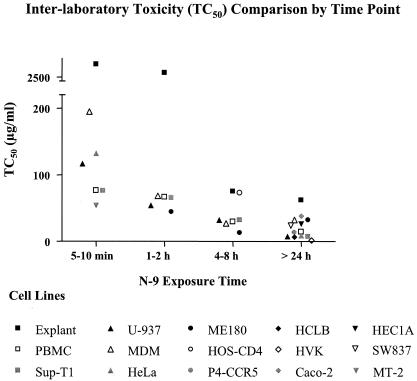
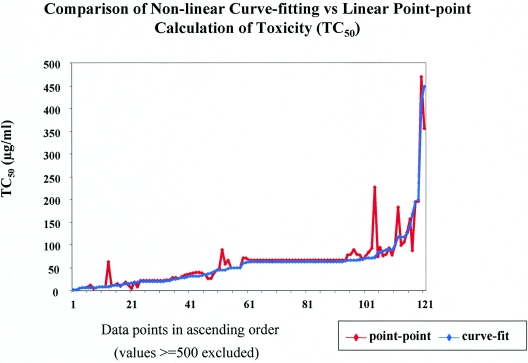
The first product to be clinically evaluated as a microbicide contained the nonionic surfactant nonoxynol-9 (nonylphenoxypolyethoxyethanol; N-9). Many laboratories have used N-9 as a control compound for microbicide assays. However, no published comparisons of the results among laboratories or attempts to establish standardized protocols for preclinical testing of microbicides have been performed. In this study, we compared results from 127 N-9 toxicity and 72 efficacy assays that were generated in five different laboratories over the last six years and were performed with 14 different cell lines or tissues. Intra-assay reproducibility was measured at two-, three-, and fivefold differences using standard deviations. Interassay reproducibility was assessed using general linear models, and interaction between variables was studied using step-wise regression. The intra-assay reproducibility within the same N-9 concentration, cell type, assay duration, and laboratory was consistent at the twofold level of standard deviations. For interassay reproducibility, cell line, duration of assay, and N-9 concentration were all significant sources of variability (P < 0.01). Half-maximal toxicity concentrations for N-9 were similar between laboratories for assays of similar exposure durations, but these similarities decreased with lower test concentrations of N-9. Results for both long (>24 h) and short (<2 h) exposures of cells to N-9 showed variability, while assays with 4 to 8 h of N-9 exposure gave results that were not significantly different. This is the first analysis to compare preclinical N-9 toxicity levels that were obtained by different laboratories using various protocols. This comparative work can be used to develop standardized microbicide testing protocols that will help advance potential microbicides to clinical trials.
Figures



References
-
- Barnhart, K. T., A. Stolpen, E. S. Pretorius, and D. Malamud. 2001. Distribution of a spermicide containing nonoxynol-9 in the vaginal canal and the upper female reproductive tract. Hum. Reprod. 16:1151-1154. - PubMed
-
- Barre-Sinoussi, F., J. C. Chermann, F. Rey, M. T. Nugeyre, S. Chamaret, J. Gruest, C. Dauguet, C. Axler-Blin, F. Vezinet-Brun, C. Rouzioux, W. Rozenbaum, and L. Montagnier. 1983. Isolation of a T-lymphotropic retrovirus from a patient at risk for acquired immune deficiency syndrome (AIDS). Science 220:868-871. - PubMed
-
- Bourinbaiar, A. S., and S. Lee-Huang. 1994. Comparative in vitro study of contraceptive agents with anti-HIV activity: gramicidin, nonoxynol-9, and gossypol. Contraception 49:131-137. - PubMed
-
- Brambilla, D. 8. July 2002, posting date. VQA quantitative HIV RNA proficiency testing scoring criteria and policies. VQA RNA New Statistics Department. [Online.] http://aactg.s-3.com/pub/download/vir/VQA-RNA-PT-statistical-document.pdf.
-
- Catalone, B. J., T. M. Kish-Catalone, L. R. Budgeon, E. B. Neely, M. Ferguson, F. C. Krebs, M. K. Howett, M. Labib, R. Rando, and B. Wigdahl. 2004. Mouse model of cervicovaginal toxicity and inflammation for preclinical evaluation of topical vaginal microbicides. Antimicrob. Agents Chemother. 48:1837-1847. - PMC - PubMed
Publication types
MeSH terms
Substances
Grants and funding
LinkOut - more resources
Full Text Sources
Medical
