


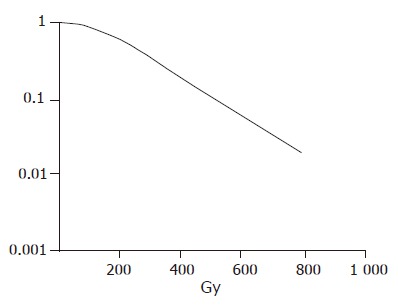
Cell survival curve for primary hepatic carcinoma cells and relationship between SF(2) of hepatic carcinoma cells and radiosensitivity
- PMID: 16437614
- PMCID: PMC4717052
- DOI: 10.3748/wjg.v11.i44.7040
Cell survival curve for primary hepatic carcinoma cells and relationship between SF(2) of hepatic carcinoma cells and radiosensitivity
Abstract
Aim: To establish the cell survival curve for primary hepatic carcinoma cells and to study the relationship between SF(2) of primary hepatic carcinoma cells and radiosensitivity.
Methods: Hepatic carcinoma cells were cultured in vitro using 39 samples of hepatic carcinoma at stages II-IV. Twenty-nine samples were cultured successfully in the fifth generation cells. After these cells were radiated with different dosages, the cell survival ratio and SF(2) were calculated by clonogenic assay and SF(2) model respectively. The relationship between SF(2) and the clinical pathological feature was analyzed.
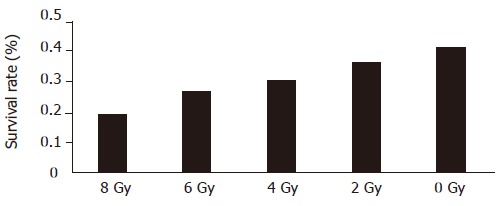
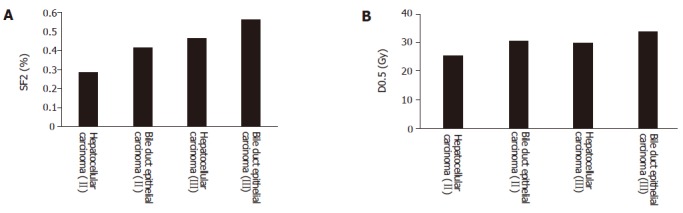
Results: Twenty-nine of thirty-nine samples were successfully cultured. After X-ray radiation of the fifth generation cells with 0, 2, 4, 6, 8 Gy, the cell survival rate was 41%, 36.5%, 31.0%, 26.8%, and 19%, respectively. There was a negative correlation between cell survival and irradiation dosage (r = -0.973, P<0.05). SF(2) ranged 0.28-0.78 and correlated with the clinical stage and pathological grade of hepatic carcinoma (P<0.05). There was a positive correlation between SF(2) and D0.5 (r = 0.773, P<0.05).
Conclusion: SF(2) correlates with the clinical stage and pathological grade of hepatic carcinoma and is a marker for predicting the radiosensitivity of hepatic carcinomas.
Figures
References
-
- Tamamoto T, Ohnishi K, Takahashi A, Wang X, Yosimura H, Ohishi H, Uchida H, Ohnishi T. Correlation between gamma-ray-induced G2 arrest and radioresistance in two human cancer cells. Int J Radiat Oncol Biol Phys. 1999;44:905–909. - PubMed
-
- Vral A, Thierens H, Baeyens A, De Ridder L. Chromosomal aberrations and in vitro radiosensitivity: intra-individual versus inter-individual variability. Toxicol Lett. 2004;149:345–352. - PubMed
-
- Bedford JS, Dewey WC. Radiation Research Society. 1952-2002. Historical and current highlights in radiation biology: has anything important been learned by irradiating cells? Radiat Res. 2002;158:251–291. - PubMed
MeSH terms
LinkOut - more resources
Full Text Sources
Medical
