


Comment
doi: 10.1038/nn0206-159.
Another BOLD role for astrocytes: coupling blood flow to neural activity
- PMID: 16439980
- PMCID: PMC8906497
- DOI: 10.1038/nn0206-159
Item in Clipboard
Comment
Another BOLD role for astrocytes: coupling blood flow to neural activity
Nat Neurosci.
2006 Feb.
Abstract
Increased local blood flow in response to neural activity is critical for brain function and the basis for functional imaging. Takano et al. now show that in vivo, astrocytes are central in translating neural activity into vasodilation via a mechanism involving COX1 metabolites.
Figures
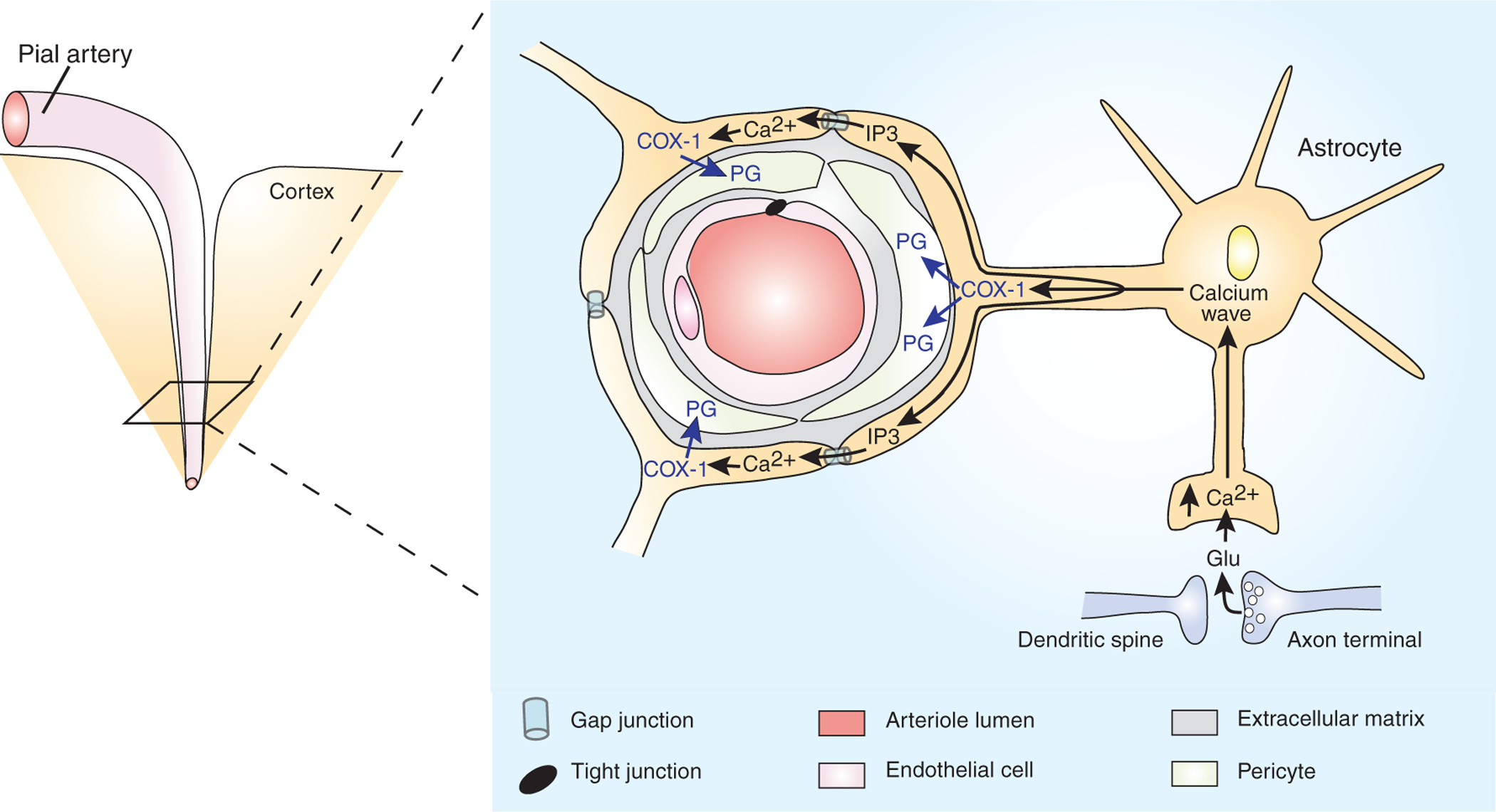
Astrocytes couple increased local blood flow to neuronal activity. By sending specialized processes both to arterioles (astrocyte endfeet) and to glutamatergic synapses, cortical astrocytes form an anatomical link between neurons and the blood supply. During neuronal activity, glutamate spills out of glutamatergic synapses, and, by activating astrocytic metabotropic glutamate receptors, triggers an astrocytic calcium wave. As the calcium wave invades an astrocytic endfoot, Ca2+ stimulates phospholipase A2 to produce arachidonic acid (AA). The AA is metabolized by the cyclooxygenase, COX-1, into a vasodilating prostaglandin (PG). Coordinated vasodilation is facilitated by Ca2+-induced production of IP3, which passes through gap junctions to trigger synchronous calcium waves and PG production in neighboring endfeet. For simplicity, PG is depicted as inducing vasodilation by acting in pericytes that surround the arteriole. However, the site of action of PG is unknown, and there are other arteriole-associated cell types.
Comment on
-
Astrocyte-mediated control of cerebral blood flow.Nat Neurosci. 2006 Feb;9(2):260-7. doi: 10.1038/nn1623. Epub 2005 Dec 25. Nat Neurosci. 2006. PMID: 16388306
References
Publication types
MeSH terms
Substances
Grants and funding
LinkOut - more resources
Full Text Sources
