RNA editing and alternative splicing: the importance of co-transcriptional coordination
- PMID: 16440002
- PMCID: PMC1456888
- DOI: 10.1038/sj.embor.7400621
RNA editing and alternative splicing: the importance of co-transcriptional coordination
Abstract
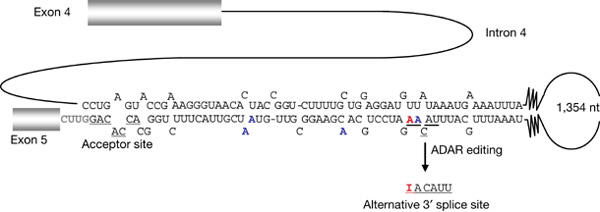
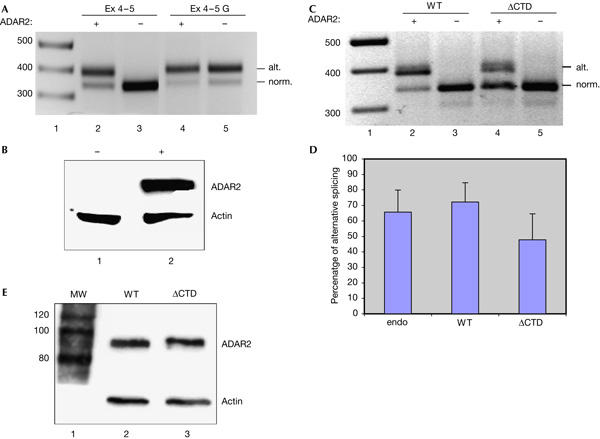
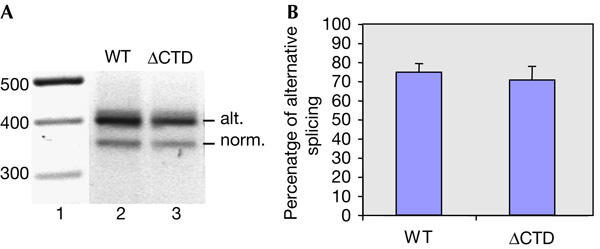
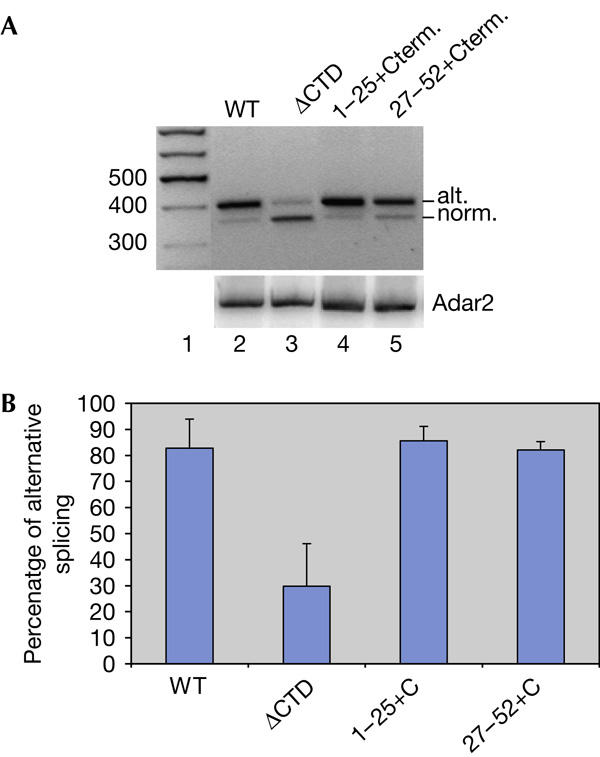
The carboxy-terminal domain (CTD) of the large subunit of RNA polymerase II (pol II) is essential for several co-transcriptional pre-messenger RNA processing events, including capping, 3'-end processing and splicing. We investigated the role of the CTD of RNA pol II in the coordination of A to I editing and splicing of the ADAR2 (ADAR: adenosine deaminases that act on RNA) pre-mRNA. The auto-editing of Adar2 intron 4 by the ADAR2 adenosine deaminase is tightly coupled to splicing, as the modification of the dinucleotide AA to AI creates a new 3' splice site. Unlike other introns, the CTD is not required for efficient splicing of intron 4 at either the normal 3' splice site or the alternative site created by editing. However, the CTD is required for efficient co-transcriptional auto-editing of ADAR2 intron 4. Our results implicate the CTD in site-selective RNA editing by ADAR2 and in coordination of editing with alternative splicing.
Figures
Comment in
-
An editor controlled by transcription.EMBO Rep. 2006 Mar;7(3):269-70. doi: 10.1038/sj.embor.7400650. EMBO Rep. 2006. PMID: 16607395 Free PMC article. No abstract available.
References
-
- Baskaran R, Escobar SR, Wang JY (1999) Nuclear c-Abl is a COOH-terminal repeated domain (CTD)-tyrosine (CTD)-tyrosine kinase-specific for the mammalian RNA polymerase II: possible role in transcription elongation. Cell Growth Differ 10: 387–396 - PubMed
-
- Burns CM, Chu H, Rueter SM, Hutchinson LK, Canton H, Sanders-Bush E, Emeson RB (1997) Regulation of serotonin-2C receptor G-protein coupling by RNA editing. Nature 387: 303–308 - PubMed
Publication types
MeSH terms
Substances
Grants and funding
LinkOut - more resources
Full Text Sources
Research Materials