


Review
doi: 10.1016/j.micinf.2005.06.032.
Epub 2006 Jan 6.
Reasons for the increase in emerging and re-emerging viral infectious diseases
Affiliations
- PMID: 16448839
- PMCID: PMC7110580
- DOI: 10.1016/j.micinf.2005.06.032
Item in Clipboard
Review
Reasons for the increase in emerging and re-emerging viral infectious diseases
Microbes Infect.
2006 Mar.
Abstract
In the past two decades, humans have faced many new viral infectious agents in emerging and re-emerging infectious diseases (EIDs). Many factors contribute to the appearance of EIDs. These factors are complex but can be classified into three different categories: virus factors, human factors, and ecological factors. The factors contributing to the cause of such viral infectious diseases will be systematically reviewed in this article.
Figures
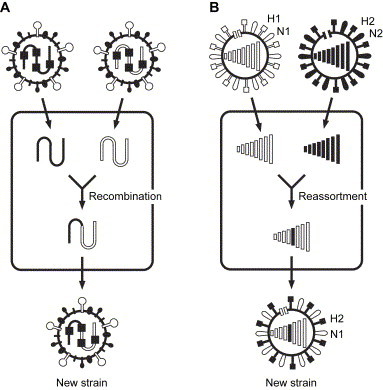
Recombination and reassortment. (A) Two CoVs co-infect in a single cell. The long viral genome may have a chance to undergo recombination. The genome of the new strain is a chimera of the parent strains. (B) Two different strains of influenza A viruses (H1N1 and H2N2, in this case) co-infect a single cell. The progeny virus combines genomic segments from parent strains to form the new strain (H2N1 in this case).
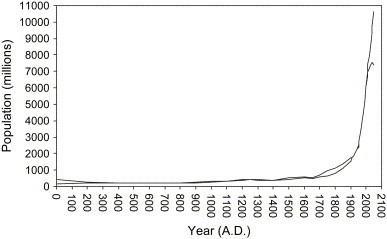
World human population growth curve. Two curves represent the human population in upper and lower medium values. (Source: U.S. Census Bureau International Database and U.N. Population Division Population Database.)
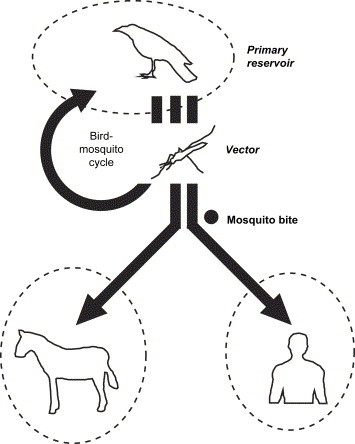
Schematic diagram of the principal routes of transmission of WNV. WNV is maintained in an enzootic bird-mosquito cycle, which involves wild birds as the primary reservoir and mosquitoes as the vector. The virus moves out of this bird-mosquito cycle when infected mosquitoes bite humans or other vertebrate animals (such as horses). However, humans and other mammals serve as “dead-end hosts”, which do not sufficiently amplify virus for mosquito transmission. Arrows represent the route of transmission. Circles with dotted lines represent a species. Arrows crossing between two circles represent cross-species transmission.
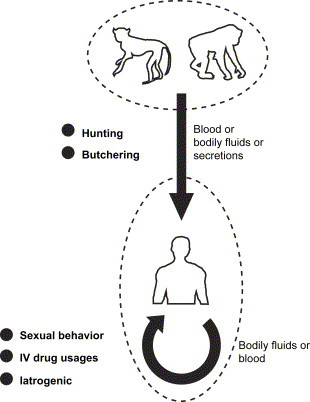
Schematic diagram of the principal route of the transmission of AIDS. HIV-1 and HIV-2 originated from SIV in chimpanzees and sooty mangabeys, respectively. The virus might enter humans during animal hunting and butchering. After that, HIV is transmitted from person-to-person through exchange of bodily fluids, including blood, semen, and breast milk.
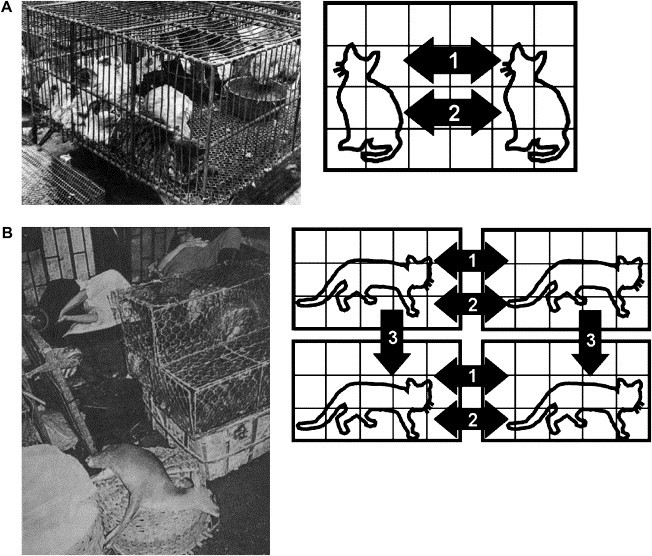
Virus transmission during pasture practices. (A) In southern China, captured animals were put in the same animal-holding cage before slaughtering or butchering. The animals were in close proximity and fought (arrow 1) or were bitten (arrow 2) inside the cage. Therefore, the virus was transmitted to the animals through bloody wounds or close contact. (B) To save storage space, the animal-holding cages are often stacked cage upon cage. Animals at the same level can transfer disease by fighting (arrow 1) or biting (arrow 2). The excreted droppings from the upper level wound increase the chance of infection in the animals held in the lower level (arrow 3). Cross-species transmission will occur if there are different animals in the cages that are staked together.
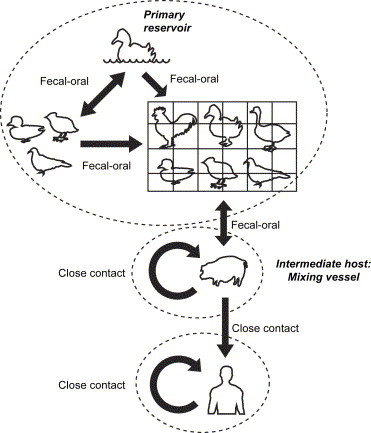
Schematic diagram of the principal routes of transmission of influenza A virus. Influenza A viruses have an extensive reservoir in aquatic wildfowl, in which they usually cause asymptomatic infections. Influenza viruses in birds replicate in the intestines of the avian and are transmitted primarily through the fecal-oral route. Since the tracheal epithelium of pigs contains both receptors for avian and human influenza viruses, pigs can be simultaneously infected with both avian and mammalian viruses. Therefore, pigs were proposed to be the intermediate hosts in which genetic reassortment would take place, giving rise to novel influenza A viruses. Humans can be infected by the viruses from infected pigs. Such infections are usually sporadic and tend to occur in individuals who are exposed to infected pigs. Influenza viruses are transmitted from person to person very easily through aerosolized particles from coughing and sneezing.
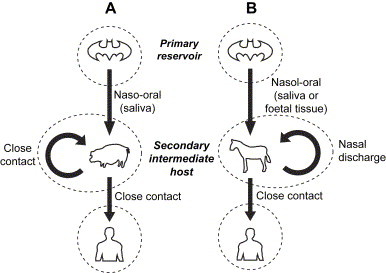
Schematic diagram of the principal routes of transmission of NiV and HeV. (A) The fruitbats of the genus Pteropus have been identified as a primary natural reservoir host for NiV. The natural transmission of the virus from fruitbats to pigs is possible via the naso-oral route. Viruses have been isolated from half-eaten fruit dropped near pig farms, and which may have enough virus to infect an animal that subsequently ingests them. The close proximity of pigs in many Malaysian pig farms probably contributed significantly to pig-to-pig transmissions. The lack of human-to-human transmission could be due to the lower virus load in human respiratory secretions and urine compared to that in pigs. (B) It is possible that the natural transmission of HeV from bats to horses is by the naso-oral route. It has also been hypothesized that transmission from bats to horses is affected by contact with infected fetal tissue or fluids, most probably via the ingestion of recently contaminated pasture. The possibility of contact with nasal discharge exists for horse-to-horse transmission.
References
-
- Domingo E., Biebrichen C.K., Eigen M., Holland J.J. Landes Bioscience; Georgetown, Texas, USA: 2001. Quasispecies and RNA virus evolution: principles and consequences. <Eurekah.com>.
-
- Mansky L.M. Forward mutation rate of human immunodeficiency virus type 1 in a T-lymphoid cell line. AIDS Res. Hum. Retroviruses. 1996;12:307–314. - PubMed
-
- Consortium TCSme: Molecular evolution of the SARS coronavirus during the course of the SARS epidemic in China. Science. 2004;303:1666–1669. - PubMed
-
- Daar E.S., Richman D.D. Confronting the emergence of drug-resistant HIV type 1: impact of antiretroviral therapy on individual and population resistance. AIDS Res. Hum. Retroviruses. 2005;21:343–357. - PubMed
-
- Hatta M., Gao P., Halfmann P., Kawaoka Y. Molecular basis for high virulence of Hong Kong H5N1 influenza A viruses. Science. 2001;293:1840–1842. - PubMed
Publication types
MeSH terms
LinkOut - more resources
Full Text Sources
Medical
Miscellaneous
