


Lower total fasting plasma adiponectin concentrations are associated with higher metabolic rates
- PMID: 16449334
- PMCID: PMC1578760
- DOI: 10.1210/jc.2005-2271
Lower total fasting plasma adiponectin concentrations are associated with higher metabolic rates
Abstract
Context: The possible role of adiponectin, a protein uniquely produced by the adipose tissue and significantly reduced in obesity and other insulin-resistant states, in the regulation of energy expenditure (EE) is still poorly understood.
Objective: The objective of the study was to investigate the relationship between total fasting plasma adiponectin concentrations and the various components of EE measured in a metabolic chamber in Pima Indians and to test whether body fat distribution may have a role in this association.
Design: This was a cross-sectional study.
Setting: The study was an inpatient clinical research unit.
Participants: Sixty nondiabetic Pima Indians (45 males and 15 females), aged 18-45 yr, spanning a wide range of adiposity (body mass index 19.6-46.2 kg/m(2)) participated in the study.
Main outcome measures: Total fasting plasma adiponectin concentrations, EE (24-h respiratory chamber), insulin sensitivity (euglycemic-hyperisulinemic clamp), body composition (dual-energy x-ray absorptiometry), and body fat distribution (waist to thigh ratio) were the main outcome measures.
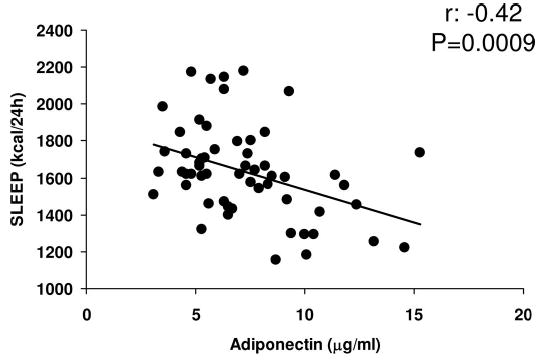
Results: Total fasting plasma adiponectin concentrations are negatively associated with sleep EE adjusted for sex, age, fat-free mass, and fat mass. This correlation is still significant, although attenuated, after inclusion of insulin-stimulated glucose disposal among the regressors and further attenuated when adjusted also for waist to thigh ratio.
Conclusions: The decrease in total fasting plasma adiponectin concentrations that accompanies fat accumulation may be a mechanism to prevent further weight gain by decreasing insulin sensitivity and increasing energy expenditure.
Figures
References
-
- Matsuzawa Y. Adiponectin: identification, physiology and clinical relevance in metabolic and vascular disease. Atheroscler Suppl. 2005;6:7–14. - PubMed
-
- Yang WS, Lee WJ, Funahashi T, Tanaka S, Matsuzawa Y, Chao CL, Chen CL, Tai TY, Chuang LM. Weight reduction increases plasma levels of an adipose-derived anti-inflammatory protein, adiponectin. J Clin Endocrinol Metab. 2001;86:3815–3819. - PubMed
-
- Xydakis AM, Case CC, Jones PH, Hoogeveen RC, Liu MY, Smith EO, Nelson KW, Ballantyne CM. Adiponectin, inflammation, and the expression of the metabolic syndrome in obese individuals: the impact of rapid weight loss through caloric restriction. J Clin Endocrinol Metab. 2004;89:2697–2703. - PubMed
-
- Weyer C, Funahashi T, Tanaka S, Hotta K, Matsuzawa Y, Pratley RE, Tataranni PA. Hypoadiponectinemia in obesity and type 2 diabetes: close association with insulin resistance and hyperinsulinemia. J Clin Endocrinol Metab. 2001;86:1930–1935. - PubMed
-
- Qi Y, Takahashi N, Hileman SM, Patel HR, Berg AH, Pajvani UB, Scherer PE, Ahima RS. Adiponectin acts in the brain to decrease body weight. Nat Med. 2004;10:524–529. - PubMed
