


Review
doi: 10.1038/sj.bjc.6602970.
Mutation of the PIK3CA oncogene in human cancers
Affiliations
- PMID: 16449998
- PMCID: PMC2361173
- DOI: 10.1038/sj.bjc.6602970
Item in Clipboard
Review
Mutation of the PIK3CA oncogene in human cancers
Br J Cancer.
.
Abstract
It is now well established that cancer is a genetic disease and that somatic mutations of oncogenes and tumour suppressor genes are the initiators of the carcinogenic process. The phosphatidylinositol 3-kinase signalling pathway has previously been implicated in tumorigenesis, and evidence over the past year suggests a pivotal role for the phosphatidylinositol 3-kinase catalytic subunit, PIK3CA, in human cancers. In this review, we analyse recent reports describing PIK3CA mutations in a variety of human malignancies, and discuss their possible implications for diagnosis and therapy.
Figures
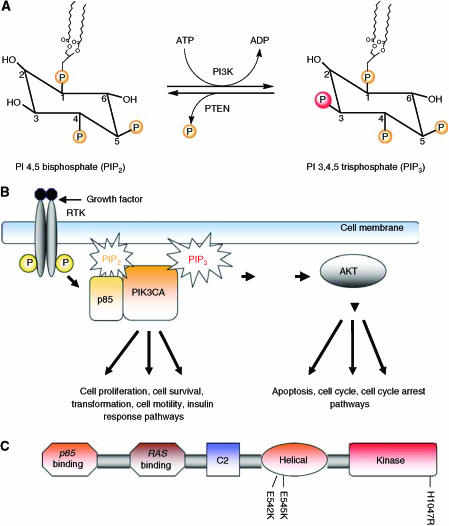
(A) The main reaction catalysed by PI3K: phosphatidylinositol (PI) 4,5 bisphosphate (PIP2) to phosphatidylinositol (PI) 3,4,5-triphosphate (PIP3). (B) PI3K is activated upon ligand binding to a receptor tyrosine kinase (RTK), which then activates the regulatory subunit (p85) to bind the catalytic p110α subunit. This ultimately triggers various downstream signalling cascades resulting in cell survival, apoptosis, transformation, metastasis, and cell migration. (C) Schematic representation of PIK3CA (p110α catalytic subunit of PI3K) and its functional domains with the most common somatic mutations, E542K, E545K and H1047R within the helical and kinase domains indicated.
References
-
- Bachman KE, Argani P, Samuels Y, Silliman N, Ptak J, Szabo S, Konishi H, Karakas B, Blair BG, Lin C, Peters AB, Velculescu VE, Park BH (2004) The PIK3CA gene is mutated with high frequency in human breast cancers. Cancer Biol Ther 3: 772–775 - PubMed
-
- Broderick DK, Di C, Parrett TJ, Samuels YR, Cummins JM, McLendon RE, Fults DW, Velculescu VE, Bigner DD, Yan H (2004) Mutations of PIK3CA in anaplastic oligodendrogliomas, high-grade astrocytomas, and medulloblastomas. Cancer Res 64: 5048–5050 - PubMed
-
- Campbell IG, Russell SE, Choong DYH, Montgomery KG, Ciavarella ML, Hooi CSF, Cristiano BE, Pearson RB, Phillips WA (2004) Mutation of the PIK3CA gene in ovarian and breast cancer. Cancer Res 64: 7678–7681 - PubMed
-
- Cantley LC (2002) The phosphoinositide 3-kinase pathway. Science 296: 1655–1657 - PubMed
-
- Cantley LC, Auger KR, Carpenter C, Duckworth B, Graziani A, Kapeller R, Soltoff S (1991) Oncogenes and signal transduction. Cell 64: 281–302 - PubMed
Publication types
MeSH terms
Substances
Grants and funding
LinkOut - more resources
Full Text Sources
Other Literature Sources
Miscellaneous
