


Optimizing the use of aromatase inhibitors in adjuvant therapy for postmenopausal patients with hormone-responsive early breast cancer: current and future prospects
- PMID: 16450161
- PMCID: PMC12161089
- DOI: 10.1007/s00432-006-0081-0
Optimizing the use of aromatase inhibitors in adjuvant therapy for postmenopausal patients with hormone-responsive early breast cancer: current and future prospects
Abstract
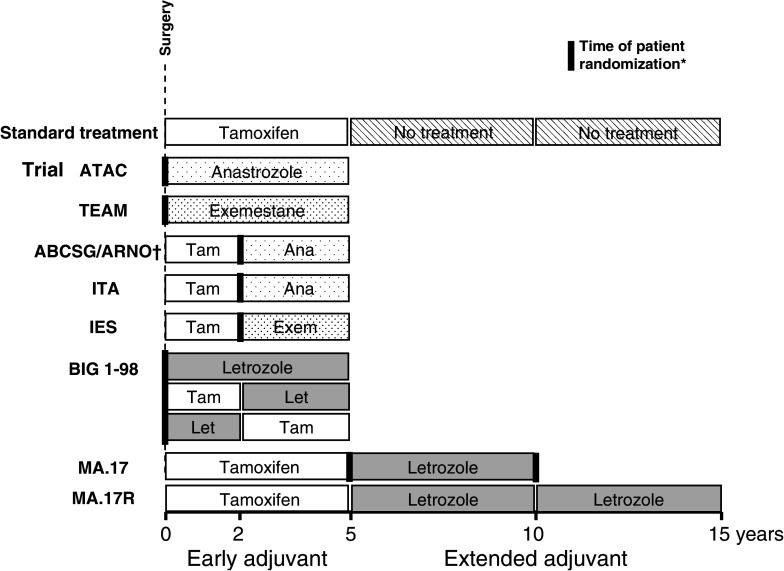
Purpose: Five years of tamoxifen treatment after primary surgery has had a significant impact on outcomes for women with early breast cancer, but the third-generation aromatase inhibitors (AIs) are now challenging tamoxifen as the gold standard endocrine adjuvant treatment. Results from two large, phase III, early adjuvant studies have indicated that the AIs letrozole and anastrozole offer greater protection against recurrence than tamoxifen in upfront substitution strategies in the first 5 years after surgery. Similarly, changeover to an AI (exemestane or anastrozole) after 2-3 years of tamoxifen has been shown to offer greater protection against recurrence than 5 years of tamoxifen. More than 50% of early breast cancer recurrences occur five or more years after surgery. Letrozole has been shown to offer greater protection against recurrence than placebo in the 5 years after a standard course of tamoxifen. The safety implications of treatment with these potent AIs for 5 years or more are being closely monitored. Anticipated effects of estrogen deprivation on bone health may be treatable with bisphosphonates, and this strategy is under investigation. Effects on the cardiovascular system, and other estrogen-sensitive systems such as the central nervous system, are currently unclear and further results are awaited.
Conclusion: Current evidence indicates that the third-generation AIs will improve outcomes for many women with early breast cancer.
Figures
References
-
- ATAC (Arimidex, Tamoxifen Alone or in Combination) Trialists’ Group (2002) Anastrozole alone or in combination with tamoxifen versus tamoxifen alone for adjuvant treatment of postmenopausal women with early breast cancer: first results of the ATAC randomised trial. Lancet 359:2131–2139. Erratum in: Lancet (2002) 360:1520 - PubMed
-
- Atalay G, Dirix L, Biganzoli L, Beex L, Nooij M, Cameron D, Lohrisch C, Cufer T, Lobelle JP, Mattiaci MR, Piccart M, Paridaens R (2004) The effect of exemestane on serum lipid profile in postmenopausal women with metastatic breast cancer: a companion study to EORTC Trial 10951, ‘Randomized phase II study in first line hormonal treatment for metastatic breast cancer with exemestane or tamoxifen in postmenopausal patients’. Ann Oncol 15:211–277 - DOI - PubMed
-
- Baum M, Buzdar A, Cuzick J, Forbes J, Houghton J, Howell A, Sahmoud T, The ATAC (Arimidex, Tamoxifen Alone or in Combination) Trialists’ Group (2003) Anastrozole alone or in combination with tamoxifen versus tamoxifen alone for adjuvant treatment of postmenopausal women with early-stage breast cancer: results of the ATAC (Arimidex, Tamoxifen Alone or in Combination) trial efficacy and safety update analyses. Cancer 98:1802–1810 - PubMed
-
- Boccardo F, Rubagotti A, Puntoni M, Guglielmini P, Amoroso D, Fini A, Paladini G, Mesiti M, Romeo D, Rinaldini M, Scali S, Porpiglia M, Benedetto C, Restuccia N, Buzzi F, Franchi R, Massidda B, Distante V, Amadori D, Sismondi P (2005) Switching to anastrozole versus continued tamoxifen treatment of early breast cancer: preliminary results of the Italian tamoxifen anastrozole trial. J Clin Oncol 23:5138–5147 - DOI - PubMed
Publication types
MeSH terms
Substances
LinkOut - more resources
Full Text Sources
Medical
