Comparative Study
. 2005 Dec 30;6 Suppl 1(Suppl 1):S26.
doi: 10.1186/1471-2156-6-S1-S26.

Comparison of single-nucleotide polymorphisms and microsatellites in inference of population structure

Affiliations
Comparative Study

Comparison of single-nucleotide polymorphisms and microsatellites in inference of population structure

Nianjun Liu et al. BMC Genet. .

Abstract

Single-nucleotide polymorphisms (SNPs) are a class of attractive genetic markers for population genetic studies and for identifying genetic variations underlying complex traits. However, the usefulness and efficiency of SNPs in comparison to microsatellites in different scientific contexts, e.g., population structure inference or association analysis, still must be systematically evaluated through large empirical studies. In this article, we use the Collaborative Studies on Genetics of Alcoholism (COGA) data from Genetic Analysis Workshop 14 (GAW14) to compare the performance of microsatellites and SNPs in the whole human genome in the context of population structure inference. A total of 328 microsatellites and 15,840 SNPs are used to infer population structure in 236 unrelated individuals. We find that, on average, the informativeness of random microsatellites is four to twelve times that of random SNPs for various population comparisons, which is consistent with previous studies. Our results also indicate that for the combined set of microsatellites and SNPs, SNPs constitute the majority among the most informative markers and the use of these SNPs leads to better inference of population structure than the use of microsatellites. We also find that the inclusion of less informative markers may add noise and worsen the results.


Figures
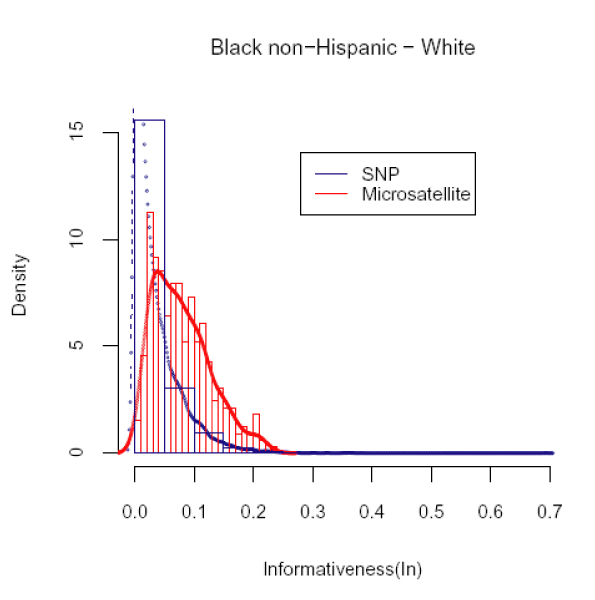
Figure 1
Figure 1
The distributions of informativeness (In) of microsatellites and SNPs for Black non-Hispanic vs. White. The dotted curves are the estimated kernel densities of the data.
Figure 2
Figure 2
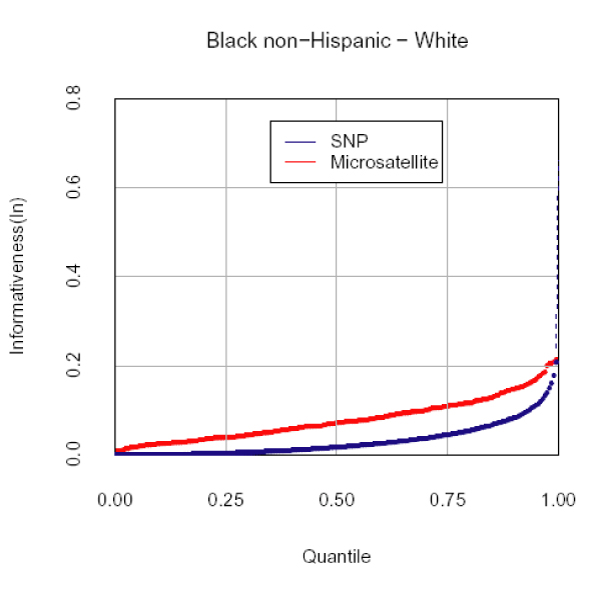
Informativeness quantiles for microsatellites and SNPs for Black non-Hispanic vs. White
Figure 3
Figure 3
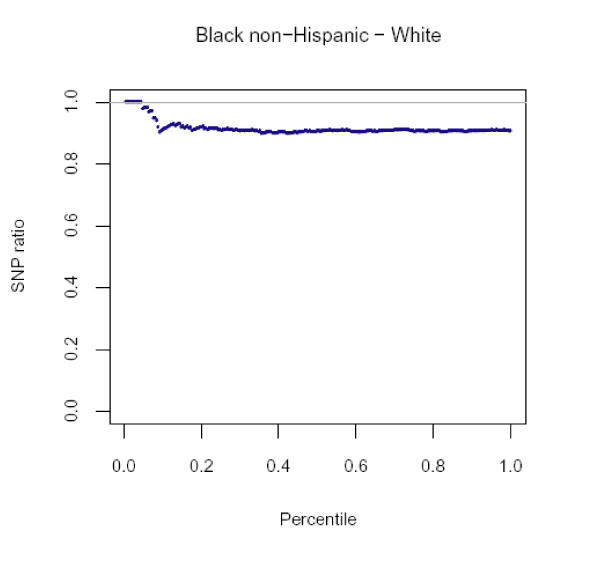
The percentage of SNPs among the most informative markers where microsatellites and SNPs are pooled together (for Black non-Hispanic vs. White).
Figure 4
Figure 4
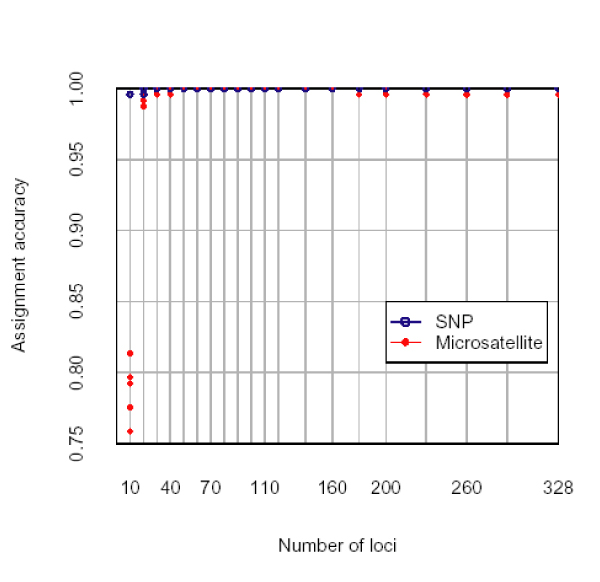
The assignment accuracies for the 5 runs of microsatellites and SNPs each for various numbers of loci.

References

    1. Pritchard JK, Stephens M, Donnelly P. Inference of population structure using multilocus genotype data. Genetics. 2000;155:945–959. - PMC - PubMed
    1. Rosenberg NA, Burke T, Elo K, Feldman MW, Freidlin PJ, Groenen MA, Hillel J, Maki-Tanila A, Tixier-Boichard M, Vignal A, Wimmers K, Weigend S. Empirical evaluation of genetic clustering methods using multilocus genotypes from 20 chicken breeds. Genetics. 2001;159:699–713. - PMC - PubMed
    1. Hoggart CJ, Esteban JP, Shriver MD, Bonilla C, Kittles RA, Clayton DG, McKeigue PM. Control of confounding of genetic association in stratified populations. Am J Human Genet. 2003;72:1492–1504. doi: 10.1086/375613. - DOI - PMC - PubMed
    1. Rosenberg NA, Li LM, Ward R, Pritchard JK. Informativeness of genetic markers for inference of ancestry. Am J Hum Genet. 2003;73:1402–1422. doi: 10.1086/380416. - DOI - PMC - PubMed
    1. Patterson N, Hattangadi N, Lane B, Lohmueller KE, Hafler DA, Oksenberg JR, Hauser SL, Smith MW, O'Brien SJ, Altshuler D, Daly MJ, Reich D. Methods for high-density admixture mapping of disease genes. Am J Hum Genet. 2004;74:979–1000. doi: 10.1086/420871. - DOI - PMC - PubMed

Publication types

LinkOut - more resources