. 2006 Feb;188(4):1419-36.
doi: 10.1128/JB.188.4.1419-1436.2006.

The genome of the novel phage Rtp, with a rosette-like tail tip, is homologous to the genome of phage T1

Affiliations

The genome of the novel phage Rtp, with a rosette-like tail tip, is homologous to the genome of phage T1

Andreas Wietzorrek et al. J Bacteriol. 2006 Feb.

Abstract

A new Escherichia coli phage, named Rtp, was isolated and shown to be closely related to phage T1. Electron microscopy revealed that phage Rtp has a morphologically unique tail tip consisting of four leaf-like structures arranged in a rosette, whereas phage T1 has thinner, flexible leaves that thicken toward the ends. In contrast to T1, Rtp did not require FhuA and TonB for infection. The 46.2-kb genome of phage Rtp encodes 75 open reading frames, 47 of which are homologous to phage T1 genes. Like phage T1, phage Rtp encodes a large number of small genes at the genome termini that exhibit no sequence similarity to known genes. Six predicted genes larger than 300 nucleotides in the highly homologous region of Rtp are not found in T1. Two predicted HNH endonucleases are encoded at positions different from those in phage T1. The sequence similarity of rtp37, -38, -39, -41, -42, and -43 to equally arranged genes of lambdoid phages suggests a common tail assembly initiation complex. Protein Rtp43 is homologous to the lambda J protein, which determines lambda host specificity. Since the two proteins differ most in the C-proximal area, where the binding site to the LamB receptor resides in the J protein, we propose that Rtp43 contributes to Rtp host specificity. Lipoproteins similar to the predicted lipoprotein Rtp45 are found in a number of phages (encoded by cor genes) in which they prevent superinfection by inactivating the receptors. We propose that, similar to the proposed function of the phage T5 lipoprotein, Rtp45 prevents inactivation of Rtp by adsorption to its receptor during cells lysis. Rtp52 is a putative transcriptional regulator, for which 10 conserved inverted repeats were identified upstream of genes in the Rtp genome. In contrast, the much larger E. coli genome has only one such repeat sequence.


Figures

FIG. 1.
FIG. 1.
Electron micrographs of purified phages after negative staining with uranyl acetate. A, phage Rtp; B, phage T1. Note the thinner and longer tail fibers of phage T1 in comparison to those of phage Rtp. Bar, 100 nm.
FIG. 2.
FIG. 2.
Comparative maps of the genomes of E. coli phages Rtp (top, 46,219 bp) and T1 (bottom, 48,836 bp). Both phages contain circularly permutated genomes, which are shown with the predicted locations of the pac sites close to the left end. The scale for the T1 genome starts 2 kb to the left of the scale for the genome of Rtp. The T1 map is redrawn to scale from the data presented by Roberts et al. (75). The relative locations of orthologous genes, shown by the dashed lines between the Rtp and T1 genes, reveal a high degree of synteny (see Table 2 for details). Gene numbering is shown above the ORFs. The locations of the HNH endonuclease genes (two genes in Rtp, three genes in T1) are not conserved between the two phages. Gene products: Pnk, polynucleotide kinase; TerS, terminase small subunit; TerL, terminase large subunit; tail tip proteins M, L, K, and I and fiber J, homologs of λ tail assembly proteins; Erf, essential recombination function; Ssb, single-stranded-DNA-binding protein. Regul., regulator.
FIG. 3.
FIG. 3.
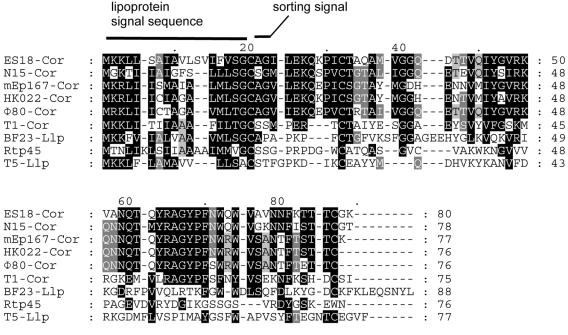
Alignment of Cor proteins with other predicted small phage lipoproteins. This multiple-sequence alignment of full-length protein sequences was generated with ClustalW. The fully conserved cysteine residue at position 20 of the alignment constitutes the N-terminal amino acid of the mature lipoproteins. It is the site for cleavage of the signal sequence and lipid modification. Llp of phage T5 is the only one of these proteins for which lipid modification and its functional importance have been experimentally proven (28, 68, 77).The Cor protein of phage T1 is the most distant member of the Cor family, which consists of a group of six homologous sequences. Llp of T5 and BF23 and Rtp45 show little sequence conservation with respect to the Cor proteins beyond the signal and sorting sequences. The correct amino acid sequence for Cor of Φ80 has been taken from Vostrov et al. (88). Accession numbers of the other Cor and Llp proteins: ES18, AAW70503; N15, NP_046919; mEp167, AAT11800; HK022, NP_037685; T1, AAP49969; T5, Q38162; BF23, AAZ03643.
FIG. 4.
FIG. 4.
Genetic map of the cor region in FhuA-dependent phages and the corresponding region of T1-related phage Rtp. Homologous genes of FhuA-dependent phages HK022, N15, ES18, Φ80, and T1 and T1-related phage Rtp are indicated by white arrows. J, homolog of λ tail fiber gene J; fibB, putative second tail fiber gene (the module of three recombination genes in T1 and Rtp is followed by fibB homologs in these phages); cor, lysogenic/lytic conversion gene (see text). The lengths of the gene products are indicated inside the arrows; values between the gene arrows indicate intergenic distances (negative values for overlapping genes). The genome of Φ80 has not been sequenced. Two partial ORFs encoding FibB and a homolog of the conserved but uncharacterized 212-, 225-, 217-, and 228-aa proteins of the other FhuA-dependent phages were identified by TBlastN searches of the nucleotide database entry for Φ80 cor (D00360). The genes of Rtp shown by gray shaded arrows, including that for the putative lipoprotein Rtp45, are not homologous to the genes of the FhuA-dependent phages. The latter display a conserved arrangement of the genes between fibJ and cor.
FIG. 5.
FIG. 5.
Identification of a DNA-binding helix-turn-helix motif in Rtp52 and T1-gp23. (A) Alignment of the helix-turn-helix regions of Rtp52 and T1-gp23 with distantly related DNA-binding domains. The numbering of homologs refers to the PSI-BLAST results in panel B. Numbering of amino acids is shown at the right side of the alignment. A helix-turn-helix motif search by the Dodd-Egan method (32) identified the sequence GTKANIAKQLKVTPQAVEEWFK, starting at position 53 in Rtp52, with a score of 5.19, representing approximately 100% probability for a DNA-binding helix-turn-helix fold. The position of the predicted helix-turn-helix motif is shown by an arrow below the alignment. All of the other proteins in the alignment also contained a predicted helix-turn-helix motif in an equivalent position. (B) Result of PSI-BLAST iteration 5 with Rtp52 as the query sequence. The 10 best-scoring hits were tested for helix-turn-helix motifs. The probabilities for a helix-turn-helix motif based on the Dodd-Egan method are shown next to the PSI-BLAST expectation values. The annotation of each remote homolog was reexamined by BlastP database searches. In the PSI BLAST analysis of Rtp52, we excluded hits to the multidomain proteins of the nonribosomal peptide synthetase family from subsequent iterations of the search. Manual filtering was necessary since low-scoring PSI-BLAST search results tend to be drawn to large protein families.
FIG. 6.
FIG. 6.
Repeat sequences in putative promoter regions of the Rtp genome. (A) Alignment of upstream regions of Rtp genes containing the repeat sequence TAGCA-(N)5-TGCTA with one mismatch allowed. This 15-nt repeat sequence presents an inverted repeat with a 5-nt spacer. The inverted repeat (matching bases in uppercase letters) is followed downstream by a 22-nt spacer region and a hexamer that conforms to the −10 consensus sequence of E. coli σ70-dependent promoters (consensus-matching bases in uppercase letters). Additional sequences flanking these elements are also shown. The bases that occupy the positions of a canonical −35 hexamer 17 nt upstream of the aligned −10 regions are underlined. These bases do not resemble −35 sequences of σ70 promoters, even if a shift of 1 nt to the right or left is considered (16- or 18-nt promoter spacer). The consensus sequence of E. coli σ70-dependent promoters is shown below the alignment, highly conserved bases are in uppercase, and less conserved bases are in lowercase (35a, 44, 50a); asterisks below the sequence alignment mark further conserved nucleotide positions that are not discussed. (B) Positions of the putative transcriptional regulatory regions. The listed coordinates on the Rtp genome start at the left end of the hyphenated TAGCA inverted repeats and end with the last nucleotide of the predicted −10 elements shown in panel A. The upstream region of gene rtp75 contains two copies of the motif; both are located much farther away from the start codon than in the other genes.

References

    1. Abedon, S. T. 2000. The murky origin of Snow White and her T-even dwarfs. Genetics 155:481-486. - PMC - PubMed
    1. Altschul, S. F., T. L. Madden, A. A. Schaffer, J. Zhang, Z. Zhang, W. Miller, and D. J. Lipman. 1997. Gapped BLAST and PSI-BLAST: a new generation of protein database search programs. Nucleic Acids Res. 25:3389-3402. - PMC - PubMed
    1. Amitsur, M., I. Morad, and G. Kaufmann. 1989. In vitro reconstitution of anticodon nuclease from components encoded by phage T4 and Escherichia coli CTr5X. EMBO J. 8:2411-2415. - PMC - PubMed
    1. Anantharaman, V., and L. Aravind. 2003. Evolutionary history, structural features and biochemical diversity of the NlpC/P60 superfamily of enzymes. Genome Biol. 4:R11. - PMC - PubMed
    1. Austin, E. A., J. F. Graves, L. A. Hite, C. T. Parker, and C. A. Schnaitman. 1990. Genetic analysis of lipopolysaccharide core biosynthesis by Escherichia coli K-12: insertion mutagenesis of the rfa locus. J. Bacteriol. 172:5312-5325. - PMC - PubMed

Publication types

Associated data

LinkOut - more resources