Comparative Study
. 2006 Jan-Feb;13(1):35-44.
doi: 10.1101/lm.130506.

Critical role of nitric oxide-cGMP cascade in the formation of cAMP-dependent long-term memory

Affiliations
Comparative Study

Critical role of nitric oxide-cGMP cascade in the formation of cAMP-dependent long-term memory

Yukihisa Matsumoto et al. Learn Mem. 2006 Jan-Feb.

Abstract

Cyclic AMP pathway plays an essential role in formation of long-term memory (LTM). In some species, the nitric oxide (NO)-cyclic GMP pathway has been found to act in parallel and complementary to the cAMP pathway for LTM formation. Here we describe a new role of the NO-cGMP pathway, namely, stimulation of the cAMP pathway to induce LTM. We have studied the signaling cascade underlying LTM formation by systematically coinjecting various "LTM-inducing" and "LTM-blocking" drugs in crickets. Multiple-trial olfactory conditioning led to LTM that lasted for several days, while memory induced by single-trial conditioning decayed away within several hours. Injection of inhibitors of the enzyme forming NO, cGMP, or cAMP into the hemolymph prior to multiple-trial conditioning blocked LTM, whereas injection of an NO donor, cGMP analog, or cAMP analog prior to single-trial conditioning induced LTM. Induction of LTM by injection of an NO donor or cGMP analog paired with single-trial conditioning was blocked by inhibitors of the cAMP pathway, but induction of LTM by a cAMP analog was unaffected by inhibitors of the NO-cGMP pathway. Inhibitors of cyclic nucleotide-gated channel (CNG channel) or calmodulin-blocked induction of LTM by cGMP analog paired with single-trial conditioning, but they did not affect induction of LTM by cAMP analog. Our findings suggest that the cAMP pathway is a downstream target of the NO-cGMP pathway for the formation of LTM, and that the CNG channel and calcium-calmodulin intervene between the NO-cGMP pathway and the cAMP pathway.


Figures
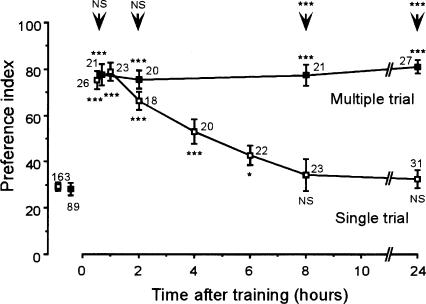
Figure 1.
Figure 1.
Memory retention after single- and multiple-trial conditioning. Seven animal groups were subjected to single-trial conditioning (□) and another four groups were subjected to multiple-trial conditioning (▪). Odor preference tests were given to all animals before and at various times after conditioning. Preference indexes (PIs) for rewarded odor are shown as means ± SE. To simplify the figure, the PIs before conditioning are shown as pooled data from seven single-trial or four multiple-trial groups. Statistical comparisons of odor preferences were made before and after conditioning for each group (WCX test) and between single- and multiple-trial groups at each time after conditioning (M-W test), and the results are shown at each data point and above the arrow, respectively. (*) P < 0.05; (**) P < 0.01; (***) P < 0.001; (NS) P > 0.05). The number of animals is shown at each data point. The preferences for rewarded odor remained unchanged from 30 min to 24 h after conditioning in the multiple-trial group (P > 0.05, M-W test).
Figure 2.
Figure 2.
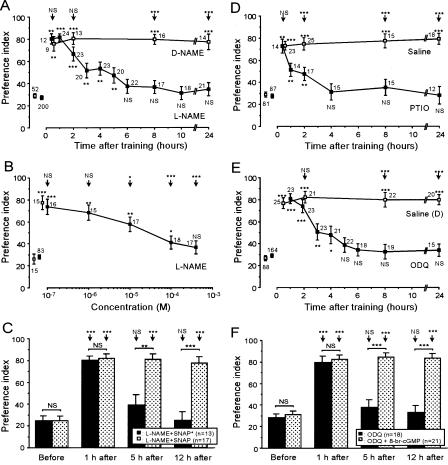
Effects of inhibitors of components of the NO-cGMP pathway on LTM formation. At 20 min prior to multiple-trial conditioning, animals were each injected with 3 μL of saline or saline containing various drugs. The preference indexes (PIs) before and at 8 h (B) or at various times after conditioning (A,C-F) are shown as means ± SE. In A, animals in 10 experimental groups were each injected with L-NAME (400 μM) (▪) and animals in another four control groups were each injected with D-NAME (400 μM) (□). In B, animals in five groups were each injected with 0.1-400 μM L-NAME, and animals in a control group were each injected with saline. In C, animals in one group were each injected with L-NAME (400 μM) and SNAP (200 μM) (shaded bars) and animals in another group were each injected with L-NAME (400 μM) and degassed SNAP (200 μM) (black bars). Odor preferences of these animals were tested before and at 1, 5, and 12 h after conditioning. In D, animals in six groups were each injected with PTIO (10 μM) (black squares) and animals in another four control groups were injected with saline (open squares). In E, animals in eight groups were each injected with ODQ (200 μM) dissolved in saline containing 0.1% DMSO (▪), and animals in another four control groups were each injected with saline containing 0.1% DMSO (saline (D) group, □). In F, animals in one group were each injected with ODQ (200 μM) and 8-br-cGMP (200 μM) (shaded bars) and animals in another one group were each injected with ODQ (200 μM) (black bars). Odor preference tests were done on animals in these groups before and at 1, 5, and 12 hours after conditioning. In A, B, D, and E, the PIs before conditioning are shown as pooled data from all experimental or control groups. Odor preferences were compared before and after conditioning for each group (WCX test) and between experimental and control groups at each time after conditioning (M-W test), and the results are shown at each data point and above the arrow, respectively. (*) P < 0.05; (**) P < 0.01; (***) P < 0.001; (NS) P > 0.05. The number of animals tested is shown at each data point. In A, D, and E, the preferences for rewarded odor remained unchanged from 30 min to 24 h after conditioning in the control groups (P > 0.05, M-W test). The preferences for rewarded odor of the L-NAME+SNAP group (C) and the ODQ+8-br-cGMP group (F) at 12 h after conditioning did not significantly differ from those of the D-NAME group (A) and the saline (D) group (E) at 8 or 24 h after conditioning, respectively (P > 0.05, M-W test).
Figure 3.
Figure 3.
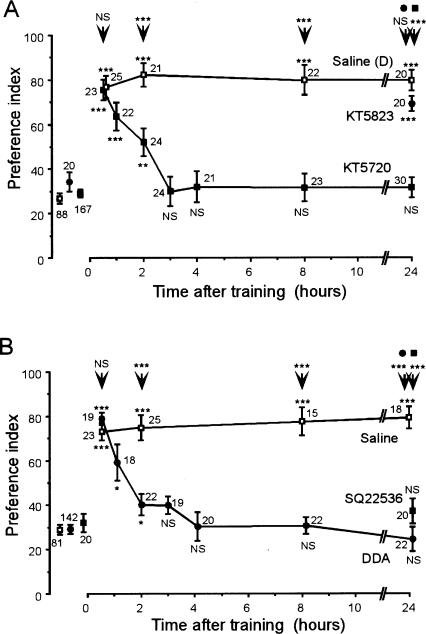
Effects of the PKG inhibitor KT5823, the PKA inhibitor KT5720, and the adenylyl cyclase inhibitor DDA or SQ22536 on LTM formation. At 20 min prior to multiple-trial conditioning, animals were injected with 3 μL of saline containing drugs. In A, animals in seven groups were each injected with KT5720 (200 μM) (▪) and animals in another group were each injected with KT5823 (1 mM) (•). These drugs were dissolved in saline containing 0.1% DMSO, and animals in another four control groups were each injected with saline containing 0.1% DMSO (□). In B, animals in seven groups were each injected with DDA (1 mM) (•), animals in one group were injected with SQ22536 (1 mM) (▪) and animals in another four groups were each injected with saline (□). Odor preferences tests were done before and at various times after conditioning. Preference indexes (PIs) are shown as means ± SE. The PIs before conditioning for KT5720, DDA, and saline-injected groups are shown as pooled data from all groups. Odor preferences were compared before and after conditioning (WCX test) and between experimental and control groups (M-W test), and the results are shown at each data point and above the arrow, respectively. (*) P < 0.05; (**) P < 0.01; (***) P < 0.001; (NS) P > 0.05, WCX-test. The number of animals tested is shown at each data point.
Figure 4.
Figure 4.
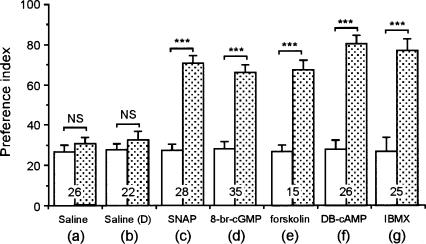
Effects of SNAP, 8-br-cGMP, forskolin, DB-cAMP, and IBMX on LTM formation. At 20 min prior to single-trial conditioning, animals in two groups were each injected with 3 μL of saline (a) or saline containing 0.1% DMSO (b), and animals in another five groups were each injected with 3 μL of saline containing SNAP (200 μM) (c), 8-br-cGMP (200 μM) (d), forskolin (200 μM) (e), DB-cAMP (200 μM) (f), or IBMX (200 μM) and 0.1% DMSO (g). The PIs were measured before conditioning (white bars) and 24 h after conditioning (shaded bars) and are shown as means ± SE., and the results of statistical comparison between them are indicated. (***) P < 0.001, (NS) P > 0.05, WCX test. The number of animals tested is shown at each data point. The odor preferences at 24 h after conditioning of the groups shown in c-g did not significantly differ among each other (P > 0.05, K-W test).
Figure 5.
Figure 5.
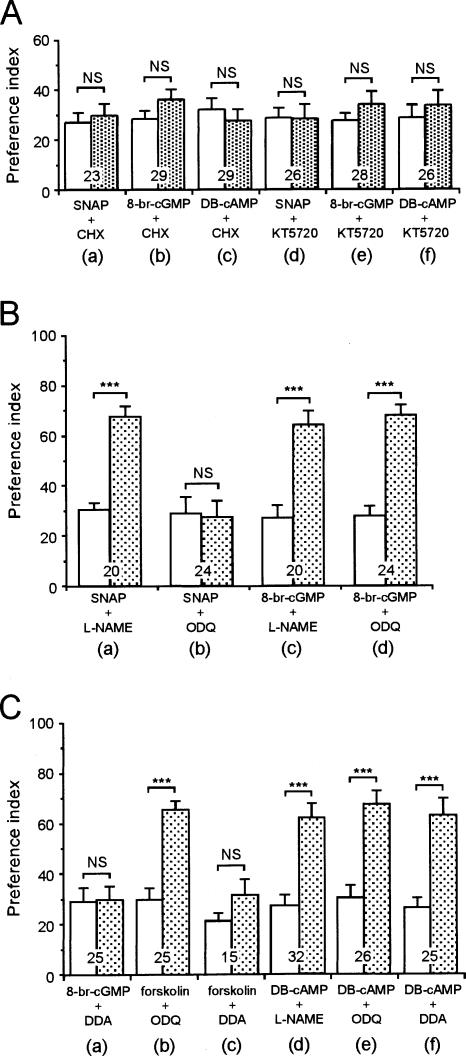
Effects of various drugs on induction of LTM by an NO donor, cGMP analog, forskolin, or cAMP analog paired with single-trial conditioning. At 20 min prior to single-trial conditioning, animals were injected with 3 μL of saline containing various drugs. In A, animals in six groups were each coinjected with SNAP (200 μM) and cycloheximide (CHX, 10 mM) (a), 8-br-cGMP (200 μM) and CHX (10 mM) (b), DB-cAMP (200 μM) and CHX (10 mM) (c), SNAP (200 μM) and KT5720 (200 μM) (d), 8-br-cGMP (200 μM) and KT5720 (200 μM) (e), or DB-cAMP (200 μM) and KT5720 (200 μM) (f). In B, animals in four groups were each coinjected with SNAP (200 μM) and L-NAME (400 μM) (a), SNAP (200 μM) and ODQ (200 μM) (b), 8-br-cGMP (200 μM) and L-NAME (400 μM) (c), or 8-br-cGMP (200 μM) and ODQ (200 μM) (d). In C, animals in six groups were each coinjected with 8-br-cGMP (200 μM) and DDA (1 mM) (a), forskolin (200 μM) and ODQ (200 μM) (b), forskolin (200 μM) and DDA (1 mM) (c), DB-cAMP (200 μM) and L-NAME (400 μM) (d), DB-cAMP (200 μM) and ODQ (200 μM) (e), or DB-cAMP (200 μM) and DDA (1 mM) (f). The PIs measured before (white bars) and 24 h after conditioning (shaded bars) are shown as means ± SE. The results of statistical comparison before and 24 h after conditioning are shown. (***) P < 0.001, (NS) P > 0.05, WCX test. The number of animals tested is shown at each data point. The odor preferences at 24 h after conditioning of the groups shown in a, c, and d in B and b, d, e, and f in C did not significantly differ among each other (P > 0.5, K-W test).
Figure 6.
Figure 6.
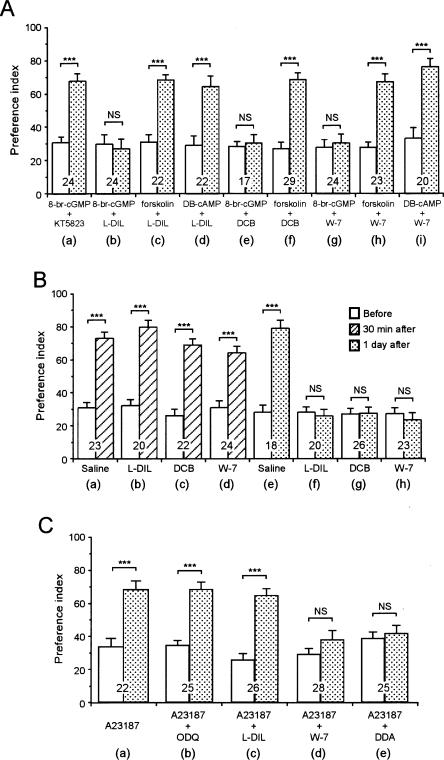
Investigation of the biochemical pathway intervening the NO-cGMP pathway and adenylyl cyclase-cAMP-PKA pathway. In A, animals in nine groups were each coinjected with 3 μL of saline containing 8-br-cGMP (200 μM) and KT5823 (200 μM) (a), 8-br-cGMP (200 μM) and L-DIL (1 mM) (b), forskolin (200 μM) and L-DIL (1 mM) (c), DB-cAMP (200 μM) and L-DIL (1 mM) (d), 8-br-cGMP (200 μM) and DCB (1 mM) (e), forskolin (200 μM) and DCB (1 mM) (f), 8-br-cGMP (200 μM) and W-7 (200 μM) (g), forskolin (200 μM) and W-7 (200 μM) (h), or DB-cAMP (200 μM) and W-7 (200 μM) (i) before single-trial conditioning. The PIs before (white bars) and at 24 h after conditioning (shaded bars) are shown as means ± SE. In B, animals in two groups were each injected with 3 μL saline (a,e) and animals in another six groups were each injected with 3 μL saline containing L-DIL (1 mM) (b,f), DCB (1 mM) (c,g), or W-7 (200 μM) (d,h) before multiple-trial conditioning. PIs were measured before (white bars) and at 30 min (hatched bars) or 1 d (shaded bars) after conditioning and are shown as mean ± SE. In C, animals in five groups were each injected with 3 μL saline containing A23187 (200 μM) (a), A23187 (200 μM) and ODQ (200 μM) (b), A23187 (200 μM) and L-DIL (1 mM) (c), A23187 (200 μM) and W7 (200 μM) (d), or A23187 (200 μM) and DDA (1 mM) (e). The PIs measured before (white bars) and 24 h (shaded bars) after conditioning are shown as means ± SE. The results of statistical comparison before and 24 h after conditioning are shown. (***) P < 0.001, (NS) P > 0.05, WCX test. The number of animals tested is shown at each data point. The odor preferences at 24 h after conditioning of the groups shown in a, c, d, f, h, and i in A and a,b,c in C did not significantly differ among each other (P > 0.05, K-W test).
Figure 7.
Figure 7.
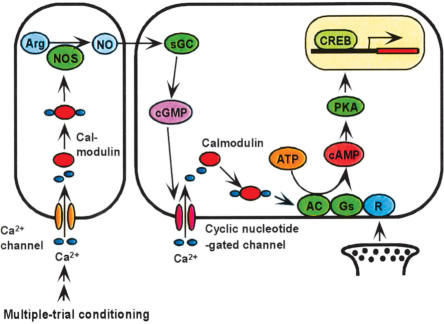
A model of biochemical pathways for LTM formation in associative olfactory conditioning. The model is proposed on the basis of the present findings in crickets and some documented findings in fruitflies (see text). Multiple-trial conditioning activates the NO-cGMP pathway, and this in turn activates the adenylyl cyclase (AC)-cAMP-PKA-CREB (cAMP-responsive element-binding protein) signaling pathway via the CNG channel and calcium-calmodulin, resulting in protein synthesis-dependent LTM formation. (CAM) Calmodulin; (Arg) arginine; (Gs) receptor; (R)-coupled G-protein.

References

    1. Abel, T., Nguyen, P.V., Barad, M., Deuel, T.A.S., and Kandel, E.R. 1997. Genetic demonstration of a role for PKA in the late phase of LTP and in hippocampus-based long-term memory. Cell 88: 615-626. - PubMed
    1. Aonuma, H. and Newland, P.L. 2001. Opposing actions of nitric oxide on synaptic inputs of identified interneurones in the central nervous system of the crayfish. J. Exp. Biol. 204: 1319-1332. - PubMed
    1. ____. 2002. Synaptic inputs onto spiking local interneurons in crayfish are depressed by nitric oxide. J. Neurobiol. 52: 144-155. - PubMed
    1. Aonuma, H. and Niwa, K. 2004. Nitric oxide regulates the levels of cGMP accumulation in the cricket brain. Acta Biol. Hung. 55: 65-70. - PubMed
    1. Bartsch, D., Gjorardo, M., Skehel, P.A., Karl, K.A., Herder, S.P., Chen, M., Bailey, C.H., and Kandel, E.R. 1995. Aplysia CREB2 represses long-term facilitation: Relief of repression converts transient facilitation into long-term functional and structural change. Cell 83: 979-992. - PubMed

Publication types

LinkOut - more resources