Evaluation of gait kinetics in puppies with coxofemoral joint laxity
- PMID: 16454627
- PMCID: PMC2094731
- DOI: 10.2460/ajvr.67.2.236
Evaluation of gait kinetics in puppies with coxofemoral joint laxity
Abstract
Objective: To characterize ground reaction forces (GRFs) and determine whether there were correlations between forces and passive coxofemoral joint laxity in puppies.
Animals: Fifty-one 16-week-old hound-breed dogs.
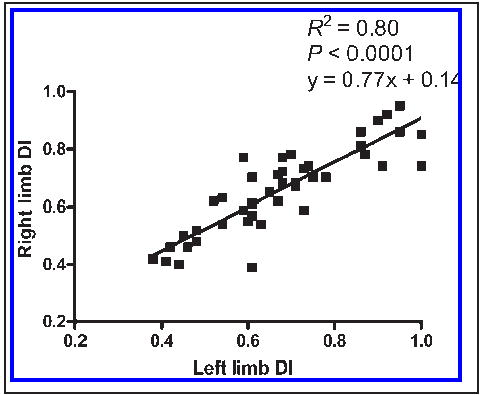
Procedure: Force-plate gait evaluation and distraction radiographic imaging were performed. Ground reaction forces evaluated included x (mediolateral), y (craniocaudal breaking and propulsion), and z (vertical) peak force and impulse. Z-plane limb loading and unloading rates, loading interval, and weight distribution and y-plane stance time breaking and propulsion percentages were calculated. One-way ANOVA with the Duncan multiple range test was used to evaluate differences in gait variables among limbs. The relationships of left, right, highest, and mean distraction index (DI) with individual limb data of each dog were evaluated with the Spearman rank correlation. Left and right DIs were compared by means of linear regression analysis.
Results: Mean +/- SEM DI was 0.67 +/- 0.02. Left and right DIs were strongly correlated, but there were no significant relationships between DIs and gait variables. Most fore- and hind limb gait variables differed significantly, whereas paired fore- and hind limb gait variables did not. Asymmetry was most pronounced in the x- and y-planes.
Conclusions and clinical relevance: GRFs were consistent with those of clinically normal mature dogs, supporting an absence of association between GRF and DI in young dogs. The GRFs and elucidation of the relationship between GRFs and DI may be useful for future studies in immature dogs.
Figures
References
-
- Pedersen EN, Simonsen EB, Alkjaer T, et al. Walking pattern in adults with congenital hip dysplasia: 14 women examined by inverse dynamics. Acta Orthop Scand. 2004;75:2–9. - PubMed
-
- Endo H, Mitani S, Senda M, et al. Three-dimensional gait analysis of adults with hip dysplasia after rotational acetabular osteotomy. J Orthop Sci. 2003;8:762–771. - PubMed
-
- Powers MY, Biery DN, Lawler DE, et al. Use of the caudolateral curvilinear osteophyte as an early marker for future development of osteoarthritis associated with hip dysplasia in dogs. J Am Vet Med Assoc. 2004;225:233–237. - PubMed
-
- Smith GK. Advances in diagnosing canine hip dysplasia. J Am Vet Med Assoc. 1997;210:1451–1457. - PubMed
-
- Novacheck TF. Developmental dysplasia of the hip. Pediatr Clin North Am. 1996;43:829–848. - PubMed
Publication types
MeSH terms
Grants and funding
LinkOut - more resources
Full Text Sources