Use of an adaptation of a commercially available PCR assay aimed at diagnosis of chlamydia and gonorrhea to detect Trichomonas vaginalis in urogenital specimens
- PMID: 16455885
- PMCID: PMC1392661
- DOI: 10.1128/JCM.44.2.366-373.2006
Use of an adaptation of a commercially available PCR assay aimed at diagnosis of chlamydia and gonorrhea to detect Trichomonas vaginalis in urogenital specimens
Abstract
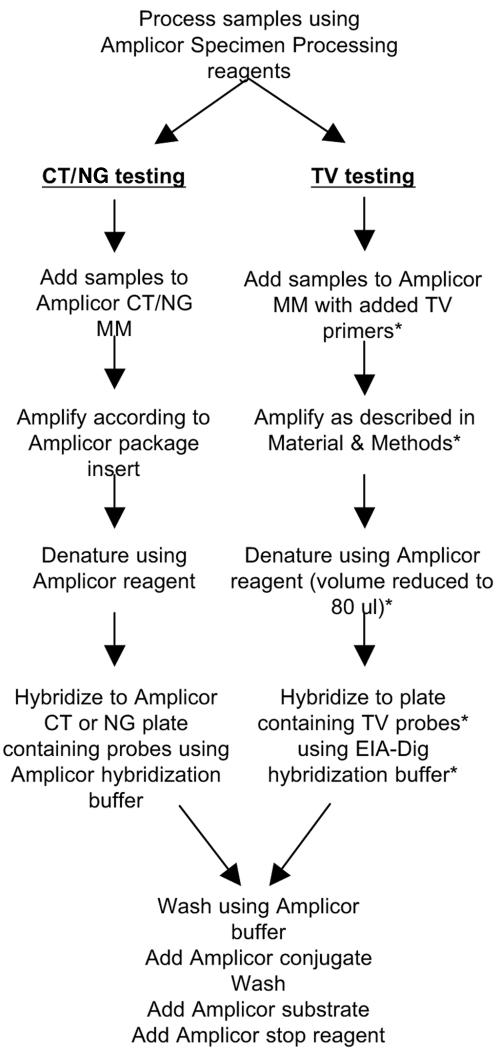
Trichomonas vaginalis PCR using reagents from a commercially available assay for Chlamydia trachomatis and Neisseria gonorrhoeae was evaluated for detection of infection in women and men attending a sexually transmitted disease clinic. Evaluations included three primer sets, endocervical swabs, vaginal swabs and urine, and various storage conditions. The TVK3/TVK7 primer set was optimal in our hands with sensitivities ranging from 69.5 to 96.8%. In all comparisons, T. vaginalis PCR performed better than routine diagnostics using microscopy for women and culture for men (P > 0.05). The assay performed well for all sample types tested, and vaginal swabs were stable for up to 7 days at ambient temperature. Using samples prepared for, and reagents from, the C. trachomatis-N. gonorrhoeae PCR assay allowed incorporation of T. vaginalis PCR diagnosis into routine clinical testing.
Figures
References
-
- Buvé, A., H. A. Weiss, M. Laga, E. Van Dyck, R. Musonda, I. Zekeng, M. Kahindo, S. Anagonou, L. Morison, N. J. Robinson, and R. J. Hayes for the Study Group on Heterogeneity of HIV Epidemics in African Cities. 2001. The epidemiology of trichomoniasis in women in four African cities. AIDS 15:S89-S96. - PubMed
-
- Chesson, H. W., J. M. Blandford, and S. D. Pinkerton. 2004. Estimates of the annual number and cost of new HIV infections among women attributable to trichomoniasis in the United States. Sex. Transm. Dis. 31:547-551. - PubMed
-
- Cotch, M. F., J. G. Pastorek, R. P. Nugent, S. L. Hillier, R. S. Gibbs, D. H. Martin, D. A. Eschenbach, R. Edelman, J. C. Carey, J. A. Regan, M. A. Krohn, M. A. Klebanoff, A. V. Rao, G. G. Rhoads, et al. 1997. Trichomonas vaginalis associated with low birth weight and preterm delivery. Sex. Transm. Dis. 24:353-360. - PubMed
-
- Gram, I. T., M. Macaluso, J. Churchill, and H. Stalsberg. 1992. Trichomonas vaginalis (TV) and human papillomavirus (HPV) infection and the incidence of cervical intraepithelial neoplasia (CIN) grade III. Cancer Causes Control 3:231-236. - PubMed
Publication types
MeSH terms
Substances
LinkOut - more resources
Full Text Sources
Other Literature Sources
Medical