


doi: 10.1128/JCM.44.2.589-591.2006.
Identification of Cpgp40/15 Type Ib as the predominant allele in isolates of Cryptosporidium spp. from a waterborne outbreak of gastroenteritis in South Burgundy, France
Affiliations
- PMID: 16455918
- PMCID: PMC1392645
- DOI: 10.1128/JCM.44.2.589-591.2006
Item in Clipboard
Identification of Cpgp40/15 Type Ib as the predominant allele in isolates of Cryptosporidium spp. from a waterborne outbreak of gastroenteritis in South Burgundy, France
J Clin Microbiol.
2006 Feb.
Abstract
Cryptosporidium sp. isolates from a waterborne outbreak of diarrhea in France were analyzed by PCR-restriction fragment length polymorphism analysis and sequencing of the Cpgp40/15 locus. Ninety-one percent of the isolates were Cryptosporidium hominis type Ib. The results of this study and those of studies of other outbreaks suggest that the type Ib allele is the predominant allele associated with waterborne cryptosporidiosis.
Figures
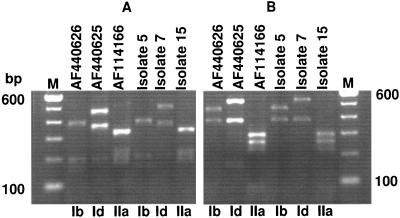
PCR-RFLP analysis of the Cpgp40/15 locus from representative isolates. (A) Secondary PCR amplicons digested with RsaI; (B) secondary PCR amplicons digested with AluI. The first three lanes of both panels show the RFLP profiles for known subgenotype Ib, Id, and IIa Cpgp40/15 sequences previously deposited in GenBank (GenBank accession numbers AF440626, AF440625, and AF114166, respectively), while the last three lanes in each panel show the PCR-RFLP profiles from isolates 5 (a representative type Ib isolate), 7, and 15, respectively. Lane M, markers. Following RsaI digestion, the expected sizes of the PCR products, based on the known sequences of isolates with GenBank accession numbers AF440626 (type Ib), AF440625 (type Id), and AF114166 (type IIa), were 387, 200, 195, 159, and 35 bp for the Ib subtype; 483, 367, 200, and 30 bp for the Id subtype; and 329, 207, 195, 177, and 35 bp for the IIa subtype. Following AluI digestion, the expected sizes of the PCR products were 457, 380, 85, and 56 bp for the Ib subtype; 520, 385, and 175 bp for the Id subtype; and 294, 258, 214, 81, 60, and 36 bp for the IIa subtype.
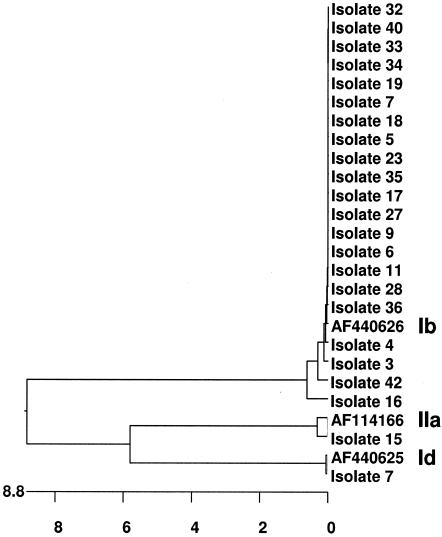
Genetic relationship among isolates from the outbreak. The Cpgp40/15 nucleotide sequences from the type Ib, Id, and IIa isolates from the outbreak were aligned with each other and with known Cpgp40/15 subgenotype sequences previously deposited in GenBank (GenBank accession numbers AF440626, AF440625, and AF114166, respectively) by using the Clustal W algorithm in the MegAlign 6.2 program from the Lasergene suite 6.0 of DNASTAR Inc. A phylogenetic tree was constructed from the alignment by using the neighbor-joining algorithm in the MegAlign 6.2 program. The nucleotide substitutions are in hundreds.
References
-
- Dalle, F., P. Roz, G. Dautin, M. Di-Palma, E. Kohli, C. Sire-Bidault, M. G. Fleischmann, A. Gallay, S. Carbonel, F. Bon, C. Tillier, P. Beaudeau, and A. Bonnin. 2003. Molecular characterization of isolates of waterborne Cryptosporidium spp. collected during an outbreak of gastroenteritis in South Burgundy, France. J. Clin. Microbiol. 41:2690-2693. - PMC - PubMed
-
- Leav, B. A., M. Mackay, and H. D. Ward. 2003. Cryptosporidium species: new insights and old challenges. Clin. Infect. Dis. 36:903-908. - PubMed
Publication types
MeSH terms
Substances
Associated data
- Actions
- Actions
- Actions
- Actions
- Actions
- Actions
- Actions
- Actions
- Actions
- Actions
- Actions
- Actions
- Actions
- Actions
- Actions
- Actions
- Actions
- Actions
- Actions
- Actions
- Actions
- Actions
- Actions
Grants and funding
LinkOut - more resources
Full Text Sources
Medical
Miscellaneous
