. 2006 Feb;72(2):1258-66.
doi: 10.1128/AEM.72.2.1258-1266.2006.

Root-associated bacteria contribute to mineral weathering and to mineral nutrition in trees: a budgeting analysis

Affiliations

Root-associated bacteria contribute to mineral weathering and to mineral nutrition in trees: a budgeting analysis

Christophe Calvaruso et al. Appl Environ Microbiol. 2006 Feb.

Abstract

The principal nutrient source for forest trees derives from the weathering of soil minerals which results from water circulation and from plant and microbial activity. The main objectives of this work were to quantify the respective effects of plant- and root-associated bacteria on mineral weathering and their consequences on tree seedling growth and nutrition. That is why we carried out two column experiments with a quartz-biotite substrate. The columns were planted with or without pine seedlings and inoculated or not with three ectomycorrhizosphere bacterial strains to quantify biotite weathering and pine growth and to determine how bacteria improve pine growth. We showed that the pine roots significantly increased biotite weathering by a factor of 1.3 for magnesium and 1.7 for potassium. We also demonstrated that the inoculation of Burkholderia glathei PML1(12) significantly increased biotite weathering by a factor of 1.4 for magnesium and 1.5 for potassium in comparison with the pine alone. In addition, we observed a significant positive effect of B. glathei PMB1(7) and PML1(12) on pine growth and on root morphology (number of lateral roots and root hairs). We demonstrated that PML1(12) improved pine growth when the seedlings were supplied with a nutrient solution which did not contain the nutrients present in the biotite. No improvement of pine growth was observed when the seedlings were supplied with all the nutrients necessary for pine growth. We therefore propose that the growth-promoting effect of B. glathei PML1(12) mainly resulted from the improved plant nutrition via increased mineral weathering.


Figures
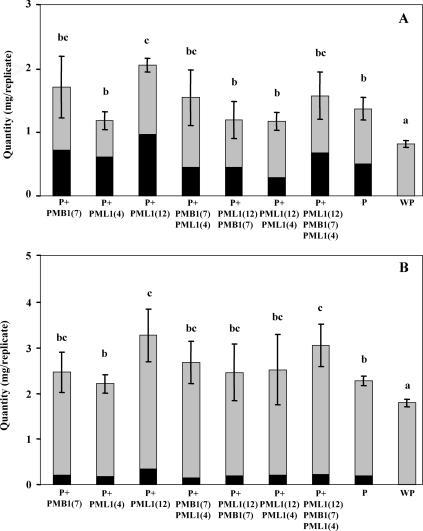
FIG. 1.
FIG. 1.
Mass balance of potassium (A) and magnesium (B) released into leaching solution (gray) and taken up by plants (black). Each plot is a mean value of results for four replicates. Bars represent standard deviations referring to the values of the weathering budget. For each variable (sum of potassium or magnesium quantities released into leachates and taken up by plants), treatments associated with the same letter are not significantly different according to a one-factor (plant and bacterial treatment) ANOVA (P = 0.05) and the Bonferroni-Dunn test.
FIG. 2.
FIG. 2.
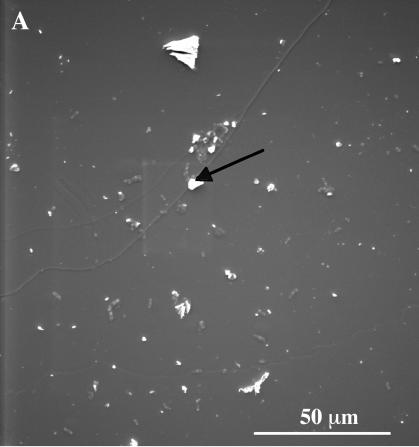
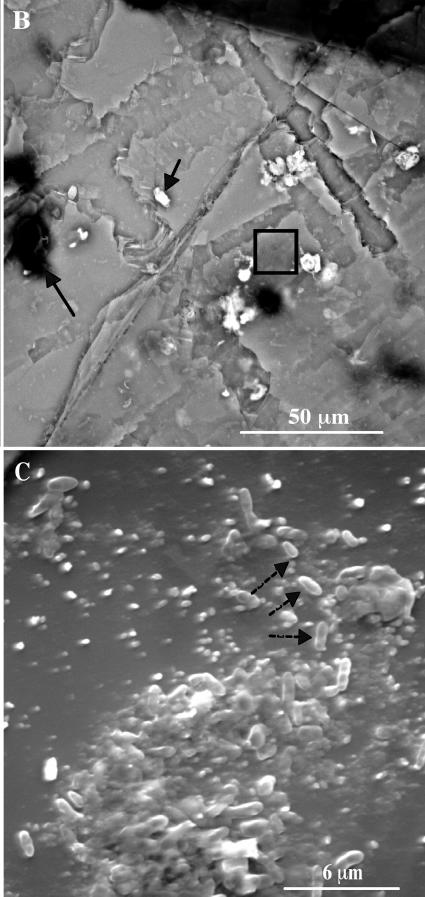
SEM photography of biotite surfaces without plant and bacteria (A) and with plant inoculated with the bacterial strain PML1(12) (B and C). The white and black areas presented with a black arrow correspond, respectively, to iron precipitates and carbon deposits. Panel C corresponds to an enlargement of the square region in panel B. The dotted arrows point to bacteria on the biotite surface.
FIG. 2.
FIG. 2.
SEM photography of biotite surfaces without plant and bacteria (A) and with plant inoculated with the bacterial strain PML1(12) (B and C). The white and black areas presented with a black arrow correspond, respectively, to iron precipitates and carbon deposits. Panel C corresponds to an enlargement of the square region in panel B. The dotted arrows point to bacteria on the biotite surface.
FIG. 3.
FIG. 3.
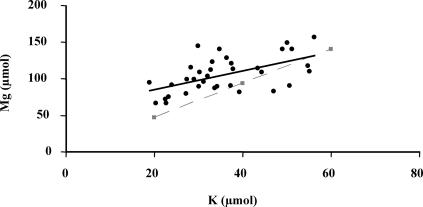
Relation between the magnesium and potassium quantities leached into the solution and taken up by plants, i.e., mobilized in the biotite. The black linear regression curve (y = 1.29x + 59.10; R2 = 0.321) was obtained with the experimental data set. This regression is significant at a P value of <0.001. The dotted curve represents the Mg/K stoichiometry in the Bancroft biotite, which refers to a congruent dissolution process. The area under the dotted curve corresponds to the transformation domain of the biotite into vermiculite.
FIG. 4.
FIG. 4.
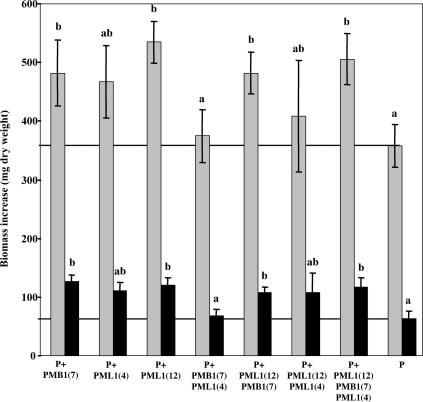
Increase of the root (black) and total plant (gray) biomass during the 76 days of the growth chamber experiment in the different treatments. Each plot is a mean value of results from four replicates. Bars represent standard deviations. For each variable (total plant growth or root growth), treatments associated with the same letter are not significantly different according to a one-factor (bacterial treatment) ANOVA (P = 0.05) and the Bonferroni-Dunn test.
FIG. 5.
FIG. 5.
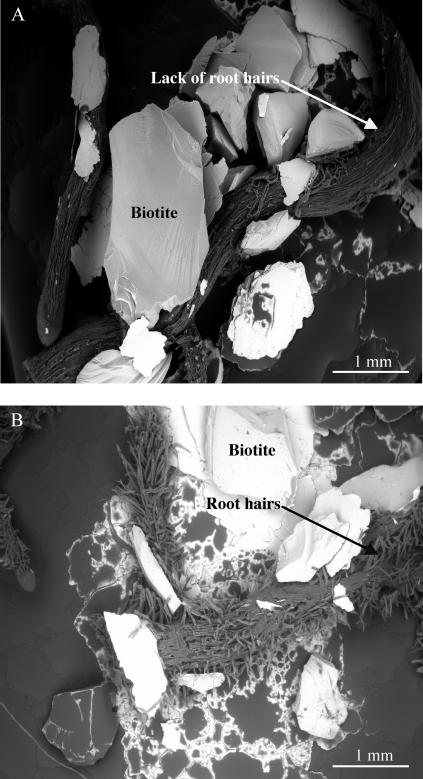
Low-vacuum SEM photography of a noninoculated root (A) and a root inoculated with the bacterial strain PML1(12), which presents many root hairs (B).
FIG. 6.
FIG. 6.
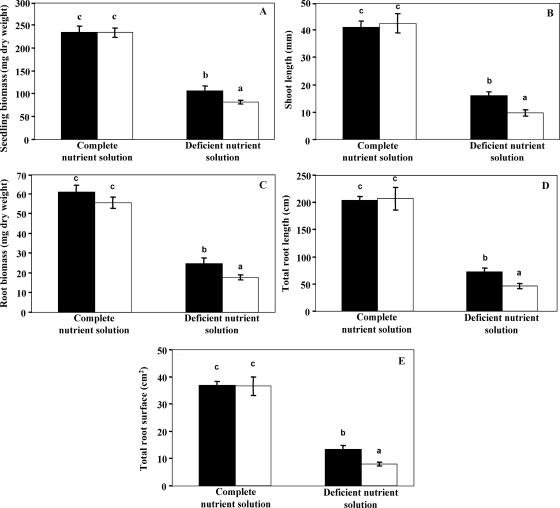
Growth of the plants during the 102 days of the greenhouse experiment in the different treatments. (A) Total seedling biomass; (B) shoot length measured above cotyledons; (C) root biomass; (D) total the root length; (E) total root surface area. Black plots correspond to plants inoculated with the bacterial strain PML1(12), and white ones correspond to noninoculated plants. Each plot is a mean value of results from 10 replicates. Bars represent standard deviations. For each variable, treatments associated with the same letter are not significantly different according to a one-factor (bacterial treatment) ANOVA (P = 0.05) and the Bonferroni-Dunn test.

References

    1. Altschul, S. F., T. L. Madden, A. A. Schaffer, J. Zhang, Z. Zhang, W. Miller, and D. J. Lipman. 1997. Gapped BLAST and PSI-BLAST: a new generation of protein database search programs. Nucleic Acids Res. 25:3389-3402. - PMC - PubMed
    1. Augusto, L., J. Ranger, M. P. Turpault, and P. Bonnaud. 2001. Experimental in situ transformation of vermiculite to study the weathering impact of the tree species on the soil. Eur. J. Soil Sci. 52:81-92.
    1. Badeau, V., E. Dambrine, and C. Walter. 1999. Propriétés des sols forestiers français: résultats du premier inventaire systématique. Etude Gest. Sols 6:165-180.
    1. Bakker, M. R., E. George, M. P. Turpault, J. Zhang, and B. Zeller. 2004. Impact of Douglas-fir and Scots pine seedlings on plagioclase weathering under acidic conditions. Plant Soil 266:247-259.
    1. Barber, S. A. 1995. Soil nutrient bioavailability: a mechanistic approach, 2nd ed. J. B. Wiley & Sons, New York, N.Y.

Publication types