. 2006 Feb 14;103(7):2310-5.
doi: 10.1073/pnas.0510727103. Epub 2006 Feb 6.

Production of infectious genotype 1a hepatitis C virus (Hutchinson strain) in cultured human hepatoma cells

Affiliations

Production of infectious genotype 1a hepatitis C virus (Hutchinson strain) in cultured human hepatoma cells

MinKyung Yi et al. Proc Natl Acad Sci U S A. .

Abstract

Infections with hepatitis C virus (HCV) are marked by frequent viral persistence, chronic liver disease, and extraordinary viral genetic diversity. Although much has been learned about HCV since its discovery, progress has been slowed by a lack of permissive cell culture systems supporting its replication. Productive infections have been achieved recently with genotype 2a virus, but cirrhosis and liver cancer are typically associated with genotype 1 HCV, which is more prevalent and relatively resistant to IFN therapy. We describe production of infectious genotype 1a HCV in cells transfected with synthetic RNA derived from a prototype virus (H77-S). Viral proteins accumulated more slowly in H77-S transfected cells than in cells transfected with genotype 2a (JFH-1) RNA, but substantially more H77-S RNA was secreted into supernatant fluids. Most secreted RNA was noninfectious, banding in isopycnic gradients at a density of 1.04-1.07 gm/cm(3), but infectivity was associated with H77-S particles possessing a density of 1.13-1.14 gm/cm(3). The specific infectivity of H77-S particles (5.4 x 10(4) RNA copies per focus-forming unit) was significantly lower than JFH-1 virus (1.4 x 10(2) RNA copies per focus-forming unit). Infection with either virus was blocked by CD81 antibody. Sera from genotype 1a-infected individuals neutralized H77-S virus, but had little activity against genotype 2a virus, suggesting that these genotypes represent different serotypes. The ability of this genotype 1a virus to infect cultured cells will substantially benefit antiviral and vaccine discovery programs.


Conflict of interest statement

Conflict of interest statement: No conflicts declared.

Figures
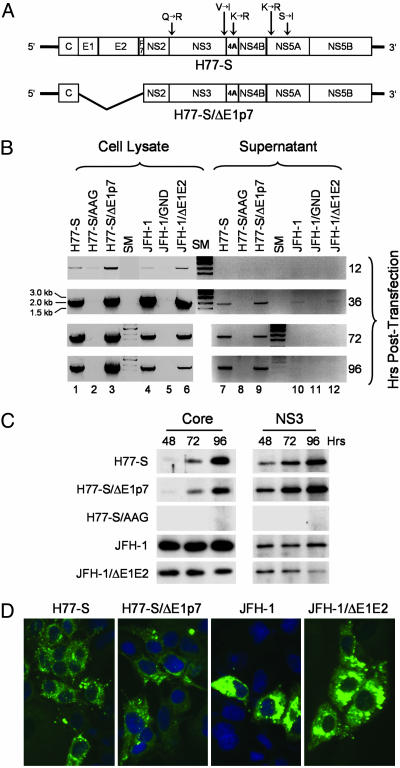
Fig. 1.
Fig. 1.
Replication of H77-S and JFH-1 RNAs in transfected Huh-7.5 cells. (A) Organization of the H77-S genomic RNA, showing location of the five adaptive mutations and the H77-S∕ΔE1p7 mutant in which sequence encoding the structural proteins was deleted. (B) Semiquantitative RT-PCR assays for HCV RNA in lysates (Left) and supernatant fluids (Right) of transfected Huh-7.5 cells. (C) Immunoblot detection of the HCV core and NS3 proteins in transfected Huh-7.5 cells. (D) Core antigen detected by indirect immunofluorescence 96 h after transfection of Huh-7.5 cells with the indicated RNA.
Fig. 2.
Fig. 2.
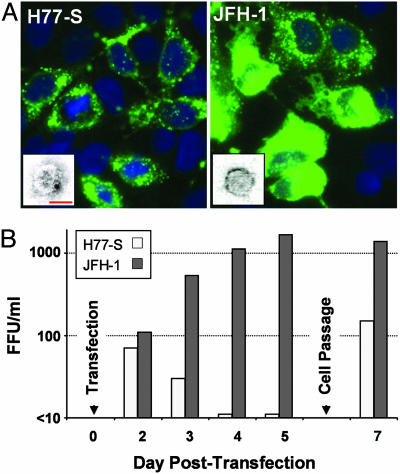
Infection of Huh-7.5 cells with H77-S and JFH-1 virus released into supernatant fluids of transfected Huh-7.5 cells. (A) HCV core antigen expression in cells infected with H77-S (Left) or JFH-1 (Right) virus. Left Inset shows a particle with immunogold labeling indicating recognition by the AP33 mAb to E2. (Bar: 50 nm.) Right Inset shows a typical JFH-1 particle for comparison. (See also Fig. 5.) (B) Time course of infectious H77-S (open bars) and JFH-1 (filled bars) virus released into supernatant fluids of RNA-transfected Huh-7.5 cells. H77-S release was greatest 24–48 h after transfection or passage of cells.
Fig. 3.
Fig. 3.
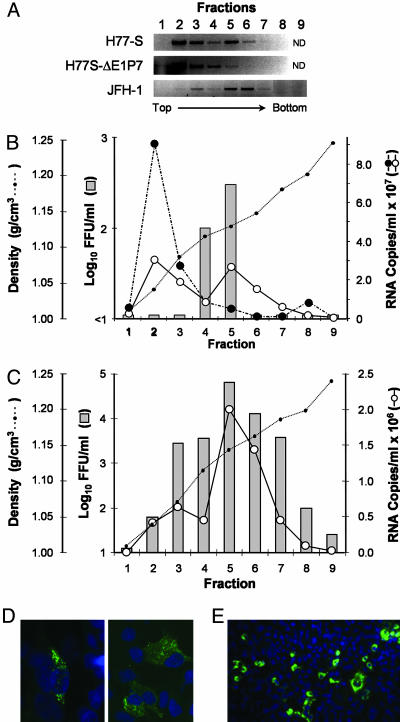
Equilibrium ultracentrifugation of H77-S and JFH-1 particles in isopycnic iodixanol gradients. (A) Semiquantitative RT-PCR detection of HCV RNA in fractions of gradients loaded with concentrated, filtered (0.2 μm) supernatant fluids from cells transfected with the indicated RNAs. (B) Results of infectivity assays (bars) and quantitative TaqMan RT-PCR assays in fractions from gradients loaded with concentrated supernatant fluids from cells transfected with H77-S (solid line with open circles) or H77-S∕ΔE1p7 (dashed line with filled circles) RNA. H77-S∕ΔE1p7 supernatant fluids contained no infectious virus. (C) Results of similar assays using fractions from gradients loaded with concentrated JFH-1 supernatant fluids. (D and E) HCV core antigen detected by indirect immunofluorescence in cells inoculated with fraction 5 of gradients loaded with H77-S (D) or JFH-1 (E) material (lower magnification).
Fig. 4.
Fig. 4.
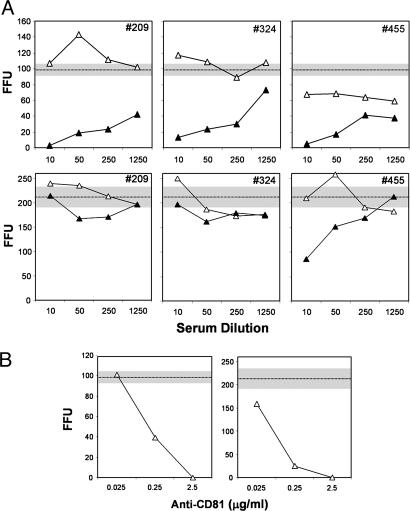
Neutralization of cell culture-produced virus infectivity by antibody to HCV or CD81. (A) Neutralization of H77-S (Upper) and JFH-1 (Lower) viruses by paired preinfection (▵) or after seroconversion (▴) sera from three individuals sustaining infection with genotype 1a HCV. The horizontal lines and shaded zones indicate the mean and range of infectious foci obtained with each viral inoculum in the absence of any serum. (B) Anti-CD81 Ab, added to virus before its inoculation onto Huh-7.5 cells, prevents infection with either H77-S (Left) or JFH-1 (Right) inocula.

References

    1. Chisari F. V. Nature. 2005;436:930–932. - PubMed
    1. Zhong J., Gastaminza P., Cheng G., Kapadia S., Kato T., Burton D. R., Wieland S. F., Uprichard S. L., Wakita T., Chisari F. V. Proc. Natl. Acad. Sci. USA. 2005;102:9294–9299. - PMC - PubMed
    1. Wakita T., Pietschmann T., Kato T., Date T., Miyamoto M., Zhao Z., Murthy K., Habermann A., Krauslich H.-G., Mizokami M., et al. Nat. Med. 2005;11:791–796. - PMC - PubMed
    1. Lindenbach B. D., Evans M. J., Syder A. J., Wolk B., Tellinghuisen T. L., Liu C. C., Maruyama T., Hynes R. O., Burton D. R., McKeating J. A., et al. Science. 2005;309:623–626. - PubMed
    1. Zein N. N. Clin. Microbiol. Rev. 2000;13:223–235. - PMC - PubMed

Publication types