. 2006 Feb 22;25(4):846-56.
doi: 10.1038/sj.emboj.7600975. Epub 2006 Feb 9.

Subtelomeric proteins negatively regulate telomere elongation in budding yeast

Affiliations

Subtelomeric proteins negatively regulate telomere elongation in budding yeast

Anne-Sophie Berthiau et al. EMBO J. .

Abstract

The Tbf1 and Reb1 proteins are present in yeast subtelomeric regions. We establish in this work that they inhibit telomerase-dependent lengthening of telomere. For example, tethering the N-terminal domain of Tbf1 and Reb1 in a subtelomeric region shortens that telomere proportionally to the number of domains bound. We further identified a 90 amino-acid long sequence within the N-terminal domain of Tbf1 that is necessary but not sufficient for its length regulation properties. The role of the subtelomeric factors in telomere length regulation is antagonized by TEL1 and does not correlate with a global telomere derepression. We show that the absence of TEL1 induces an alteration in the structure of telomeric chromatin, as defined biochemically by an increased susceptibility to nucleases and a greater heterogeneity of products. We propose that the absence of TEL1 modifies the organization of the telomeres, which allows Tbf1 and Reb1 to cis-inhibit telomerase. The involvement of subtelomeric factors in telomere length regulation provides a possible mechanism for the chromosome-specific length setting observed at yeast and human telomeres.


Figures
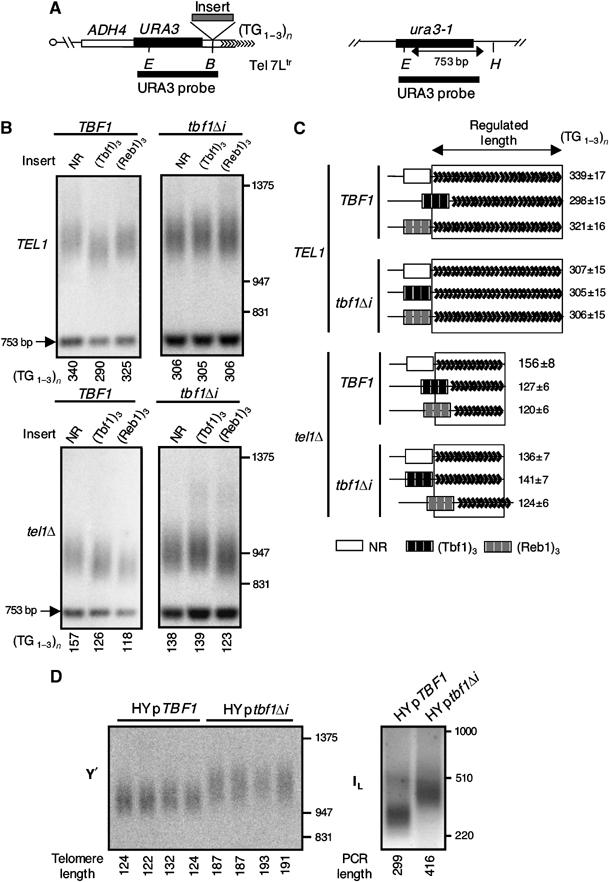
Figure 1
Figure 1
The role of Tbf1 or Reb1 in telomere length regulation. (A) Structure of Tel 7Ltr and the endogenous ura3-1 locus. B=BamHI; E=EcoRV, H=HindIII. (B) Examples of Southern blots used to measure the length of Tel 7Ltr containing either the NR control sequence, (TG1–3)23 or (T2AG3)10 insert in different genetic settings, as indicated. The genomic DNA was digested with HindIII and EcoRV and hybridized with the URA3 probe shown in panel A. The reference band of 753 bp emanates from the ura3-1 locus (see panel A) and the smear corresponds to the terminal restriction fragment that contains the distal yeast repeats. The calculated length of the distal (TG1–3)n is indicated below each lane. In order to obtain the length of the distal telomeric repeats, 800 nt was subtracted from the size of the measured terminal fragment, as shown below each lane. (C) Schematic representation of the results. The mean length corresponding to the average of at least three independent cultures is indicated on the right, together with the standard deviation. For an identical genetic setting, the part of the telomere corresponding to the distal repeats of Tel 7Ltr containing an NR control insert is boxed. As the NR sequence is not taken into account for length regulation, the boxed sequence is named the ‘regulated length'. Thus, in Tel 7Ltr containing the yeast- or vertebrate-type inserts, the part of the chromosome end that is not taken into account for length regulation appears outside the box of the ‘regulated length'. (D) XhoI Southern analysis of Y′ telomeres (left part) and PCR analysis of Tel 1L (right part) of humanized yeasts containing a plasmid copy of either TBF1 (pTBF1) or tbf1Δi (ptbf1Δi).
Figure 2
Figure 2
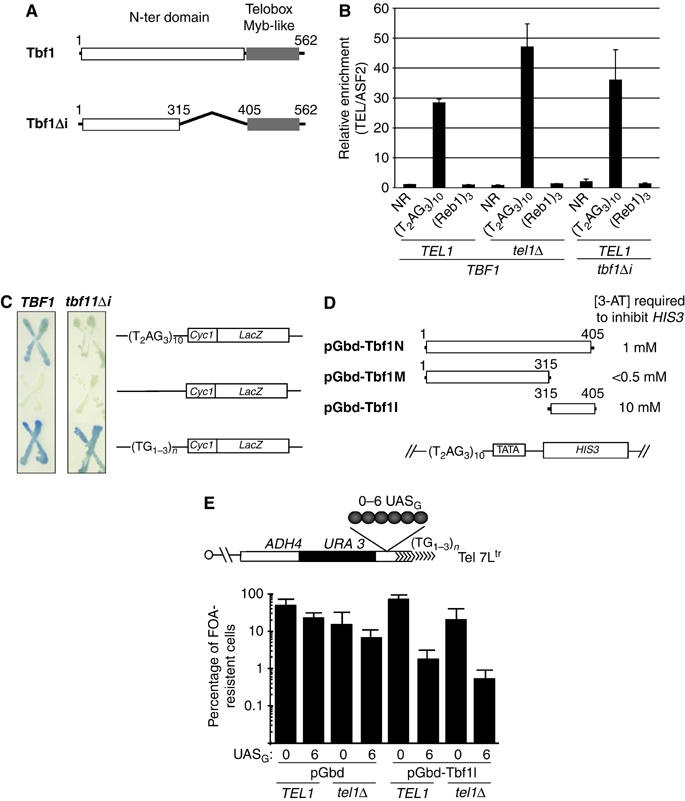
Characterization of the tbf1Δi allele. (A) Representation of Tbf1 and Tbf1Δi proteins. (B) The binding of Tbf1 was assayed by ChIP analysis followed by real-time PCR. The results are expressed as the enrichment of the immunoprecipitated Tel 7Ltr DNA to that of an ASF2 DNA (see Materials and methods). The average value for at least three experiments is shown as well as the estimated standard deviation. (C) β-Galactosidase assay performed by a X-gal coloration of patches of cells corresponding to the indicated genetic setting and containing the plasmids pSX178, pSXHuTel2 and pSXYTel carrying the CYC1-lacZ reporter construct shown on the right (see Koering et al, 2000). (D) Transactivation assays for several hybrid proteins containing different parts of TBF1. The threshold of 3-AT concentration required to inhibit the HIS3 reporter gene is indicated for each protein. (E) Antisilencing assay using the tethering of Gbd-Tbf1I between a telomere and a URA3 reporter gene. As the FOA compound is toxic for cells expressing URA, the percentage of FOA-resistant cells reflects URA3 repression.
Figure 3
Figure 3
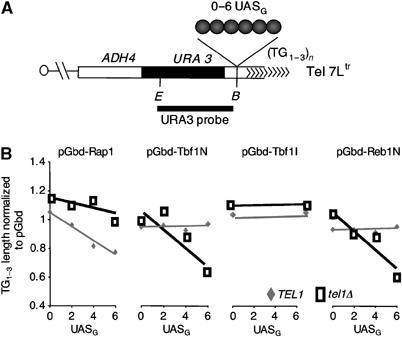
Tethering at an immediate subtelomeric location of Tbf1 and Reb1 N-terminal domains reduces telomere length. (A) Schematic representation of Tel 7Ltr and UASG sites. (B) The graphs represent, as a function of the number of UASG, the ratio of the mean length calculated from cells expressing the hybrid indicated above each graph to that from cells expressing the pGbd plasmid. The gray line represents experiments performed in TEL1 cells, and the black line, in tel1Δ cells.
Figure 4
Figure 4
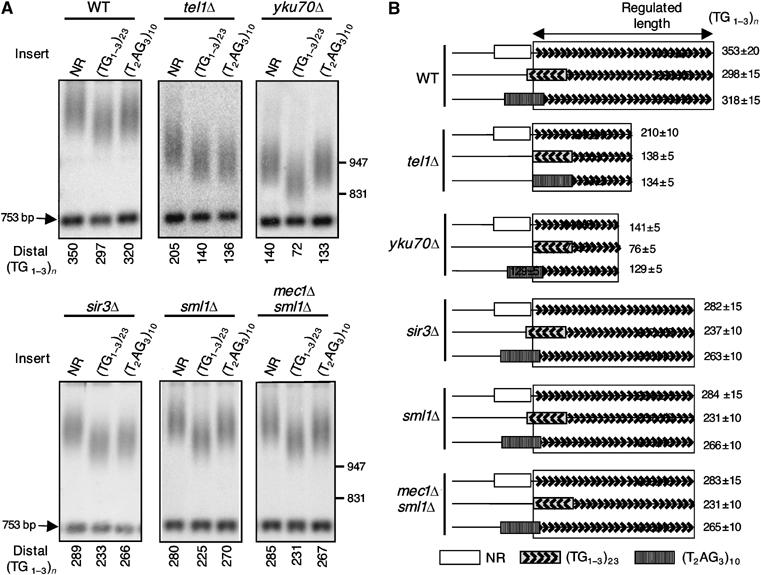
Absence of relationships between SIR3, yKU70 and MEC1 and the cis-shortening induced by a subtelomeric stretch of vertebrate telomeric repeats. (A, B) Southern blots and schematic representation of the results as described in Figure 1.
Figure 5
Figure 5
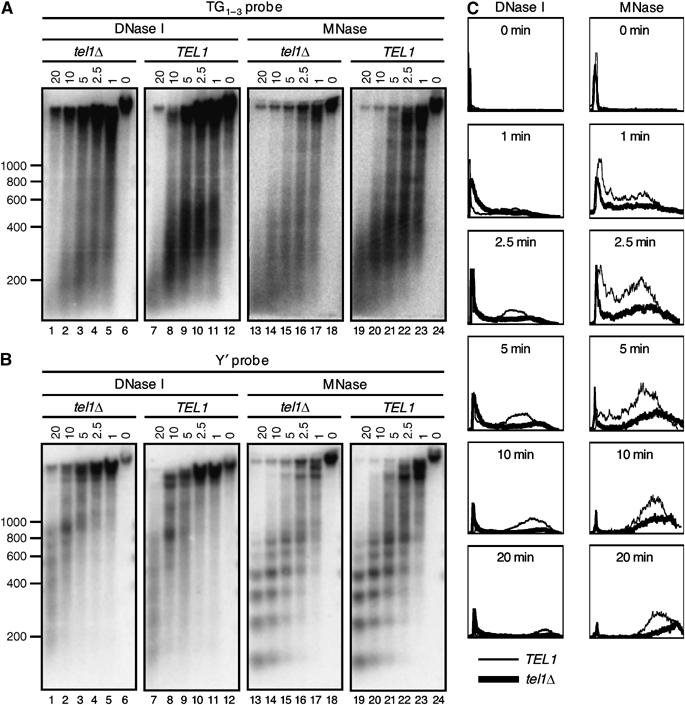
Structure of the telomeric end-complex and subtelomeric chromatin in TEL1 and tel1Δ cells. (A) DNA was isolated from fresh cell lysates treated with DNase I or MNase and then analyzed by Southern blot with a TG1–3 probe. (B) DNA was isolated from fresh cell lysates treated with DNase I or MNase and then analyzed by Southern blot with a Y′ probe. (C) Analysis of the profiles of the TG1–3 hybridizing DNA. The thick line represents the tel1Δ samples. The thin line represents the TEL1 samples.
Figure 6
Figure 6
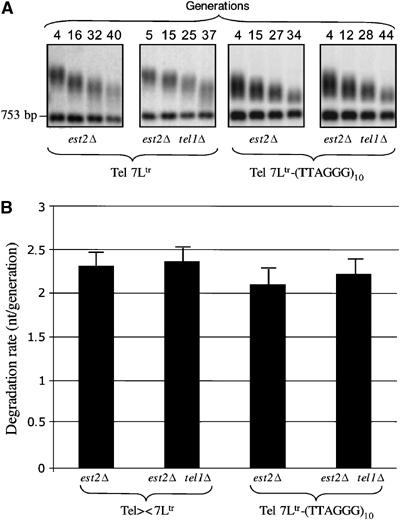
Tbf1 shortening effect requires telomerase expression. (A) Representative Southern blots used to calculate the degradation rates shown in panel B. Spores were grown in a rich liquid medium. Genomic DNAs were digested with EcoRV and HindIII and probed with URA3. (B) Telomere length was plotted versus generations and telomeric degradation rates were calculated from linear regression curves. The values represent the average of at least two independent experiments.

References

    1. Alexander MK, Zakian VA (2003) Rap1p telomere association is not required for mitotic stability of a C(3)TA(2) telomere in yeast. EMBO J 22: 1688–1696 - PMC - PubMed
    1. Ancelin K, Brunori M, Bauwens S, Koering CE, Brun C, Ricoul M, Pommier JP, Sabatier L, Gilson E (2002) Targeting assay to study the cis functions of human telomeric proteins: evidence for inhibition of telomerase by TRF1 and for activation of telomere degradation by TRF2. Mol Cell Biol 22: 3474–3487 - PMC - PubMed
    1. Aparicio OM, Billington BL, Gottschling DE (1991) Modifiers of position effect are shared between telomeric and silent mating-type loci in S. cerevisiae. Cell 66: 1279–1287 - PubMed
    1. Bilaud T, Koering CE, Binet-Brasselet E, Ancelin K, Pollice A, Gasser SM, Gilson E (1996) The telobox, a Myb-related telomeric DNA binding motif found in proteins from yeast, plants and human. Nucleic Acids Res 24: 1294–1303 - PMC - PubMed
    1. Blackburn EH (1991) Structure and function of telomeres. Nature 18: 569–573 - PubMed

Publication types

MeSH terms