Review
. 2006 Feb;6(1):37-43.
doi: 10.2174/156652406775574578.

Stressing out the ER: a role of the unfolded protein response in prion-related disorders

Affiliations
Review

Stressing out the ER: a role of the unfolded protein response in prion-related disorders

Claudio A Hetz et al. Curr Mol Med. 2006 Feb.

Abstract

Transmissible Spongiform Encephalopathies are fatal and infectious neurodegenerative diseases characterized by extensive neuronal apoptosis and the accumulation of an abnormally folded form of the cellular prion protein (PrP), denoted PrP(SC). Compelling evidence suggests the involvement of several signaling pathways in prion pathogenesis, including proteasome dysfunction, alterations in the protein maturation pathways and the unfolded protein response. Recent reports indicate that endoplasmic reticulum stress due to the PrP misfolding may be a critical factor mediating neuronal dysfunction in prion diseases. These findings have applications for developing novel strategies for treatment and early diagnosis of transmissible spongiform encephalopathies and other neurodegenerative diseases.


Figures
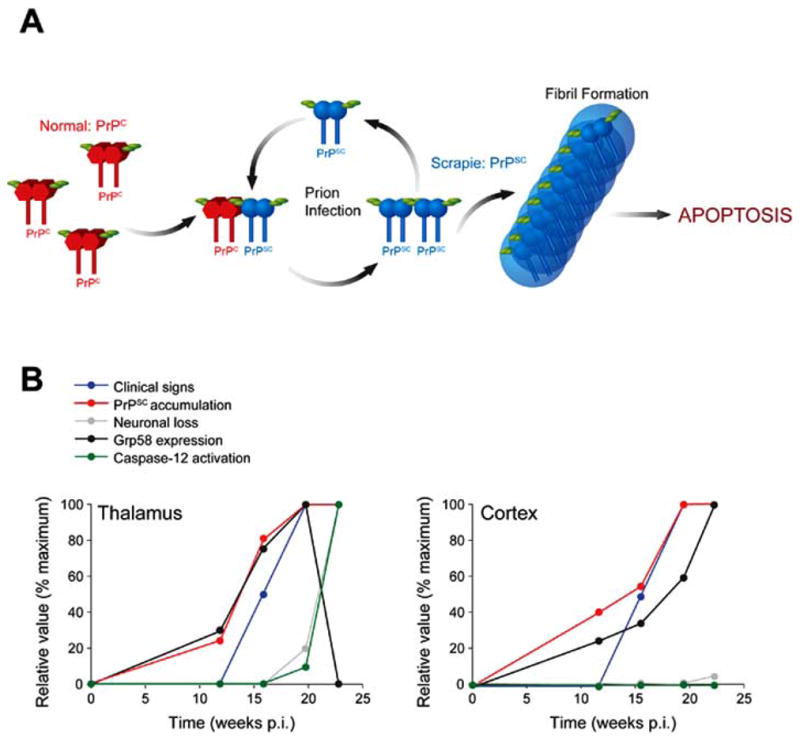
Fig. 1
Fig. 1
(A) A model for TSE progression. The hallmark event in the disease is the misfolding of PrPC to form the -sheet-rich PrPSC. Upon interaction and aggregation of endogenous PrPC with infectious PrPSC, PrPC is misfolded into the pathological form. This process proceeds in a cyclic manner during the course of the disease, generating increasing amounts of PrPSC. Deposition of PrPSC protein aggregates leads to the formation of amyloid prion rods. The final cause of clinical symptoms associated with TSEs is the extensive spongiform degeneration of the brain due to neuronal dysfunction. (B) Correlation between protein misfolding, ER stress and disease features in a murine-scrapie model. The kinetic of neuronal loss, PrPSC accumulation, caspase-12 activation and the expression levels of Grp58 in thalamus and cortex is presented over time. Also, the progression of clinical signs of the disease is shown. To facilitate the comparison, the data is shown as relative values normalized as a percentage of the maximum value observed for each parameter (data from [25]).
Fig. 2
Fig. 2
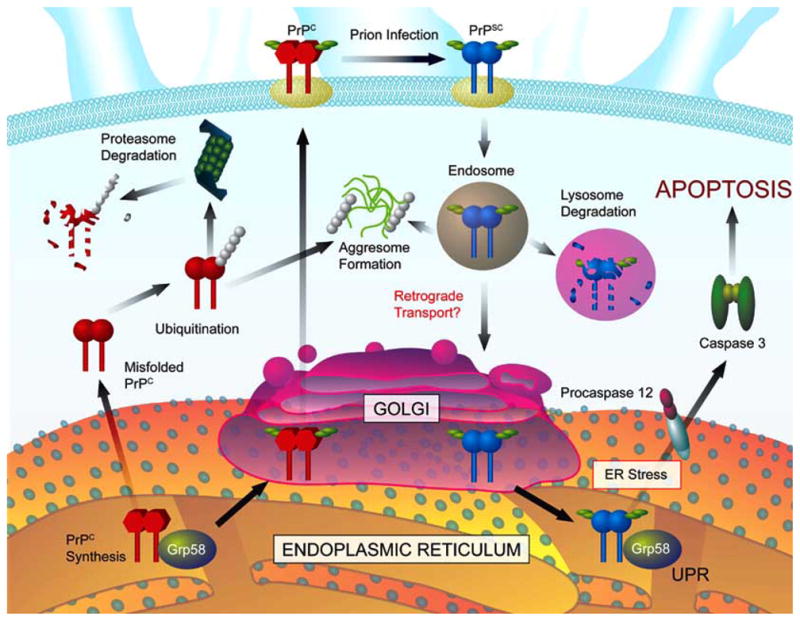
Cellular pathways involved in the synthesis, folding, secretion, trafficking, clearance and neurotoxicity of the prion protein. During synthesis, immature PrP is proteolytically processed in the amino- and carboxy-terminus signal peptide sequence in the ER, and GPI membrane anchor is added. After its transit through the Golgi compartment, mature glycosylations are attached to the protein, and PrP is exported to the cell surface. During the normal cycle, PrP can be internalized by endocytosis and re-targeted to the plasma membrane or delivered to degradation in lysosomes. A fraction of PrPC is usually misfolded during this process, undergoing degradation through the proteasome pathway. Scrapie infection triggers PrPSC generation at the plasma membrane and in early endocytic vesicles. PrPSC may trigger ER stress due to intracellular accumulation or proteasomal dysfunction. Extensive ER stress activates specific cell death pathways, which are negatively regulated by different components of the UPR including Grp58 and many other chaperones, folding enzymes and formation of aggresomes.

References

    1. Prusiner SB. Proc Natl Acad Sci USA. 1998;95:13363–13383. - PMC - PubMed
    1. Prusiner SB, Scott MR. Annu Rev Genet. 1997;286:593–606. - PubMed
    1. Collinge J. Annu Rev Neurosci. 2001;24:519–550. - PubMed
    1. Pan KM, Baldwin M, Njuyen J, Gassett M, Serban A, Groth D, Mehlhorn I, Prusiner SB. Proc Natl Acad Sci USA. 1993;90:10962–10966. - PMC - PubMed
    1. Hetz C, Maundrell K, Soto C. Trends Mol Med. 2003;9:237–243. - PubMed

Publication types