Review
. 2006 May;97(5):883-93.
doi: 10.1093/aob/mcl027. Epub 2006 Feb 10.

Role of cytokinin and auxin in shaping root architecture: regulating vascular differentiation, lateral root initiation, root apical dominance and root gravitropism

Affiliations
Review

Role of cytokinin and auxin in shaping root architecture: regulating vascular differentiation, lateral root initiation, root apical dominance and root gravitropism

R Aloni et al. Ann Bot. 2006 May.

Abstract

Background and aims: Development and architecture of plant roots are regulated by phytohormones. Cytokinin (CK), synthesized in the root cap, promotes cytokinesis, vascular cambium sensitivity, vascular differentiation and root apical dominance. Auxin (indole-3-acetic acid, IAA), produced in young shoot organs, promotes root development and induces vascular differentiation. Both IAA and CK regulate root gravitropism. The aims of this study were to analyse the hormonal mechanisms that induce the root's primary vascular system, explain how differentiating-protoxylem vessels promote lateral root initiation, propose the concept of CK-dependent root apical dominance, and visualize the CK and IAA regulation of root gravitropiosm.

Key issues: The hormonal analysis and proposed mechanisms yield new insights and extend previous concepts: how the radial pattern of the root protoxylem vs. protophloem strands is induced by alternating polar streams of high IAA vs. low IAA concentrations, respectively; how differentiating-protoxylem vessel elements stimulate lateral root initiation by auxin-ethylene-auxin signalling; and how root apical dominance is regulated by the root-cap-synthesized CK, which gives priority to the primary root in competition with its own lateral roots.

Conclusions: CK and IAA are key hormones that regulate root development, its vascular differentiation and root gravitropism; these two hormones, together with ethylene, regulate lateral root initiation.


Figures
F<sc>ig</sc>. 1.
Fig. 1.
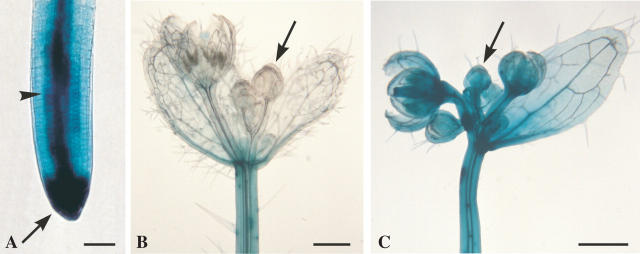
Apparent free-CK distribution in a root (A), in young flowers protected from the wind (B), or exposed to gentle wind (C), as detected by free bioactive-CK-dependent GUS expression in the CK-responsive ARR5::GUS transformant of 5-week-old Arabidopsis grown under long-day conditions (described in Aloni et al., 2005). (A) Root of wind-protected plant with strong ARR5::GUS expression reflecting high bioactive CK concentration in the cap (arrow), considerable concentration in the vascular cylinder (arrowhead) and lower concentration in the cortex. (B) Wind-protected inflorescence (by tight translucent plastic bags, under 95–100 % humidity) showing young apical flower buds (arrow) without GUS expression. (C) Plant from the same experiment as in A and B, but exposed to gentle wind (of 0.2–0.7 m s−1 under lower humidity of 60–70 %) only for the last 3 h before harvesting for the GUS assay, resulting in very strong ARR5::GUS expression in the young apical flower buds (arrow). Scale bars = 40 μm (A), 500 μm (B, C).
F<sc>ig</sc>. 2.
Fig. 2.
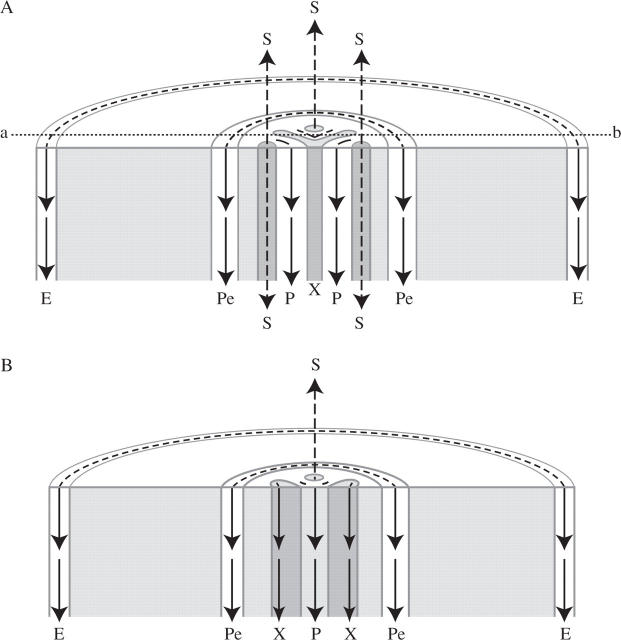
Schematic diagrams at the root's differentiation zone, showing free-IAA transport pathways in a triarch root at a phloem plane (A), and in the same root at a xylem plane (B); the xylem plane location is marked by a dotted line (a–b) in A. The long arrows in the diagrams illustrate IAA movement in a polar manner preferably in the vascular cylinder (the internal route): through the procambium (P), the differentiating xylem (X) and the pericycle (Pe). In the peripheral route (from the shoot to the root's differentiation zone), the IAA arriving from the young leaves moves downward in a polar manner (see Terasaka et al. 2005, fig. 3D, E) through the epidermis (E) (this downward peripheral IAA movement probably stops the upward peripheral IAA movement arriving from the root tip; they possibly merge and together move into the cortex. This probably induces the meristematic cortical downward IAA movement detected by the polar pattern of PIN1 in the acropetal membranes of the differentiating cortex near the root tip). In the non-polar route, IAA moves up and down (illustrated by broken-line arrows) in mature protophloem sieve tubes (S).
F<sc>ig</sc>. 3.
Fig. 3.
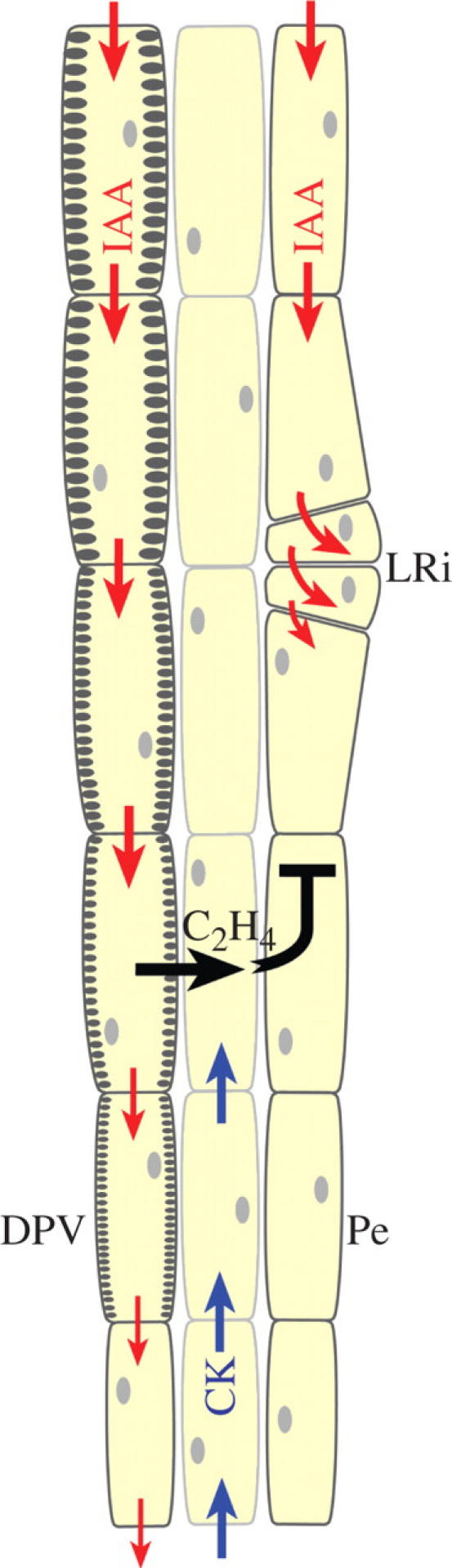
Model of IAA-, ethylene- and CK-regulated lateral root initiation (LRi) in the cell differentiation zone of a growing root. The schematic diagram shows the three outermost cell columns of the vascular cylinder in a young dicotyledonous root in the xylem plane, with a differentiating protoxylem vessel (DPV) and the pericycle (Pe). Two pathways of parallel streams of polar IAA transport (marked by red arrows) are shown: the left auxin stream induces the vessel (marked by the gradual development of secondary wall thickenings) and the right stream maintains the meristematic identity of the pericycle (which is a major preferable pathway of polar auxin transport). During vessel differentiation, a local increase of IAA concentration in a differentiating-protoxylem vessel element induces ethylene production. This C2H4 is released, and in the centrifugal direction (black arrow) it locally blocks the IAA transport in the adjacent pericycle cell, causing a local increase of IAA concentration immediately above the blockage, which induces cell division and lateral root initiation (LRi). Cytokinin (blue arrows) arriving from the root cap may inhibit lateral root initiation near the root tip.
F<sc>ig</sc>. 4.
Fig. 4.
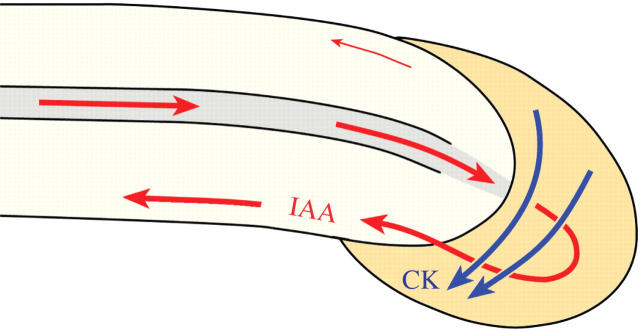
Model of CK- and IAA-regulated root gravitropiosm. When roots are turned to the horizontal position, both CK and IAA are transported laterally downward and become concentrated in the lower root side (sites of high concentrations of CK and IAA are marked). The model shows the direction of the lateral movement of free CK (marked by blue arrows) from the new upper side of the root cap to its lower side, where the high free CK concentration inhibits elongation of the lower side at the distal elongation zone (closely behind the root cap). The polar movement of IAA (red arrows) from the shoot to the root tip occurs through the central vascular cylinder, and at the cap it is laterally distributed mainly to the lower side and then transported along the lower root side to the central elongation zone, where it inhibits elongation. The asymmetric distributions of both CK and IAA inhibit the lower root side and promote elongation of the upper side, resulting in downward root bending.

References

    1. Aloni R. 1980. Role of auxin and sucrose in the differentiation of sieve and tracheary elements in plant tissue cultures. Planta 150: 255–263. - PubMed
    1. Aloni R. 1982. Role of cytokinin in differentiation of secondary xylem fibers. Plant Physiology 70: 1631–1633. - PMC - PubMed
    1. Aloni R. 1987. Differentiation of vascular tissues. Annual Review of Plant Physiology 38: 179–204.
    1. Aloni R. 1991. Wood formation in deciduous hardwood trees. In: Raghavendra AS, ed. Physiology of trees. New York: Wiley, 175–197.
    1. Aloni R. 1995. The induction of vascular tissues by auxin and cytokinin. In: Davies PJ, ed. Plant hormones: physiology, biochemistry and molecular biology. Dordrecht: Kluwer, 531–546.