. 2006 Mar;80(5):2472-82.
doi: 10.1128/JVI.80.5.2472-2482.2006.

Extensive recombination among human immunodeficiency virus type 1 quasispecies makes an important contribution to viral diversity in individual patients

Affiliations

Extensive recombination among human immunodeficiency virus type 1 quasispecies makes an important contribution to viral diversity in individual patients

Charlotte Charpentier et al. J Virol. 2006 Mar.

Abstract

Although recombination during human immunodeficiency virus type 1 (HIV-1) replication in vitro and in vivo has been documented, little information is available concerning the extent that recombination contributes to the diversity of HIV-1 quasispecies in the course of infection in individual patents. To investigate the impact of recombination on viral diversity, we developed a technique that permits the isolation of contemporaneous clonal viral populations resulting from single infectious events by plasma-derived viruses, thereby permitting the assessment of recombination throughout the viral genomes, including widely separated loci, from individual patients. A comparison of the genomic sequences of clonal viruses from six patients, including patients failing treatment with antiretroviral therapy, demonstrated strong evidence for extensive recombination. Recombination increased viral diversity through two distinct mechanisms. First, evolutionary bottlenecks appeared to be restricted to minimal segments of the genome required to obtain selective advantage, thereby preserving diversity in adjacent regions. Second, recombination between adjacent gene segments appeared to generate diversity in both pol and env genes. Thus, the shuffling of resistance mutations within the genes coding for the protease and reverse transcriptase, as well as recombination between these regions, could increase the diversity of drug resistance genotypes. These findings demonstrate that recombination in HIV-1 contributes to the diversity of viral quasispecies by restricting evolutionary bottlenecks to gene segments and by generating novel genotypes in pol and env, supporting the idea that recombination may be critical to adaptive evolution of HIV in the face of constantly moving selective pressures, whether exerted by the immune system or antiretroviral therapy.


Figures
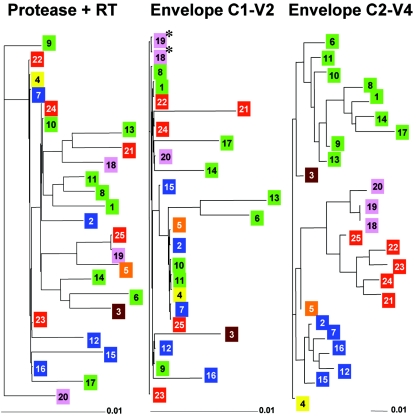
FIG. 1.
FIG. 1.
Phylogenetic trees corresponding to different parts of the genome of clonal viruses from a single patient are incongruent. Genomic regions corresponding to protease + RT (2253 to 3338), C1-V2 envelope (6221 to 6871), and C2-V4 envelope (6872 to 7567) for 25 clonal viruses obtained from patient 1 were sequenced, and phylogenetic trees were generated using the maximum-likelihood method. Clonal viruses that clustered together in the C2-V4 envelope tree are highlighted with the same color. Although certain clones remain clustered in the other trees (e.g., those marked with an asterisk in the middle panel), clonal viruses that cluster together in one tree are generally dispersed throughout the other trees. The trees were incongruent using the ILD test (P < 0.001 for all pairwise comparisons).
FIG. 2.
FIG. 2.
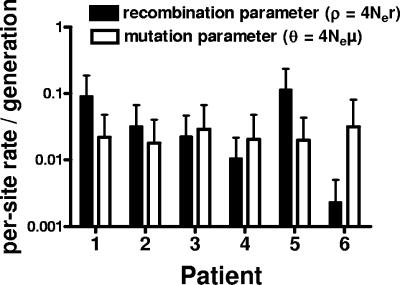
Contribution of mutation and recombination to sequence diversity. For each patient, the population recombination parameter and the population mutation parameter were determined using the coalescent-based approach described by McVean et al. (31).
FIG. 3.
FIG. 3.
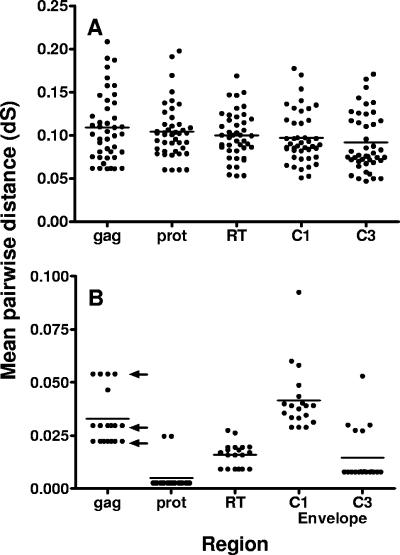
Sequence diversity in different portions of the viral genome. The dS was determined for selected regions in genes coding for the C-terminal portion of gag (gag), protease (prot), RT, envelope C1 (C1), and envelope C3 (C3) using the modified Nei-Gojobori method (36). Each point represents the average pairwise distance of each sequence to all other sequences analyzed, and the bar represents the overall mean divergence. Panel A shows the analysis of all HIV-1 subtype B viruses in the Los Alamos alignment database for which sequences of all regions were available (n = 43), and panel B shows results of the analysis of the 19 clonal viruses from patient 4. The small arrows in panel B indicate groups of clones whose gag sequences were similar at all silent positions but whose sequences differed from those of the other groups by 3 or 4 silent mutations.
FIG. 4.
FIG. 4.
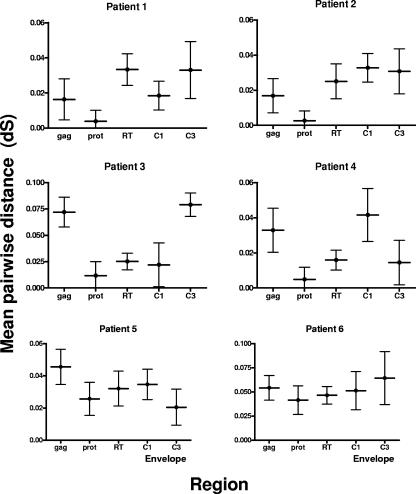
Patterns of sequence diversity in different portions of the viral genome observed for clonal viruses. For each patient, the dS was determined for selected regions in genes coding for the C-terminal portion of gag (gag), protease (prot), RT, envelope C1 (C1), and envelope C3 (C3) as described in the legend to Fig. 3. The result for each of the six patients is presented as the mean ± standard deviation of the average pairwise distance of each clonal virus compared to those of all other clonal viruses obtained from that patient.
FIG. 5.
FIG. 5.
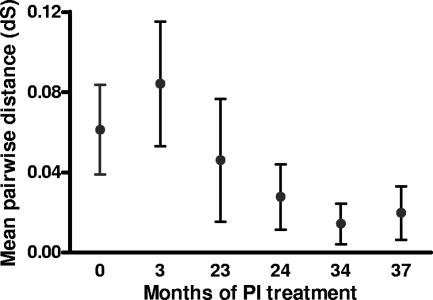
Selection of protease resistance mutations is associated with a loss of sequence diversity. The dS was determined for the region of the protease gene described in the legend to Fig. 3 by using sequences obtained at different intervals after initiation of treatment with protease inhibitors. Previously published phylogenetic studies indicated that this patient experienced bottlenecks associated with the emergence of viruses carrying the I54V and A71V mutations between 3 and 23 months and fixation of the I93L mutation between 24 and 34 months (5). Results are presented as means ± standard deviations of the average pairwise distances of each sequence compared to those of all other sequences obtained at the same time point.
FIG. 6.
FIG. 6.
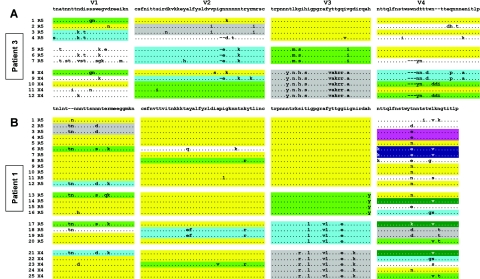
Recombination between envelope domains contributes to the diversity of env. At the top of each panel, the consensus amino acid sequences of the V1, V2, V3, and V4 regions of envelope for the 12 clonal viruses from patient 3 (panel A) and the 25 clonal viruses from patient 1 (panel B) are shown. Only amino acid changes different from the consensus sequence are shown for each clone. For each domain, sequences that are identical or that differ by a single amino acid substitution not identified in another sequence are highlighted with the same color. The tropism of the clonal viruses predicted by the algorithm of Jensen et al. is also indicated.

References

    1. Adzhubei, A. A., I. A. Adzhubei, I. A. Krasheninnikov, and S. Neidle. 1996. Non-random usage of ‘degenerate’ codons is related to protein three-dimensional structure. FEBS Lett. 399:78-82. - PubMed
    1. Bonhoeffer, S., C. Chappey, N. T. Parkin, J. M. Whitcomb, and C. J. Petropoulos. 2004. Evidence for positive epistasis in HIV-1. Science 306:1547-1550. - PubMed
    1. Boone, L. R., and A. M. Skalka. 1981. Viral DNA synthesized in vitro by avian retrovirus particles permeabilized with melittin. II. Evidence for a strand displacement mechanism in plus-strand synthesis. J. Virol. 37:117-126. - PMC - PubMed
    1. Brown, A. J., and A. Cleland. 1996. Independent evolution of the env and pol genes of HIV-1 during zidovudine therapy. AIDS 10:1067-1073. - PubMed
    1. Charpentier, C., D. E. Dwyer, F. Mammano, D. Lecossier, F. Clavel, and A. J. Hance. 2004. Role of minority populations of human immunodeficiency virus type 1 in the evolution of viral resistance to protease inhibitors. J. Virol. 78:4234-4247. - PMC - PubMed

Publication types