Clinical Trial
. 2005 Dec;32(12):3524-36.
doi: 10.1118/1.2107047.

Optimized interstitial PDT prostate treatment planning with the Cimmino feasibility algorithm

Affiliations
Clinical Trial

Optimized interstitial PDT prostate treatment planning with the Cimmino feasibility algorithm

Martin D Altschuler et al. Med Phys. 2005 Dec.

Abstract

The primary aim of this study was to determine whether optimized photodynamic therapy (PDT) treatment planning (seeking optimized positions, lengths, and strengths of the light sources to satisfy a given dose prescription) can improve dose coverage to the prostate and the sparing of critical organs relative to what can be achieved by the standard PDT plan. The Cimmino algorithm and search procedures based on that algorithm were tested for this purpose. A phase I motexafin lutetium (MLu)-mediated photodynamic therapy protocol is ongoing at the University of Pennsylvania. PDT for the prostate is performed with cylindrical diffusing fibers of various lengths inserted perpendicular to a base plate to obtain longitudinal coverage by a matrix of parallel catheters. The standard plan for the protocol uses sources of equal strength with equal spaced (1-cm) loading. Uniform optical properties were assumed. Our algorithms produce plans that cover the prostate and spare the urethra and rectum with less discrepancy from the dose prescription than the standard plan. The Cimmino feasibility algorithm is fast enough that changes to the treatment plan may be made in the operating room before and during PDT to optimize light delivery.


Figures
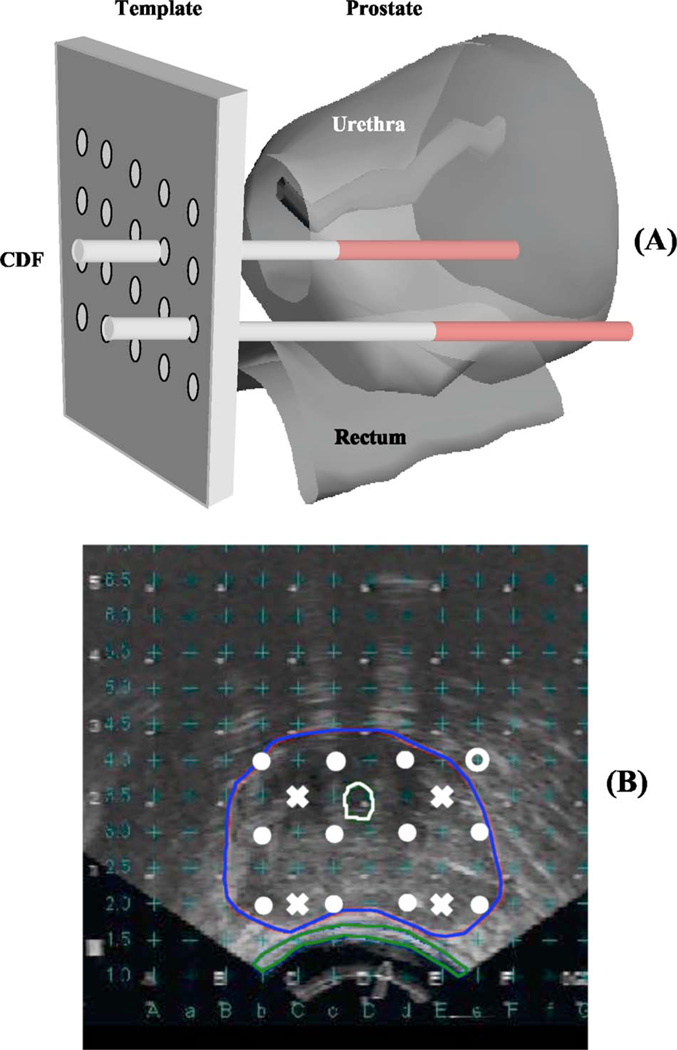
Fig. 1
Fig. 1
(a) Experimental setup for measuring the in vivo optical properties of human prostate. The prostate template was drilled with a 0.5-cm equal spaced grid. Cylindrical diffusing fibers (CDF) were inserted into the catheters to illuminate the entire prostate gland. (b) Transrectal ultrasound image. Isotropic detectors (“×”) were placed in one of the catheters, which is located at a distance between 0.5 and 1.1 cm from the light source (“ ●”). The detector reading at each location is peaked to ensure that it is at the middle of the CDF.
Fig. 2
Fig. 2
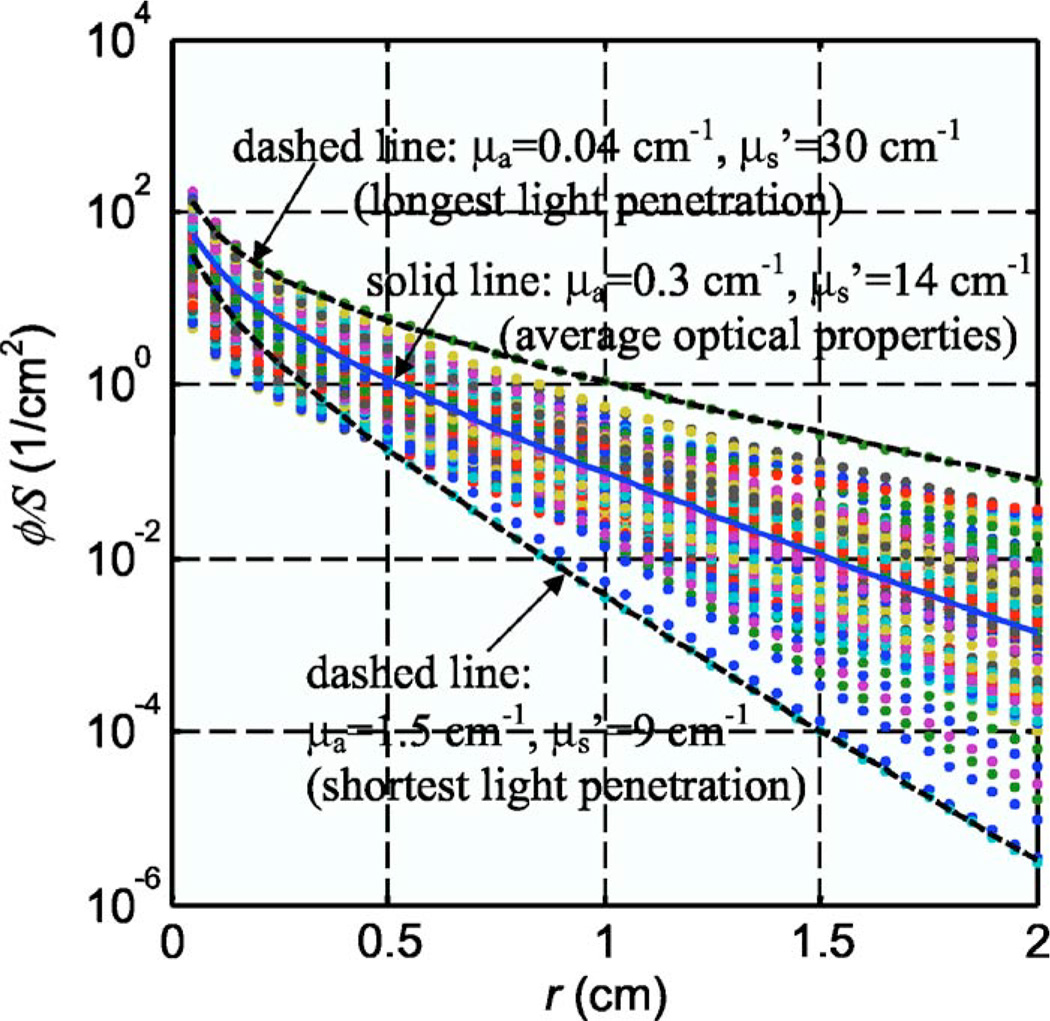
Light fluence rate per source strength, ϕ/S, for a point source for the optical properties determined from human prostate. The solid line corresponds to ϕ/S for the average optical properties: μa = 0.3 cm−1, μs=14cm1. The dashed lines correspond to ϕ/S for the longest and shortest light penetrations: μa = 0.04 cm−1, μs=30cm1 and μa = 1.5 cm−1, μs=9cm1, respectively.
Fig. 3
Fig. 3
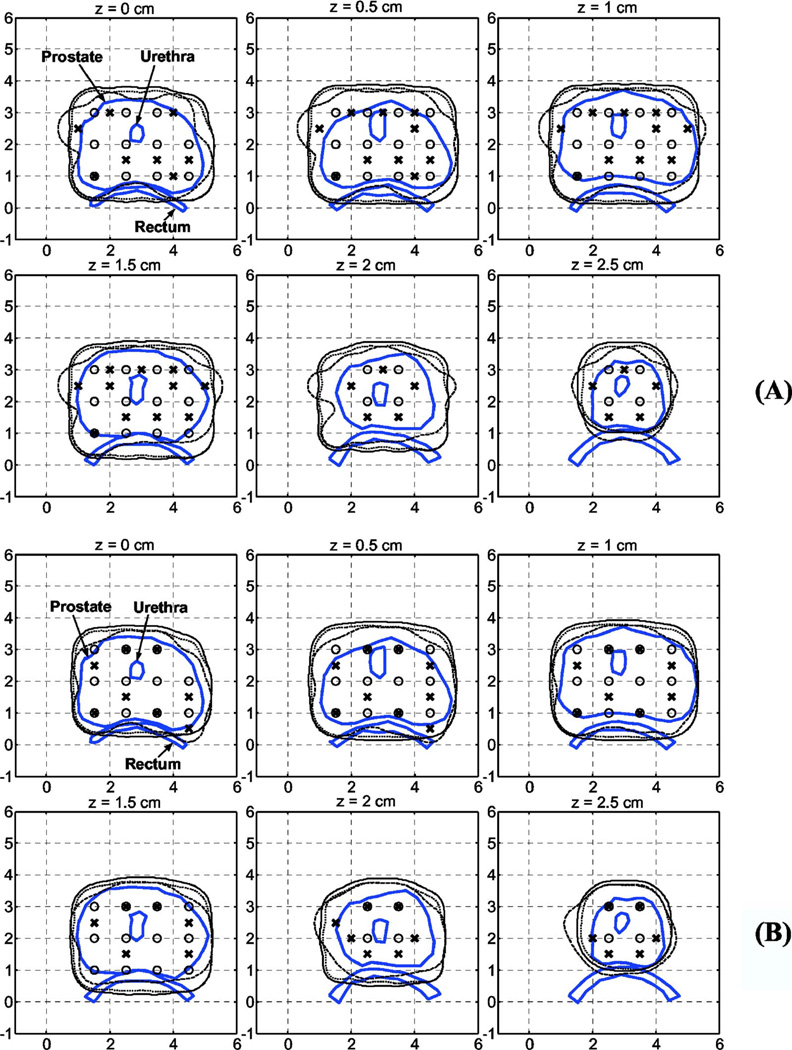
Comparison of 100% isodose lines for the manual standard plan (solid line) vs Cimmino 1 (dotted line) and Cimmino 3 (dashed line) for two optical properties: (a) μa = 0.3 cm−1, μs=14cm1, and (b) μa = 0.04, μs=30cm1. (○) The source positions in the standard plan or Cimmino 1. (×) The source positions in Cimmino 3. The source strengths are summarized in Table III.
Fig. 4
Fig. 4
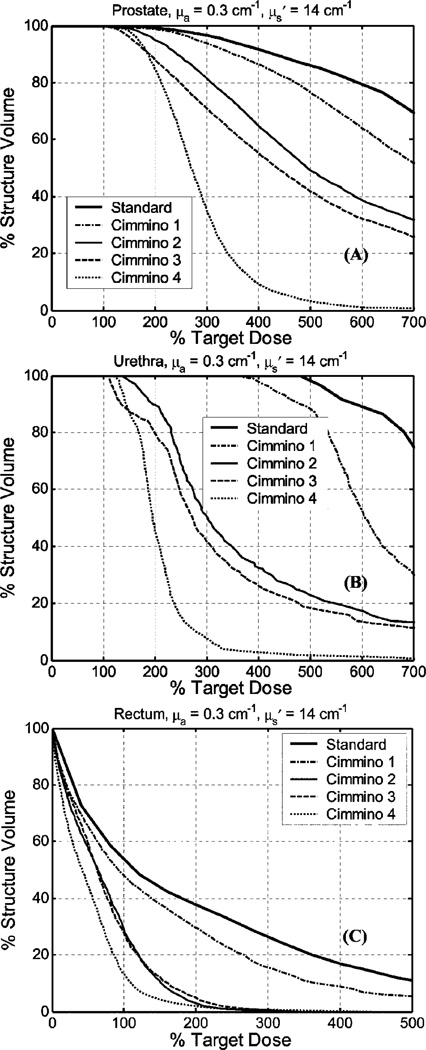
DVH comparison of the manual standard plan vs the Cimmino-based search results for optical properties μa = 0.3 cm−1, μs=14cm1 for (a) prostate, (b) urethra, and (c) rectum. The standard plan uses uniform 1-cm source loading with uniform-strength. The optimized results are: Cimmino 1 uses the same fixed source positions and source parameters as the standard plan but Cimmino optimized weights for each source; Cimmino 2 finds optimized source lengths, loading, and template locations for 12 linear sources with upper constraints of 300% for rectum and urethra; Cimmino 3 is the same as Cimmino 2 but with upper constraints of 200% for rectum and urethra; Cimmino 4 uses Cimmino optimized source lengths, loading and template for all 51 possible CDF sources through the prostate. See Table IV for the upper dose bounds used for each Cimmino-search algorithm.
Fig. 5
Fig. 5
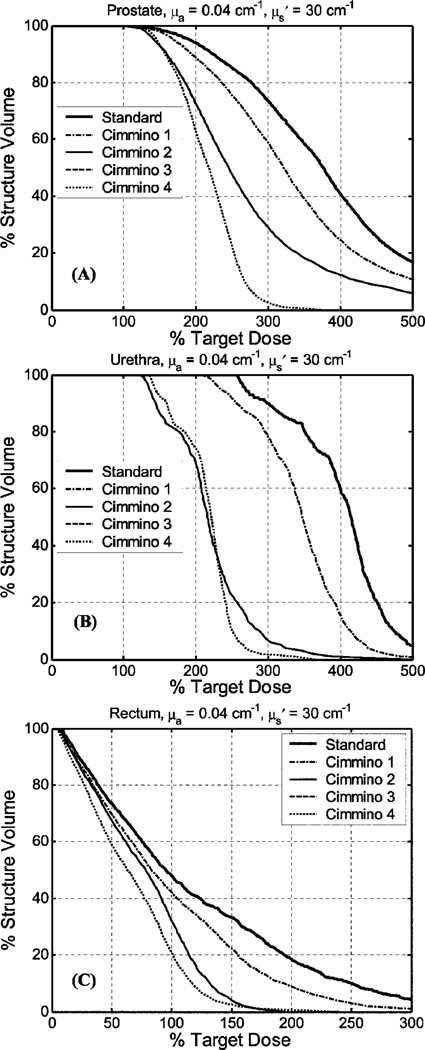
Comparison of DVH of manual standard plan vs Cimmino-based search results for optical properties μa = 0.04 cm−1, μs=30cm1 for (a) prostate, (b) urethra, and (c) rectum. The definition of the standard and Cimmino 1–4 are the same as in Fig. 4. Cimmino 2 and 3 produced identical DVH, i.e., the solid and dashed lines overlapped.
Fig. 6
Fig. 6
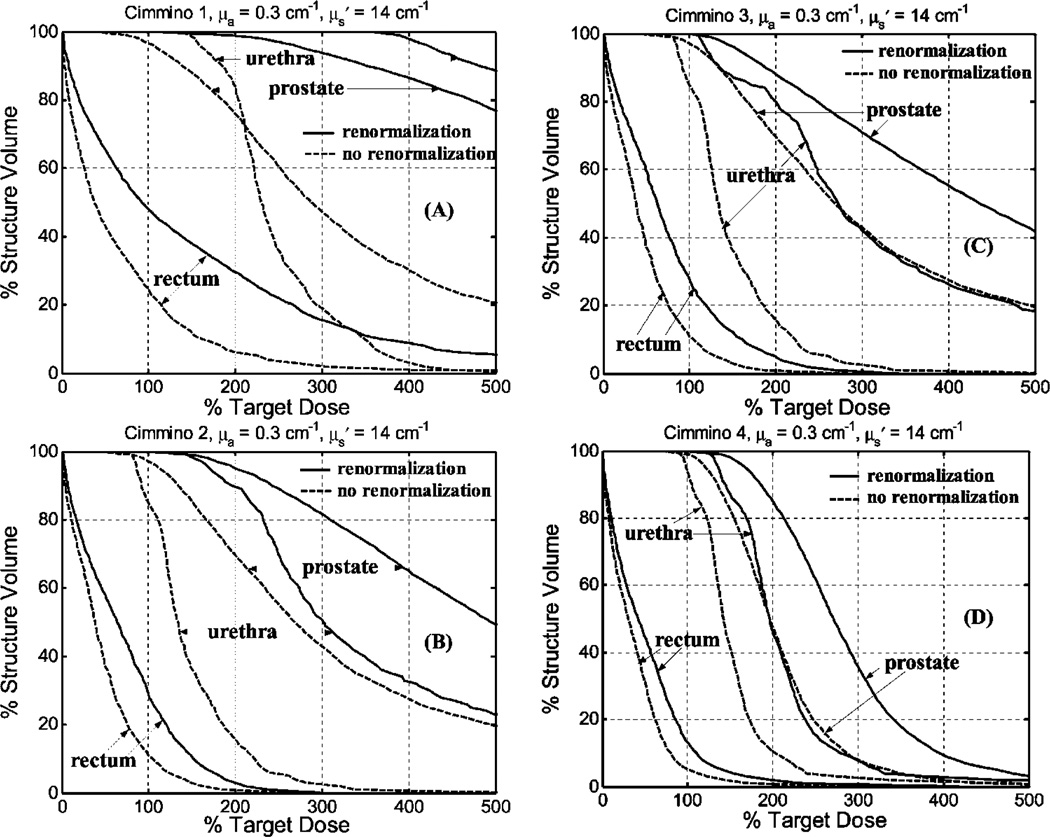
Comparison of DVH for Cimmino-based search algorithm with (solid lines) and without (dashed lines) renormalization of source strengths for prostate coverage for optical properties μa = 0.3 cm−1, μs=14cm1. The results are: (a) Cimmino 1; (b) Cimmino 2; (c) Cimmino 3; (d) Cimmino 4.
Fig. 7
Fig. 7
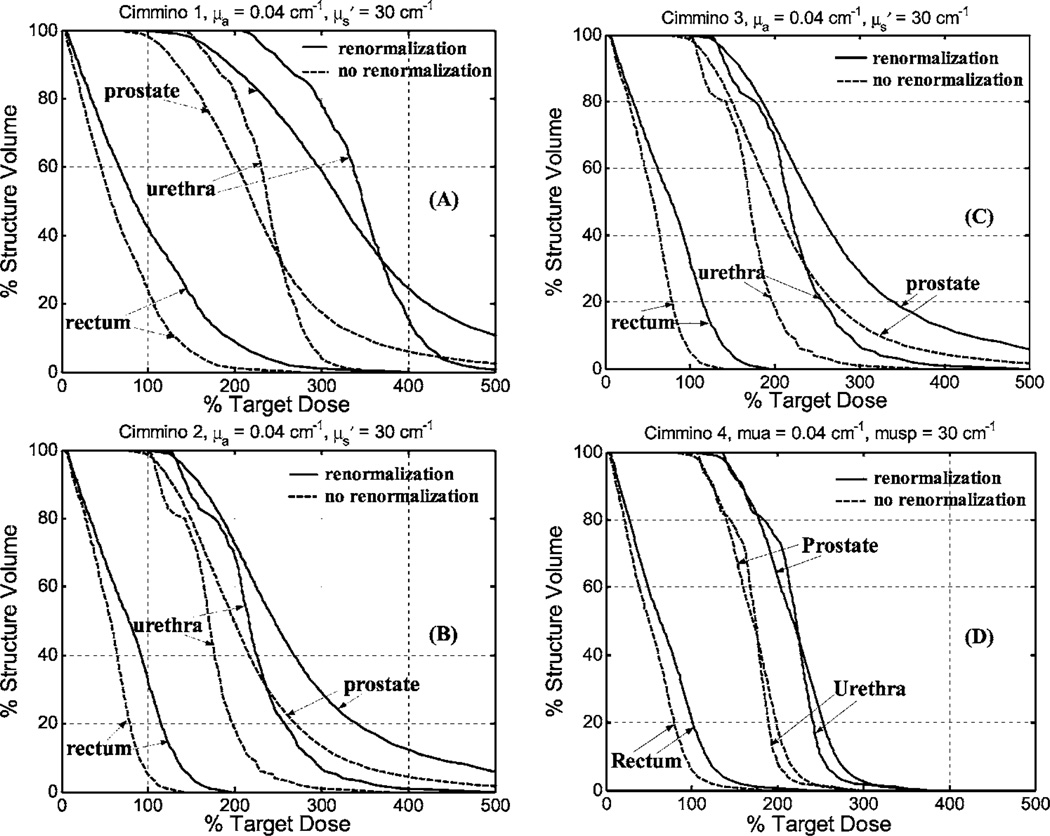
Comparison of DVH for Cimmino-based search algorithm with (solid lines) and without (dashed lines) renormalization of source strengths for prostate coverage for optical properties μa = 0.04 cm−1, μs=30cm1. The results are: (a) Cimmino 1; (b) Cimmino 2; (c) Cimmino 3; (d) Cimmino 4.
Fig. 8
Fig. 8
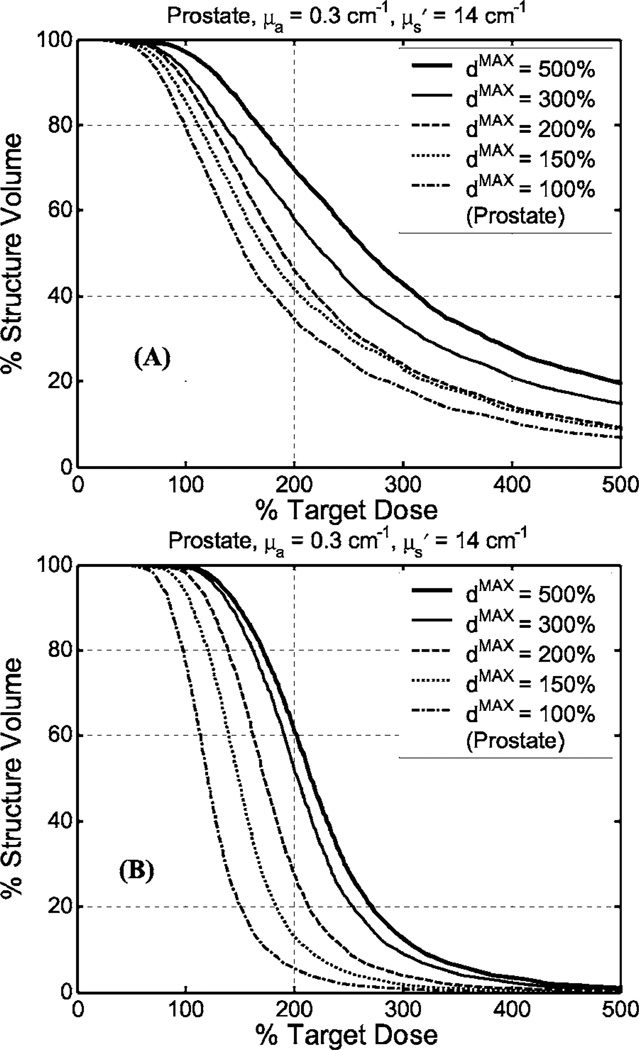
Comparison of DVH for Cimmino-based search algorithm (problem option 3) with various upper dose bounds (dmax) for prostate for (a) 12 CDFs and (b) 51 CDFs for the average optical properties. No renormalization is used.

References

    1. Hsi RA, Rosenthal DI, Glatstein E. Photodynamic therapy in the treatment of cancer: Current state of the art. Drugs. 1999;57:725–734. - PubMed
    1. Amico AVD. Role of interstitial radiotherapy in the management of clinically organ-confined prostate cancer: The jury is still out. J. Clin. Oncol. 1996;14:304–315. - PubMed
    1. Lee LK, Whitehurst C, Chen Q, Pantelides ML, Hetzel FW, Moore JV. Interstitial photodynamic therapy in the canine prostate. Br. J. Urol. 1997;80:898–902. - PubMed
    1. Chang SC, Buonaccorsi G, MacRobert A, Bown SG. Interstitial photodynamic therapy of the canine prostate using meso-tetra-(mhydroxyphenyl) chlorine. Int. J. Cancer. 1996;67:555–562. - PubMed
    1. Chang SC, Buonaccorsi G, MacRobert A, Bown SG. Interstitial photodynamic therapy of the canine prostate with disulfonated aluminum phthalocyanine and 5-aminolevulinic acid-induced protoporphyrin IX. Prostate. 1997;32:89–98. - PubMed

Publication types