Two key residues in ephrinB3 are critical for its use as an alternative receptor for Nipah virus
- PMID: 16477309
- PMCID: PMC1361355
- DOI: 10.1371/journal.ppat.0020007
Two key residues in ephrinB3 are critical for its use as an alternative receptor for Nipah virus
Abstract
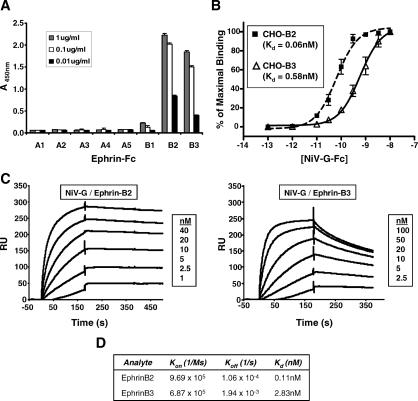
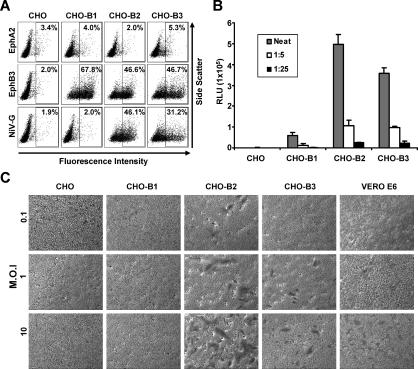
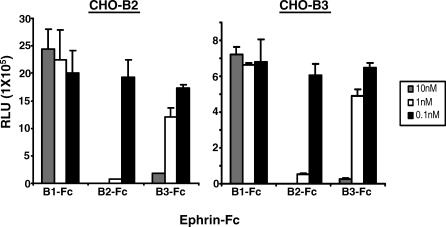
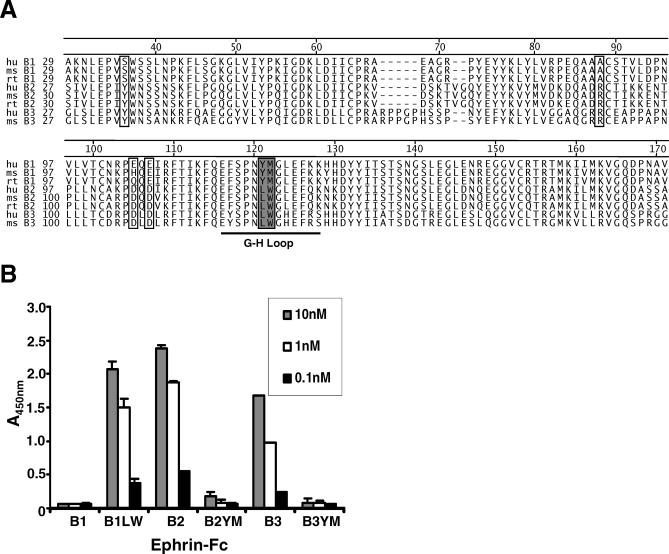
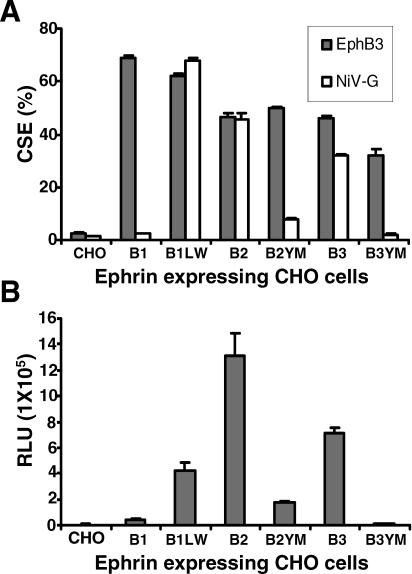
EphrinB2 was recently discovered as a functional receptor for Nipah virus (NiV), a lethal emerging paramyxovirus. Ephrins constitute a class of homologous ligands for the Eph class of receptor tyrosine kinases and exhibit overlapping expression patterns. Thus, we examined whether other ephrins might serve as alternative receptors for NiV. Here, we show that of all known ephrins (ephrinA1-A5 and ephrinB1-B3), only the soluble Fc-fusion proteins of ephrinB3, in addition to ephrinB2, bound to soluble NiV attachment protein G (NiV-G). Soluble NiV-G bound to cell surface ephrinB3 and B2 with subnanomolar affinities (Kd = 0.58 nM and 0.06 nM for ephrinB3 and B2, respectively). Surface plasmon resonance analysis indicated that the relatively lower affinity of NiV-G for ephrinB3 was largely due to a faster off-rate (K(off) = 1.94 x 10(-3) s(-1) versus 1.06 x 10(-4) s(-1) for ephrinB3 and B2, respectively). EphrinB3 was sufficient to allow for viral entry of both pseudotype and live NiV. Soluble ephrinB2 and B3 were able to compete for NiV-envelope-mediated viral entry on both ephrinB2- and B3-expressing cells, suggesting that NiV-G interacts with both ephrinB2 and B3 via an overlapping site. Mutational analysis indicated that the Leu-Trp residues in the solvent exposed G-H loop of ephrinB2 and B3 were critical determinants of NiV binding and entry. Indeed, replacement of the Tyr-Met residues in the homologous positions in ephrinB1 with Leu-Trp conferred NiV receptor activity to ephrinB1. Thus, ephrinB3 is a bona fide alternate receptor for NiV entry, and two residues in the G-H loop of the ephrin B-class ligands are critical determinants of NiV receptor activity.
Conflict of interest statement
Figures
References
-
- Chua KB, Bellini WJ, Rota PA, Harcourt BH, Tamin A, et al. Nipah virus: A recently emergent deadly paramyxovirus. Science. 2000;288:1432–1435. - PubMed
-
- Harcourt BH, Tamin A, Ksiazek TG, Rollin PE, Anderson LJ, et al. Molecular characterization of Nipah virus, a newly emergent paramyxovirus. Virology. 2000;271:334–349. - PubMed
-
- Parashar UD, Sunn LM, Ong F, Mounts AW, Arif MT, et al. Case-control study of risk factors for human infection with a new zoonotic paramyxovirus, Nipah virus, during a 1998–1999 outbreak of severe encephalitis in Malaysia. J Infect Dis. 2000;181:1755–1759. - PubMed
-
- International Centre for Diarrhoeal Disease Research, Bangladesh. Person-to-person transmission of Nipah virus during outbreak in Faridpur District, 2004. Health Sci Bull 2: 5–9; 2004. Available: http://www.icddrb.org/pub/publication.jsp?classificationID=56&pubID=5252. Accessed 10 January 2006.
Publication types
MeSH terms
Substances
Grants and funding
LinkOut - more resources
Full Text Sources
Other Literature Sources
Molecular Biology Databases
Miscellaneous