Nicotinamide protects against ethanol-induced apoptotic neurodegeneration in the developing mouse brain
- PMID: 16478293
- PMCID: PMC1370925
- DOI: 10.1371/journal.pmed.0030101
Nicotinamide protects against ethanol-induced apoptotic neurodegeneration in the developing mouse brain
Abstract
Background: Exposure to alcohol during brain development may cause a neurological syndrome called fetal alcohol syndrome (FAS). Ethanol induces apoptotic neuronal death at specific developmental stages, particularly during the brain-growth spurt, which occurs from the beginning of third trimester of gestation and continues for several years after birth in humans, whilst occurring in the first two postnatal weeks in mice. Administration of a single dose of ethanol in 7-d postnatal (P7) mice triggers activation of caspase-3 and widespread apoptotic neuronal death in the forebrain, providing a possible explanation for the microencephaly observed in human FAS. The present study was aimed at determining whether nicotinamide may prevent ethanol-induced neurodegeneration.
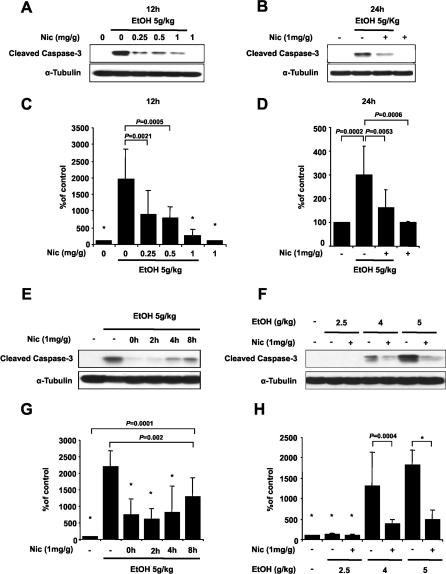
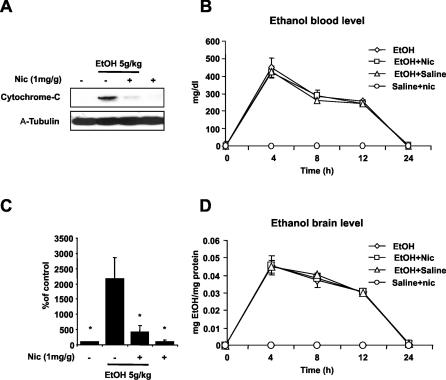
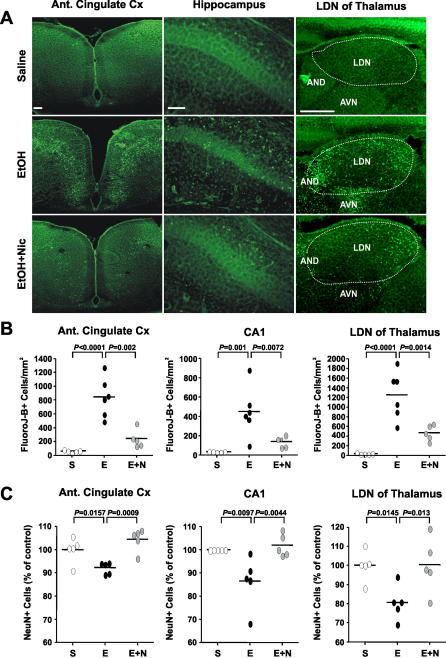
Methods and findings: P7 mice were treated with a single dose of ethanol (5 g/kg), and nicotinamide was administered from 0 h to 8 h after ethanol exposure. The effects of nicotinamide on ethanol-induced activation of caspase-3 and release of cytochrome-c from the mitochondria were analyzed by Western blot (n = 4-7/group). Density of Fluoro-Jade B-positive cells and NeuN-positive cells was determined in the cingulated cortex, CA1 region of the hippocampus, and lateral dorsal nucleus of the thalamus (n = 5-6/group). Open field, plus maze, and fear conditioning tests were used to study the behavior in adult mice (n = 31-34/group). Nicotinamide reduced the activation of caspase-3 (85.14 +/- 4.1%) and the release of cytochrome-c (80.78 +/- 4.39%) in postnatal mouse forebrain, too. Nicotinamide prevented also the ethanol-induced increase of apoptosis. We demonstrated that ethanol-exposed mice showed impaired performance in the fear conditioning test and increased activity in the open field and in the plus maze. Administration of nicotinamide prevented all these behavioral abnormalities in ethanol-exposed mice.
Conclusions: Our findings indicate that nicotinamide can prevent some of the deleterious effects of ethanol on the developing mouse brain when given shortly after ethanol exposure. These results suggest that nicotinamide, which has been used in humans for the treatment of diabetes and bullous pemphigoid, may hold promise as a preventive therapy of FAS.
Conflict of interest statement
Figures
Comment in
-
Protection against prenatal alcohol-induced damage.PLoS Med. 2006 Apr;3(4):e196. doi: 10.1371/journal.pmed.0030196. Epub 2006 Apr 18. PLoS Med. 2006. PMID: 16605309 Free PMC article.
-
Fetal alcohol syndrome and essential fatty acids.PLoS Med. 2006 May;3(5):e247; author reply e248. doi: 10.1371/journal.pmed.0030247. Epub 2006 May 30. PLoS Med. 2006. PMID: 16719552 Free PMC article. No abstract available.
References
-
- Jones KL, Smith DW. Recognition of the fetal alcohol syndrome in early infancy. Lancet. 1973;2:999–1001. - PubMed
-
- Sokol RJ, Delaney-Black V, Nordstrom B. Fetal alcohol spectrum disorder. JAMA. 2003;290:2996–2999. - PubMed
-
- Eckardt MJ, File SE, Gessa GL, Grant KA, Guerri C, et al. Effects of moderate alcohol consumption on the central nervous system. Alcohol Clin Exp Res. 1998;22:998–1040. - PubMed
-
- Goodlett CR, Horn KH, Zhou FC. Alcohol teratogenesis: Mechanisms of damage and strategies for intervention. Exp Biol Med (Maywood) 2005;230:394–406. - PubMed
-
- Bonthius DJ, West JR. Alcohol-induced neuronal loss in developing rats: Increased brain damage with binge exposure. Alcohol Clin Exp Res. 1990;14:107–118. - PubMed
Publication types
MeSH terms
Substances
LinkOut - more resources
Full Text Sources
Medical
Research Materials
Miscellaneous