


Clinical categories of patients and encounter rates in primary health care - a three-year study in defined populations
- PMID: 16483353
- PMCID: PMC1431523
- DOI: 10.1186/1471-2458-6-35
Clinical categories of patients and encounter rates in primary health care - a three-year study in defined populations
Abstract
Background: The objective was to estimate the proportion of inhabitants with a diagnosis-registered encounter with a general practitioner, and to elucidate annual variations of clinical categories of patients in terms of their individual comorbidity.
Methods: A three-year retrospective study of encounter data from electronic patient records, with an annual-based application of the Johns Hopkins Adjusted Clinical Groups (ACG) system. Data were retrieved from every patient with a diagnosis-registered encounter with a GP during the period 2001-2003 at 13 publicly managed primary health care centres in Blekinge county, southeastern Sweden, with about 150000 inhabitants.
Main outcome measures: Proportions of inhabitants with a diagnosis-registered encounter, and ranges of the annual proportions of categories of patients according to ACGs.
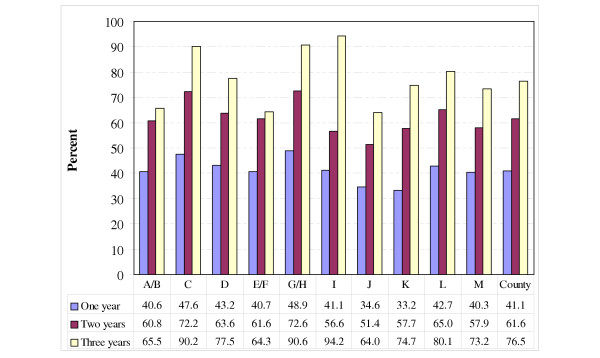
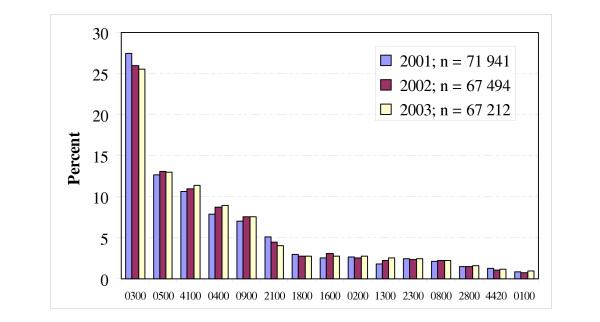
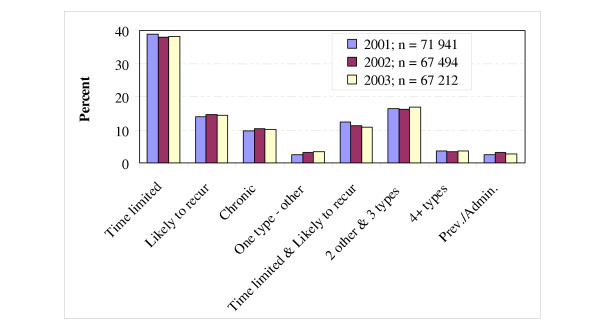
Results: The proportion of inhabitants with a diagnosis-registered encounter ranged from about 64.0% to 90.6% for the primary health care centres, and averaged about 76.5% for all inhabitants. In a three-year perspective the average range of categories of patients was about 0.4% on the county level, and about 0.9% on the primary health care centre level. About one third of the patients each year had a constellation of two or more types of morbidity.
Conclusion: About three fourths of all inhabitants had one or more diagnosis-registered encounters with a general practitioner during the three-year period. The annual variation of categories of patients according to ACGs was small on both the county and the primary health care centre level. The ACG system seems useful for demonstrating and predicting various aspects of clinical categories of patients in Swedish primary health care.
Figures
References
-
- Hutchinson A, Parkin D, Philips P. Case mix measures for ambulatory care. J Public Health Med. 1991;13:189–97. - PubMed
-
- Hornbrook MC. Hospital case mix: its definition, measurement and use. Part I: The conceptual framework. Med Care Rev. 1982;39:1–43. - PubMed
-
- Hornbrook MC. Hospital case mix: its definition, measurement and use. Part II: Review of alternative methods. Med Care Rev. 1982;39:73–123. - PubMed
-
- Holmström S, Carlsson L, Calltorp J, Rudberg Flismark L, Krakau I. Beskrivning av öppna vårdformer – en svensk modell. (Describing ambulatory care – a Swedish model). Huddinge, Samhällsmedicinska enheten, Stockholms läns landsting; 1993.
-
- Hornbrook MC, Hurtado AV, Johnson RE. Health care episodes: Definition, measurement and use. Med Care Rev. 1985;42:163–208. - PubMed
Publication types
MeSH terms
LinkOut - more resources
Full Text Sources
