


Multisensory interactions follow the hands across the midline: evidence from a non-spatial visual-tactile congruency task
- PMID: 16483553
- PMCID: PMC1482253
- DOI: 10.1016/j.brainres.2005.11.010
Multisensory interactions follow the hands across the midline: evidence from a non-spatial visual-tactile congruency task
Abstract
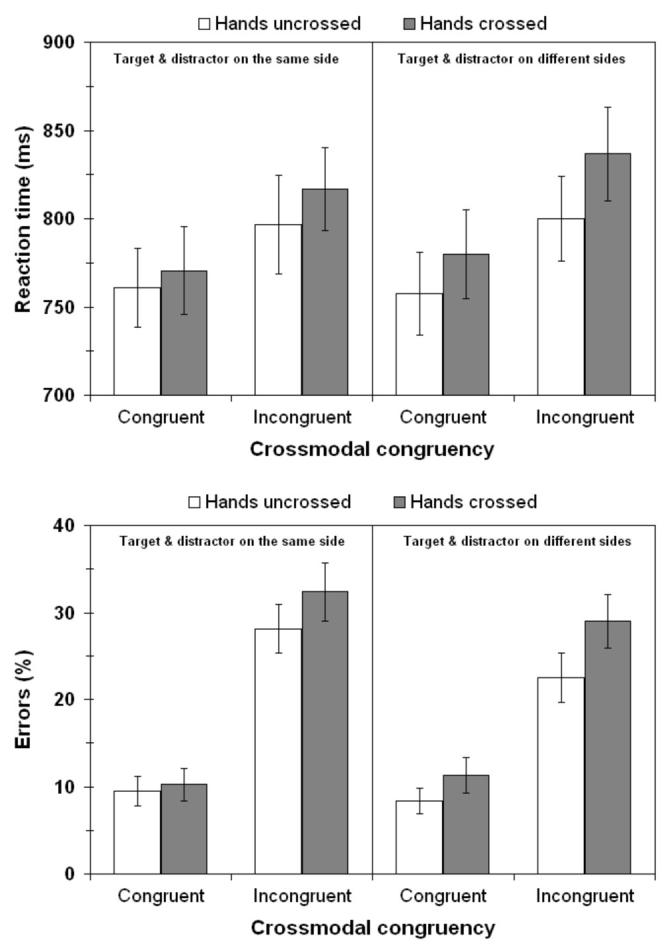
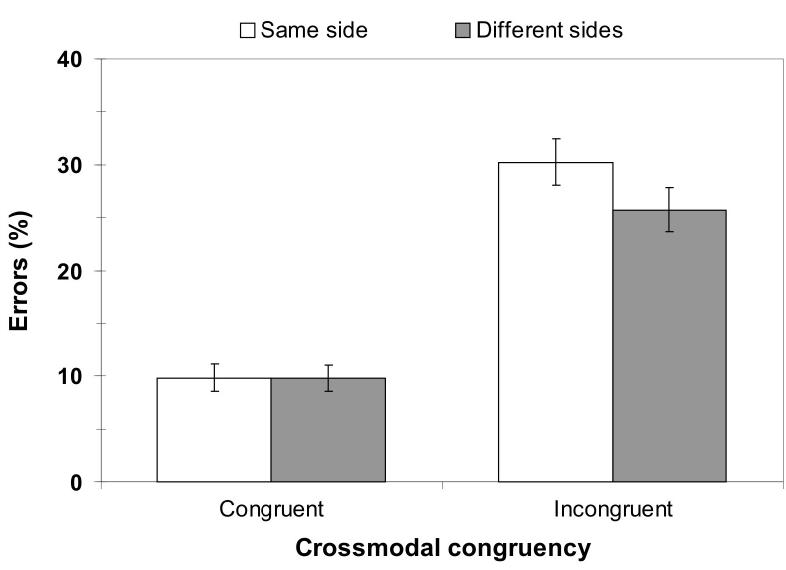
Crossing the hands over, whether across the body midline or with respect to each other, leads to measurable changes in spatial compatibility, spatial attention, and frequently to a general decrement in discrimination performance for tactile stimuli. The majority of multisensory crossed hands effects, however, have been demonstrated with explicit or implicit spatial discrimination tasks, raising the question of whether non-spatial discrimination tasks also show spatial effects when the hands are crossed. We designed a novel, non-spatial tactile discrimination task to address this issue. Participants made speeded discriminations of single- versus double-pulse vibrotactile targets, while trying to ignore simultaneous visual distractor stimuli, in both hands uncrossed and hands crossed postures. Tactile discrimination performance was significantly affected by the visual distractors (demonstrating a significant crossmodal congruency effect) and was affected most by visual distractors in the same external location as the tactile target (i.e., spatial modulation), regardless of the posture (uncrossed or crossed) of the hands (i.e., spatial 'remapping' of visual-tactile interactions). Finally, crossing the hands led to a general performance decrement with visual distractors, but not in a control task with unimodal visual or tactile judgements. These results demonstrate, for the first time, significant spatial and postural modulations of crossmodal congruency effects in a non-spatial discrimination task.
Figures
References
-
- Andersen TS, Tiippana K, Sams M. Factors influencing audiovisual fission and fusion illusions, Cogn. Brain Res. 2004;21:301–308. - PubMed
-
- Axelrod S, Thompson LW, Cohen LD. Effects of senescence on the temporal resolution of somesthetic stimuli presented to one hand or both. J. Gerontol. 1968;23:191–195. - PubMed
-
- Drew F. Attention: Experimental and critical. Am. J. Psychol. 1896;7:533–573.
-
- Driver J, Grossenbacher PG. Multimodal spatial constraints on tactile selective attention. In: Inui T, McClelland JL, editors. Attention and Performance, XVI. MIT Press; Cambridge, MA: 1996. pp. 209–235.
-
- Farrell WSJ. Coding left and right. J. Exp. Psychol. Human Percept. Perform. 1979;5:42–51. - PubMed
Publication types
MeSH terms
Grants and funding
LinkOut - more resources
Full Text Sources
