. 2006 Mar;188(5):1882-91.
doi: 10.1128/JB.188.5.1882-1891.2006.

The heterologous siderophores ferrioxamine B and ferrichrome activate signaling pathways in Pseudomonas aeruginosa

Affiliations

The heterologous siderophores ferrioxamine B and ferrichrome activate signaling pathways in Pseudomonas aeruginosa

María A Llamas et al. J Bacteriol. 2006 Mar.

Abstract

Pseudomonas aeruginosa secretes two siderophores, pyoverdine and pyochelin, under iron-limiting conditions. These siderophores are recognized at the cell surface by specific outer membrane receptors, also known as TonB-dependent receptors. In addition, this bacterium is also able to incorporate many heterologous siderophores of bacterial or fungal origin, which is reflected by the presence of 32 additional genes encoding putative TonB-dependent receptors. In this work, we have used a proteomic approach to identify the inducing conditions for P. aeruginosa TonB-dependent receptors. In total, 11 of these receptors could be discerned under various conditions. Two of them are only produced in the presence of the hydroxamate siderophores ferrioxamine B and ferrichrome. Regulation of their synthesis is affected by both iron and the presence of a cognate siderophore. Analysis of the P. aeruginosa genome showed that both receptor genes are located next to a regulatory locus encoding an extracytoplasmic function sigma factor and a transmembrane sensor. The involvement of this putative regulatory locus in the specific induction of the ferrioxamine B and ferrichrome receptors has been demonstrated. These results show that P. aeruginosa has evolved multiple specific regulatory systems to allow the regulation of TonB-dependent receptors.


Figures
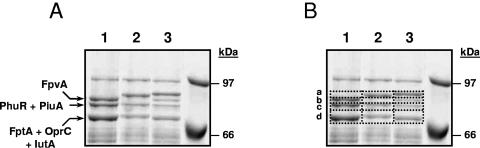
FIG. 1.
FIG. 1.
SDS-PAGE analysis of outer membrane proteins from P. aeruginosa PAO25. P. aeruginosa PAO25 was grown under iron-limiting conditions without siderophores (lane 1), with 20 μM ferrioxamine B (iron-loaded) (lane 2), or with 40 μM ferrichrome (iron-loaded) (lane 3) until late log phase. Outer membrane-enriched preparations were prepared as described in Materials and Methods and separated in a 7.5% acrylamide gel. (A) The positions of the TonB-dependent receptor proteins detected by MALDI-MS in cells grown under iron-limiting conditions are indicated on the left (arrows), and those of the molecular size markers are indicated on the right. (B) The different samples used for MALDI-MS analyses are shown.
FIG. 2.
FIG. 2.
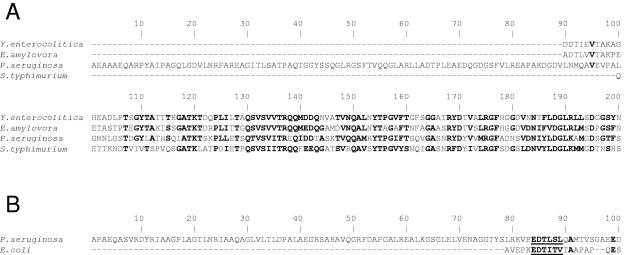
N-terminal extension of mature P. aeruginosa FoxA and FiuA proteins. (A) N-terminal extension of mature P. aeruginosa FoxA compared to mature Y. enterocolitica, E. amylovora, and S. enterica serovar Typhimurium FoxA proteins. (B) N-terminal extension of mature P. aeruginosa FiuA compared to mature E. coli FhuA. The proposed TonB box sequences are underlined. Positions at which identical or similar residues are present in at least three of the four sequences are shown in bold. The numbering of amino acid residues is indicated.
FIG. 3.
FIG. 3.
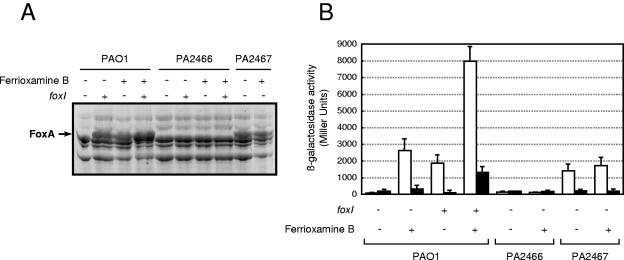
Analysis of Fox signaling system. P. aeruginosa PAO1 (wild type), PA2466 (foxA mutant), and PA2467 (foxR mutant) bearing the plasmid pMMB67EH (foxI negative) or pMUM8 (foxI positive) were grown under iron-restricted conditions without (−) or with (+) 20 μM ferrioxamine B (iron-free form) until late exponential growth phase. (A) Cell envelope preparations enriched for outer membrane proteins by Sarkosyl extraction were separated in a 7.5% acrylamide gel. The position of the ferrioxamine B receptor FoxA (PA2466) is indicated on the left. (B) P. aeruginosa strains containing the plasmid pMPR8bKm (PfoxA::lacZ transcriptional fusion) and the plasmid pMMB67EH (foxI negative) or pMUM8 (foxI positive) were grown under iron-restricted conditions (white bars) or iron-rich conditions (black bars) in either the presence (+) or absence (−) of 20 μM ferrioxamine B (iron-free form).
FIG. 4.
FIG. 4.
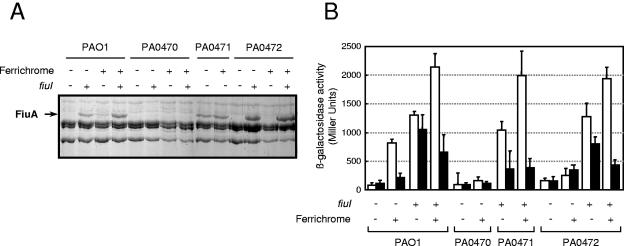
Analysis of Fiu signaling system. P. aeruginosa PAO1 (wild type), PA0470 (fiuA mutant), PA0471 (fiuR mutant), and PA0472 (fiuI mutant) bearing the plasmid pMMB67EH (fiuI negative) or pMMBFiuI (fiuI positive) were grown under iron-restricted conditions without (−) or with (+) 40 μM ferrichrome (iron-free form) until late exponential growth phase. (A) Cell envelope preparations enriched for outer membrane proteins by Sarkosyl extraction were separated in a 7.5% acrylamide gel. The position of the ferrichrome receptor FiuA (PA0470) is indicated on the left. (B) P. aeruginosa strains containing the plasmid pMPFiuAKm (PfiuA::lacZ transcriptional fusion) and the plasmid pMMB67EH (fiuI negative) or pMMBFiuI (fiuI positive) were grown under iron-restricted conditions (white bars) or iron-rich conditions (black bars) in either the presence (+) or absence (−) of 20 μM ferrichrome (iron-free form).
FIG. 5.
FIG. 5.
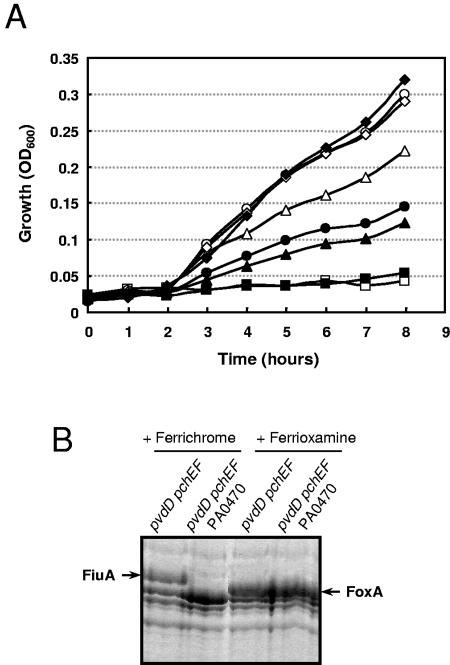
Growth phenotype of P. aeruginosa PA0470 (FiuA) mutant. (A) P. aeruginosa PAO1 pvdD pchEF (white symbols) and pvdD pchEF PA0470 (black symbols) mutant strains were grown in CAS medium containing 100 μM 2,2′-bipyridyl and no siderophores (squares), 0.5 μM ferrichrome (triangles), 2 μM ferrichrome (circles), or 0.5 μM ferrioxamine B (diamonds) (iron-free forms of the siderophores were used). Growth is expressed as an increase in the optical density measured at 600 nm. A representative growth curve from three separate experiments is shown. (B) SDS-PAGE analysis of outer membrane proteins from P. aeruginosa PAO1 pvdD pchEF mutant and its isogenic fiuA mutant (pvdD pchEF PA0470) after overnight growth in CAS medium containing 100 μM 2,2′-bipyridyl and 50 μM ferrichrome or ferrioxamine B, respectively. The position of the ferrichrome receptor FiuA (PA0470) is indicated on the left, and that of the ferrioxamine B receptor FoxA (PA2466) is indicated on the right.

References

    1. Alexeyev, M. F., I. N. Shokolenko, and T. P. Croughan. 1995. Improved antibiotic-resistance gene cassettes and omega elements for Escherichia coli vector construction and in vitro deletion/insertion mutagenesis. Gene 160:63-67. - PubMed
    1. Ankenbauer, R. G. 1992. Cloning of the outer membrane high-affinity Fe(III)-pyochelin receptor of Pseudomonas aeruginosa. J. Bacteriol. 174:4401-4409. - PMC - PubMed
    1. Aso, H., S. Miyoshi, H. Nakao, K. Okamoto, and S. Yamamoto. 2002. Induction of an outer membrane protein of 78 kDa in Vibrio vulnificus cultured in the presence of desferrioxamine B under iron-limiting conditions. FEMS Microbiol. Lett. 212:65-70. - PubMed
    1. Banin, E., M. L. Vasil, and E. P. Greenberg. 2005. Iron and Pseudomonas aeruginosa biofilm formation. Proc. Natl. Acad. Sci. USA 102:11076-11081. - PMC - PubMed
    1. Bäumler, A. J., and K. Hantke. 1992. Ferrioxamine uptake in Yersinia enterocolitica: characterization of the receptor protein FoxA. Mol. Microbiol. 6:1309-1321. - PubMed

Publication types

MeSH terms

LinkOut - more resources