


doi: 10.1128/JB.188.5.2020-2023.2006.
Effects of streptomycin resistance mutations on posttranslational modification of ribosomal protein S12
Affiliations
- PMID: 16484214
- PMCID: PMC1426572
- DOI: 10.1128/JB.188.5.2020-2023.2006
Item in Clipboard
Effects of streptomycin resistance mutations on posttranslational modification of ribosomal protein S12
J Bacteriol.
2006 Mar.
Abstract
Ribosomal protein S12 contains a highly conserved aspartic acid residue that is posttranslationally beta-methylthiolated. Using mass spectrometry, we have determined the modification states of several S12 mutants of Thermus thermophilus and conclude that beta-methylthiolation is not a determinant of the streptomycin phenotype.
Figures
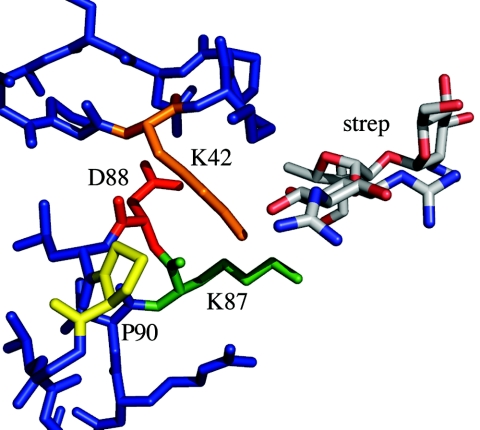
The region surrounding D88 in S12, as determined in the structure of the T. thermophilus 30S subunit complexed with antibiotics (7) (Protein Data Bank accession no. 1FJG). The conserved K42- and P90-containing loops of S12 are shown in blue. D88 is highlighted in red, P90 in yellow, K87 in green, and K42 in orange. The streptomycin (strep) binding site is proximal to these residues and is shown as tricolor sticks. This figure was illustrated with PyMol (9).
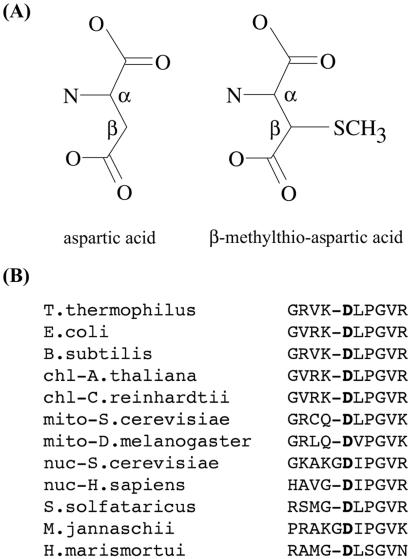
(A) Structures of aspartic acid and the modified β-methylthio-aspartic acid. (B) Amino acid alignment of the P90 loop, showing the conservation of D88 (in boldface) throughout three domains of life. Bacteria are represented by T. thermophilus, E. coli, and B. subtilis; chloroplast (chl) S12 sequences are shown for Arabidopsis thaliana and Chlamydomonas reinhardtii; mitochondrial (mito) S12 sequences are shown for Saccharomyces cerevisiae and Drosophila melanogaster; and eukaryotic nuclear (nuc) S12 sequences are represented by S. cerevisiae and Homo sapiens. A protein-protein BLAST search with T. thermophilus S12 returned 300 nonredundant bacterial S12 proteins. Chloroplast, mitochondrial, and nuclear S12 sequences were retrieved from 345 eukaryotic matches. Thirty-four sequences were exhaustive of the archaeal S12 proteins retrieved, and here they are represented by Sulfolobus solfataricus, Methanococcus jannaschii, and Haloarcula marismortui.
References
-
- Altschul, S. F., W. Gish, W. Miller, E. W. Myers, and D. J. Lipman. 1990. Basic local alignment search tool. J. Mol. Biol. 215:403-410. - PubMed
-
- Arima, K., A. Kakinuma, and G. Tamura. 1968. Surfactin, a crystalline peptidelipid surfactant produced by Bacillus subtilis: isolation, characterization and its inhibition of fibrin clot formation. Biochem. Biophys. Res. Commun. 31:488-494. - PubMed
-
- Beauclerk, A. A., and E. Cundliffe. 1987. Sites of action of two ribosomal RNA methylases responsible for resistance to aminoglycosides. J. Mol. Biol. 193:661-671. - PubMed
-
- Burkholder, P. R., and N. H. Giles. 1947. Induced biochemical mutants in Bacillus subtilis. Am. J. Bot. 34:345-348. - PubMed
Publication types
MeSH terms
Substances
Associated data
- Actions
- Actions
- Actions
- Actions
Grants and funding
LinkOut - more resources
Full Text Sources
Other Literature Sources
Medical
Molecular Biology Databases
