


Differential effects of contraction and PPAR agonists on the expression of fatty acid transporters in rat skeletal muscle
- PMID: 16484294
- PMCID: PMC1779691
- DOI: 10.1113/jphysiol.2006.106013
Differential effects of contraction and PPAR agonists on the expression of fatty acid transporters in rat skeletal muscle
Abstract
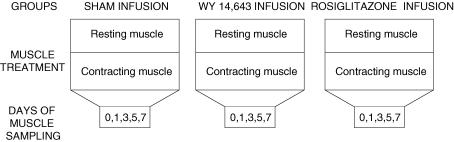
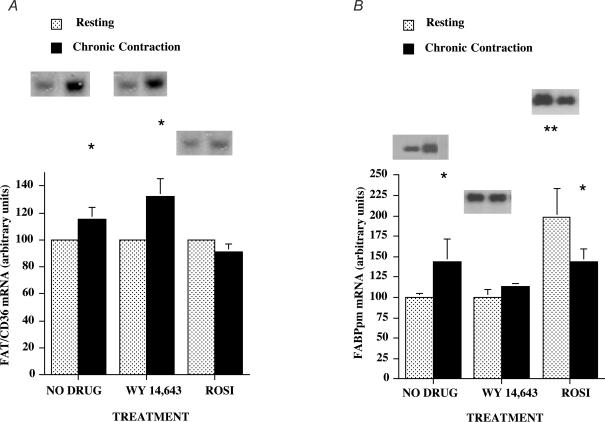
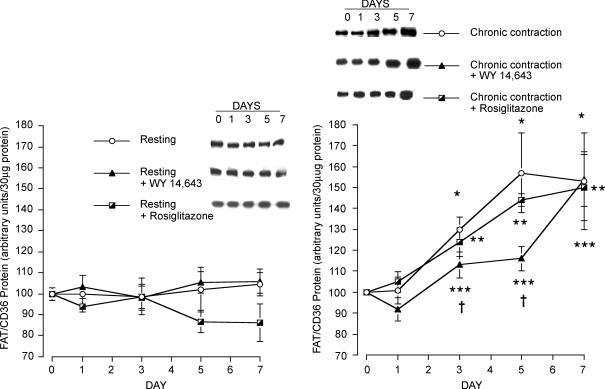
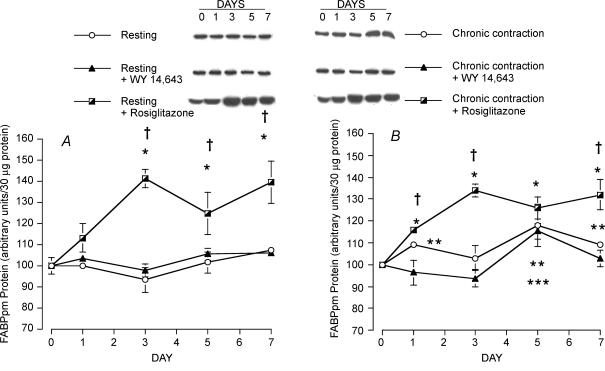
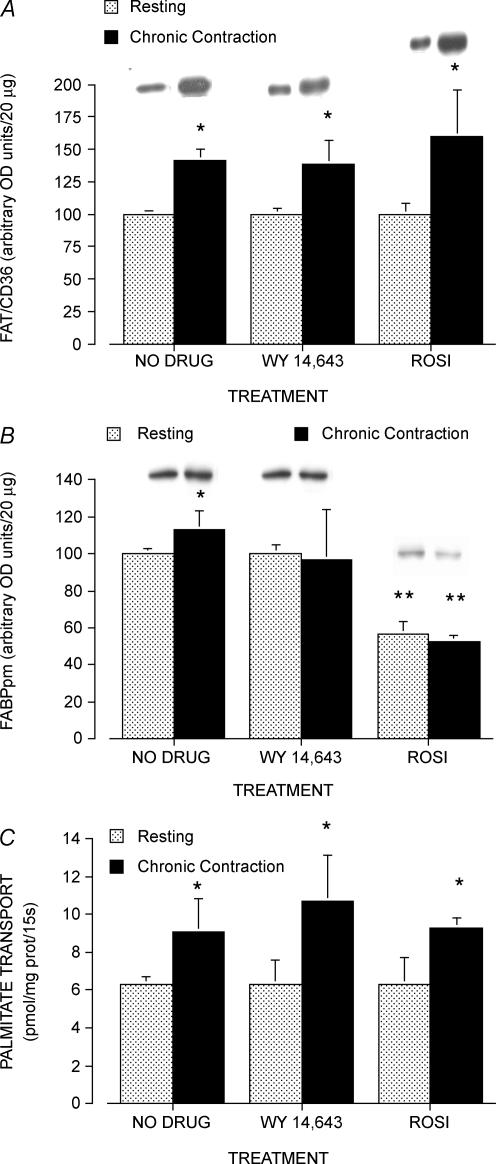
We have examined over the course of a 1-week period the independent and combined effects of chronically increased muscle contraction and the peroxisome proliferator-activated receptor (PPAR)alpha and PPARgamma activators, Wy 14,643 and rosiglitazone, on the expression and plasmalemmal content of the fatty acid transporters, FAT/CD36 and FABPpm, as well as on the rate of fatty acid transport. In resting muscle, the activation of either PPARalpha or PPARgamma failed to induce the protein expression of FAT/CD36. PPARalpha activation also failed to induce the protein expression of FABPpm. In contrast, PPARgamma activation induced the expression of FABPpm protein (40%; P < 0.05). Chronic muscle contraction increased the protein expression of FAT/CD36 (approximately 50%; P < 0.05), whereas FABPpm was slightly increased (12%; P < 0.05). Neither PPARalpha nor PPARgamma activation altered the contraction-induced expression of FAT/CD36 or FABPpm. Changes in protein expression of FAT/CD36 or FABPpm, induced by either contractions or by administration of rosiglitazone, were largely attributable to increased transcription. The contraction-induced increments in FAT/CD36 were accompanied by parallel increments in plasmalemmal FAT/CD36 and in rates of fatty acid transport (P < 0.05). Up-regulation of FABPpm expression was, however, accompanied by a reduction in plasmalemmal FABPpm, which did not affect the rates of long chain fatty acid (LCFA) transport. These studies have shown that in skeletal muscle (i) neither PPARalpha nor PPARgamma activation alters FAT/CD36 expression, (ii) PPARgamma activation selectively up-regulates FABPpm expression and (iii) contraction-induced up-regulation of LCFA transport does not appear to occur via activation of either PPARalpha or PPARgamma.
Figures
References
-
- Abumrad N, Coburn C, Ibrahimi A. Membrane proteins implicated in long-chain fatty acid uptake by mammalian cells: CD36, FATP and FABPm. Biochim Biophys Acta. 1999;1441:4–13. - PubMed
-
- Abumrad NA, El-Maghrabi MR, Amri EZ, Lopez E, Grimaldi PA. Cloning of a rat adipocyte membrane protein implicated in binding or transport of long-chain fatty acids that is induced during preadipocyte differentiation. Homology with human CD36. J Biol Chem. 1993;268:17665–17668. - PubMed
-
- Abumrad N, Harmon C, Ibrahimi A. Membrane transport of long-chain fatty acids: evidence for a facilitated process. J Lipid Res. 1998;39:2309–2318. - PubMed
-
- Abumrad NA, Park JH, Park CR. Permeation of long-chain fatty acid into adipocytes. Kinetics, specificity, and evidence for involvement of a membrane protein. J Biol Chem. 1984;259:8945–8953. - PubMed
-
- Abumrad NA, Perkins RC, Park JH, Park CR. Mechanism of long chain fatty acid permeation in the isolated adipocyte. J Biol Chem. 1981;256:9183–9191. - PubMed
Publication types
MeSH terms
Substances
LinkOut - more resources
Full Text Sources
