


Tracheobronchial aspiration of gastric contents in critically ill tube-fed patients: frequency, outcomes, and risk factors
- PMID: 16484901
- PMCID: PMC2396145
- DOI: 10.1097/01.CCM.0000206106.65220.59
Tracheobronchial aspiration of gastric contents in critically ill tube-fed patients: frequency, outcomes, and risk factors
Abstract
Objectives: To describe the frequency of pepsin-positive tracheal secretions (a proxy for the aspiration of gastric contents), outcomes associated with aspiration (including a positive Clinical Pulmonary Infection Score [a proxy for pneumonia] and use of hospital resources), and risk factors associated with aspiration and pneumonia in a population of critically ill tube-fed patients.
Design: Prospective descriptive study conducted over a 2-yr period.
Setting: Five intensive care units in a university-affiliated medical center with level I trauma status.
Patients: Each of the 360 adult patients participated for 4 days. Among the inclusion criteria were mechanical ventilation and tube feedings. An exclusion criterion was physician-diagnosed pneumonia at the time of enrollment.
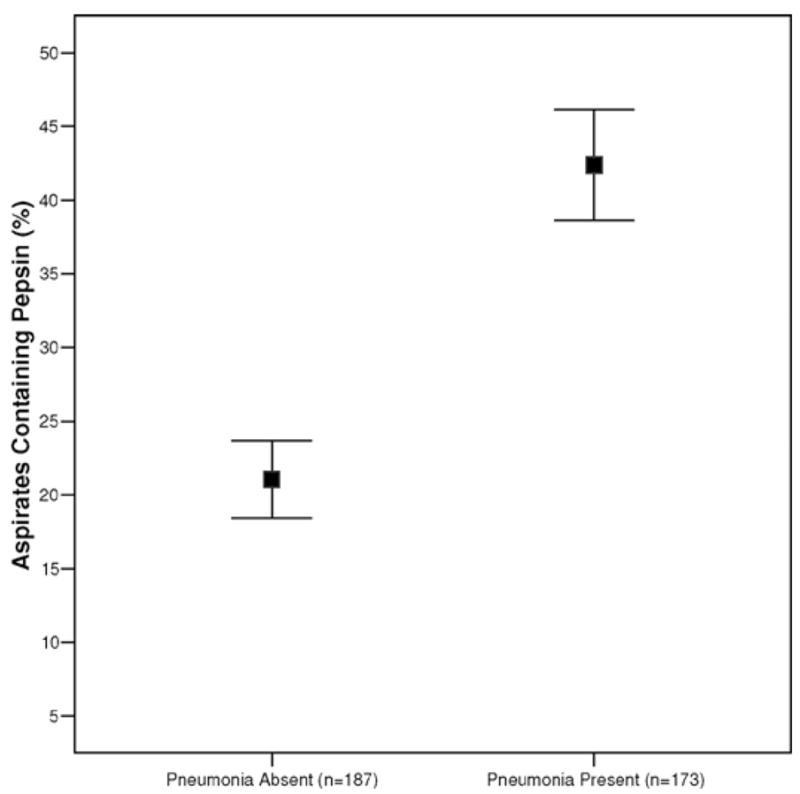
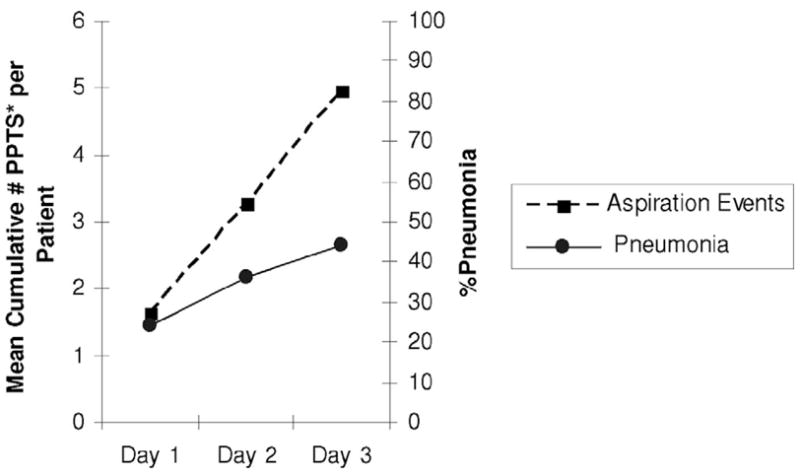
Intervention: None. MEASUREMENTS AND MAJOR RESULTS: Almost 6,000 tracheal secretions collected during routine suctioning were assayed for pepsin; of these, 31.3% were positive. At least one aspiration event was identified in 88.9% (n = 320) of the participants. The incidence of pneumonia (as determined by the Clinical Pulmonary Infection Score) increased from 24% on day 1 to 48% on day 4. Patients with pneumonia on day 4 had a significantly higher percentage of pepsin-positive tracheal secretions than did those without pneumonia (42.2% vs. 21.1%, respectively; p < .001). Length of stay in the intensive care unit and need for ventilator support were significantly greater for patients with pneumonia (p < .01). A low backrest elevation was a risk factor for aspiration (p = .024) and pneumonia (p = .018). Other risk factors for aspiration included vomiting (p = .007), gastric feedings (p = .009), a Glasgow Coma Scale score <9 (p = .021), and gastroesophageal reflux disease (p = .033). The most significant independent risk factors for pneumonia were aspiration (p < .001), use of paralytic agents (p = .002), and a high sedation level (p = .039).
Conclusions: Aspiration of gastric contents is common in critically ill tube-fed patients and is a major risk factor for pneumonia. Furthermore, it leads to greater use of hospital resources. Modifiable risk factors for aspiration need to be addressed.
Figures
References
-
- Marik PE. Aspiration pneumonitis and aspiration pneumonia [see comment] N Engl J Med. 2001;344:665–671. - PubMed
-
- Potts RG, Zaroukian MH, Guerrero PA, et al. Comparison of blue dye visualization and glucose oxidase test strip methods for detecting pulmonary aspiration of enteral feedings in intubated adults. Chest. 1993;103:117–121. - PubMed
-
- Winterbauer RH, Durning RBJ, Barron E, et al. Aspirated nasogastric feeding solution detected by glucose strips. Ann Intern Med. 1981;95:67–68. - PubMed
-
- Kinsey GC, Murray MJ, Swensen SJ, et al. Glucose content of tracheal aspirates: Implications for the detection of tube feeding aspiration. Crit Care Med. 1994;22:1557–1562. - PubMed
Publication types
MeSH terms
Grants and funding
LinkOut - more resources
Full Text Sources
Other Literature Sources
Medical
