. 2005 Dec;11(12):1874-81.
doi: 10.3201/eid1112.050485.

Porcine noroviruses related to human noroviruses

Affiliations

Porcine noroviruses related to human noroviruses

Qiu-Hong Wang et al. Emerg Infect Dis. 2005 Dec.

Abstract

Detection of genogroup II (GII) norovirus (NoV) RNA from adult pigs in Japan and Europe and GII NoV antibodies in US swine raises public health concerns about zoonotic transmission of porcine NoVs to humans, although no NoVs have been detected in US swine. To detect porcine NoVs and to investigate their genetic diversity and relatedness to human NoVs, 275 fecal samples from normal US adult swine were screened by reverse transcription-polymerase chain reaction with calicivirus universal primers. Six samples were positive for NoV. Based on sequence analysis of 3 kb on the 3' end of 5 porcine NoVs, 3 genotypes in GII and a potential recombinant were identified. One genotype of porcine NoVs was genetically and antigenically related to human NoVs and replicated in gnotobiotic pigs. These results raise concerns of whether subclinically infected adult swine may be reservoirs of new human NoVs or if porcine/human GII recombinants could emerge.


Figures
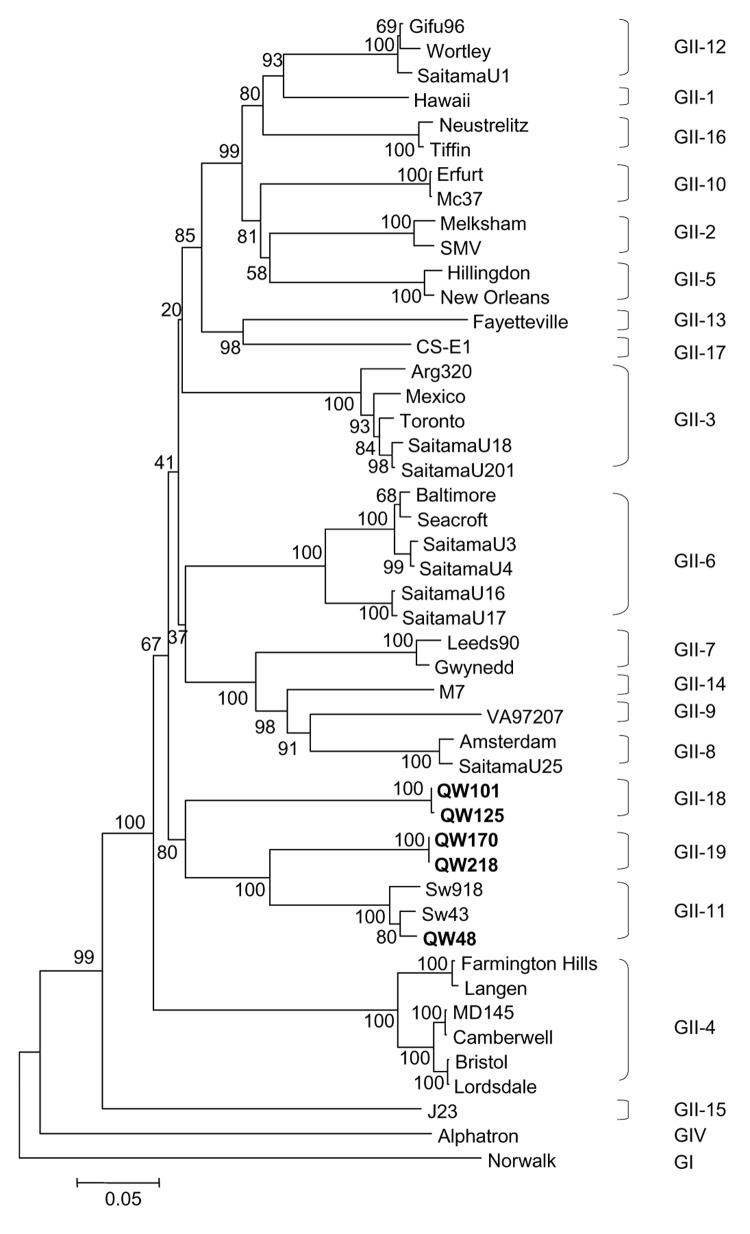
Figure 1
Figure 1
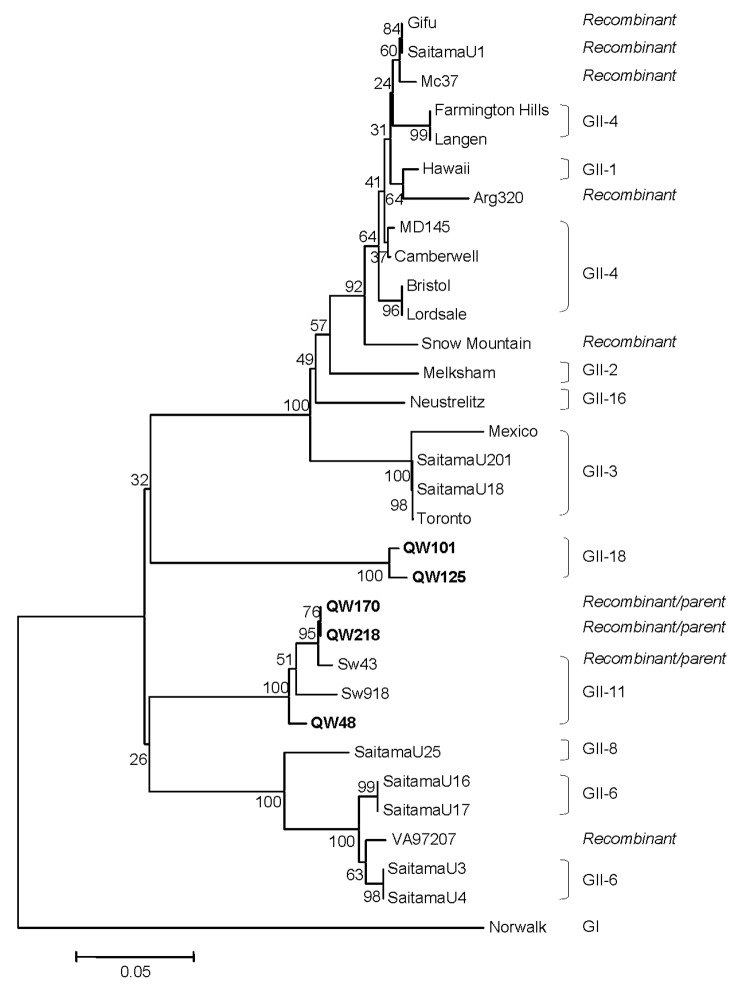
Neighbor-joining phylogenetic tree of genogroup II noroviruses (NoVs) based on the complete capsid region. The 5 newly identified porcine NoV strains are in boldface. Genogroups (G) and genotypes (numbers after G) are indicated. The human NoV GI-1/Norwalk and GIV/Alphatron strains were used as outgroup controls.
Figure 2
Figure 2
Neighbor-joining phylogenetic tree of genogroup II noroviruses (NoVs) based on the partial RNA-dependent RNA polymerase region (C-terminal 260–266 amino acids). The 5 newly identified porcine NoV strains are in boldface. Genogroups (G) and genotypes (numbers after G) are indicated. The human NoV GI-1/Norwalk strain was used as outgroup control.
Figure 3
Figure 3
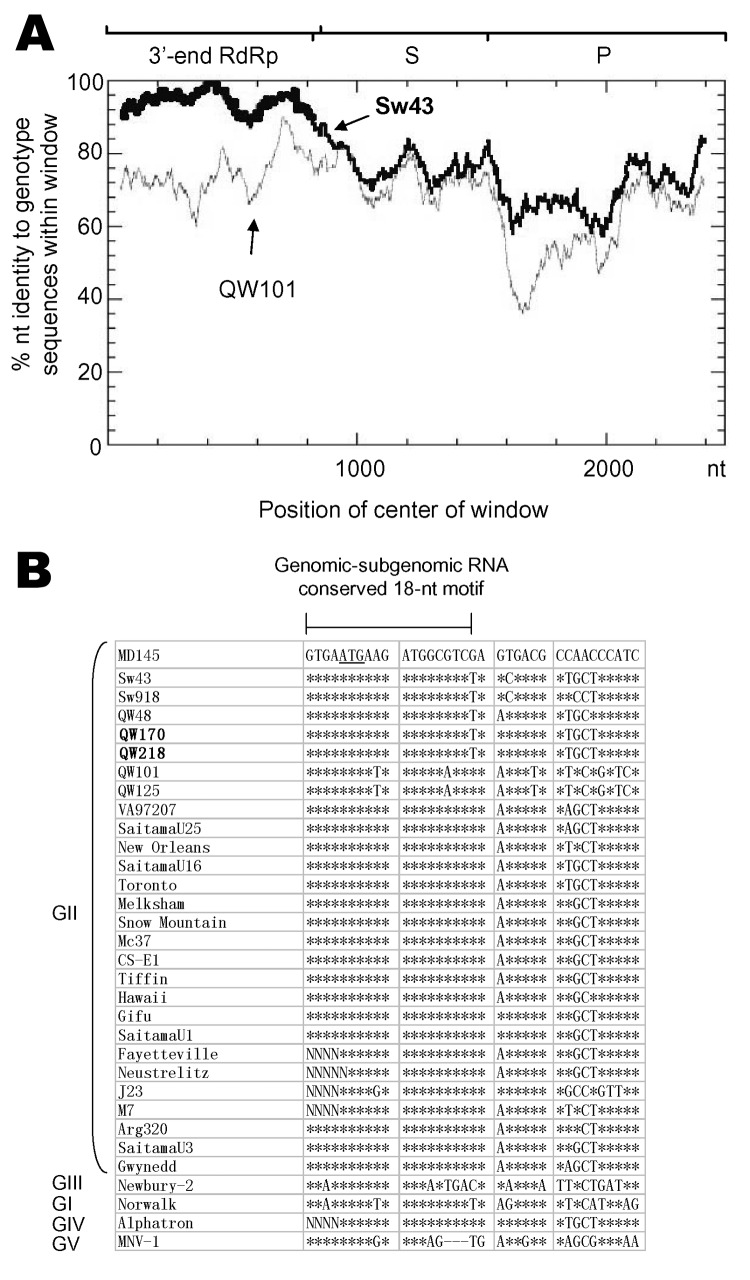
Identification of a potential recombination event between QW170 and Sw43 strains. A) Recombination Identification Program analysis of QW170 strain. At each position of the window, the query sequence (QW170) was compared to each of the background genotype representatives (GII-11/Sw43 and GII-18/QW101). When the query sequence is similar to the background sequences, the homologous regions are indicated as thick lines on the plot. Analysis parameters were window size of 100 and significance of 90%. The nucleotide positions of the 3´-end RNA-dependent RNA polymerase (RdRp) and the shell (S) and protruding (P) domains of the capsid protein are indicated. B) Sequence alignments of the RdRp-capsid junction region of noroviruses (NoVs). The genomic and subgenomic conserved 18-nucleotide (nt) motif is indicated by a horizontal line with 2 vertical bars. Asterisks indicate the identical residues to the sequence of the first line. Dashes represent gaps. The letter N indicates missing data on the residue. The start codon of open reading frame ORF 2 is underlined. Five NoV genogroups are indicated.
Figure 4
Figure 4
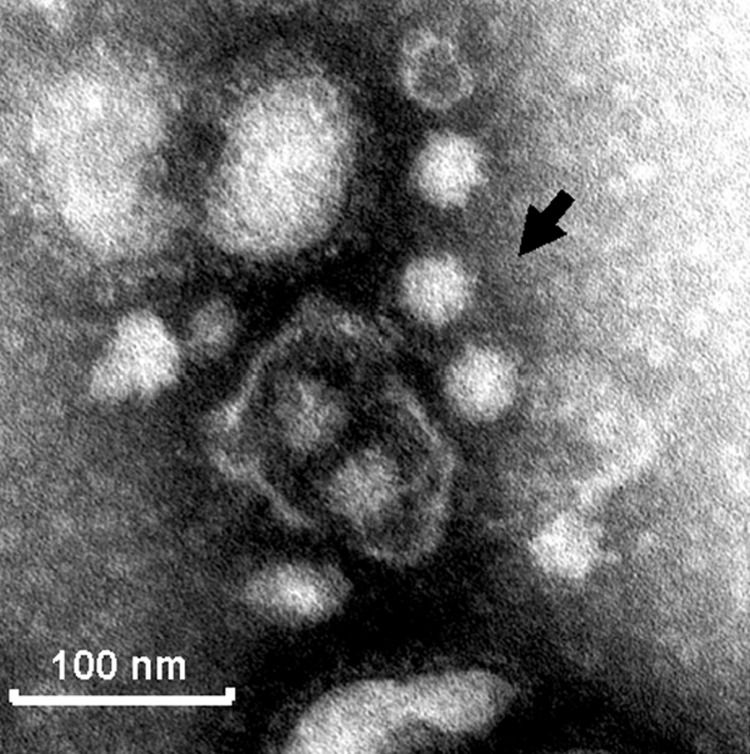
Immune electron micrograph of porcine noroviruses (NoVs). The diluted intestinal contents of a gnotobiotic pig euthanized on postinoculation day 5 to QW101-like porcine NoVs (QW144) were incubated with convalescent-phase serum LL616 from another gnotobiotic pig inoculated with QW101-like porcine NoVs (QW126) and visualized by negative staining with 3% phosphotungstic acid. The arrow indicates a small clump of NoV-like particles.
Figure 5
Figure 5
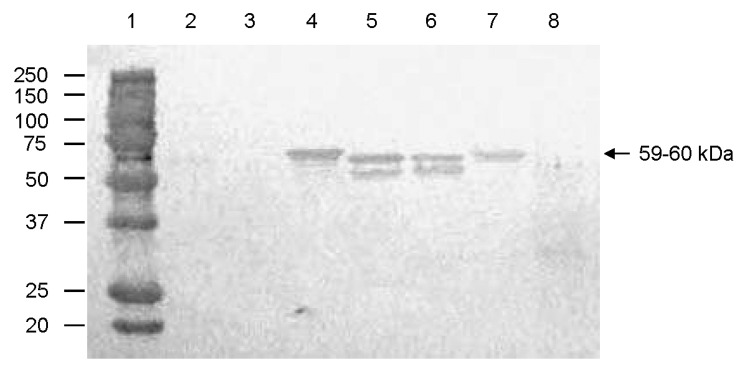
Antigenic cross-reactivity between human genogroup (G) II norovirus (NoV) capsid proteins and a pig convalescent-phase antiserum (LL616) against porcine QW101-like (GII-18) NoV was determined by Western blot. The CsCl-gradient purified viruslike particles (1,250 ng) were separated by sodium dodecyl sulfate 10% polyacrylamide gel electrophoresis, blotted onto nitrocellulose membranes, and tested with LL616. The sucrose-cushion (40%, wt/vol) purified Sf9 insect cell proteins acted as a negative control (lane 8). Lane 1, molecular weight marker (kDa); lanes 2–7, Hu/GI-3/Desert Shield, Hu/GII-1/Hawaii, Hu/GII-3/Toronto, Hu/GII-4/MD145, Hu/GII-4/HS66, and Hu/GII-6/Florida, respectively.

References

    1. Green KY, Chanock RM, Kapikian AZ. Human caliciviruses. In: Knipe DM, Howley PM, editors. Fields virology. 4th ed. Philadelphia: Lippincott Williams & Wilkins; 2001. p. 841–74.
    1. Lopman B, Vennema H, Kohli E, Pothier P, Sanchez A, Negredo A, et al. Increase in viral gastroenteritis outbreaks in Europe and epidemic spread of new norovirus variant. Lancet. 2004;363:682–8. 10.1016/S0140-6736(04)15641-9 - DOI - PubMed
    1. Liu BL, Lambden PR, Gunther H, Otto P, Elschner M, Clarke IN. Molecular characterization of a bovine enteric calicivirus: relationship to the Norwalk-like viruses. J Virol. 1999;73:819–25. - PMC - PubMed
    1. Pfister T, Wimmer E. Polypeptide p41 of a Norwalk-like virus is a nucleic acid-independent nucleoside triphosphatase. J Virol. 2001;75:1611–9. 10.1128/JVI.75.4.1611-1619.2001 - DOI - PMC - PubMed
    1. Belliot G, Sosnovtsev SV, Mitra T, Hammer C, Garfield M, Green KY. In vitro proteolytic processing of the MD145 norovirus ORF1 nonstructural polyprotein yields stable precursors and products similar to those detected in calicivirus-infected cells. J Virol. 2003;77:10957–74. 10.1128/JVI.77.20.10957-10974.2003 - DOI - PMC - PubMed

Publication types

Substances

LinkOut - more resources