


The local immune response in ulcerative lesions of Buruli disease
- PMID: 16487243
- PMCID: PMC1809619
- DOI: 10.1111/j.1365-2249.2006.03020.x
The local immune response in ulcerative lesions of Buruli disease
Abstract
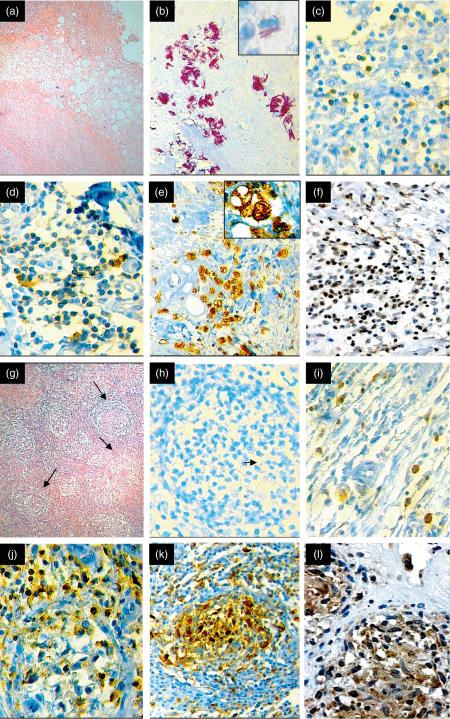
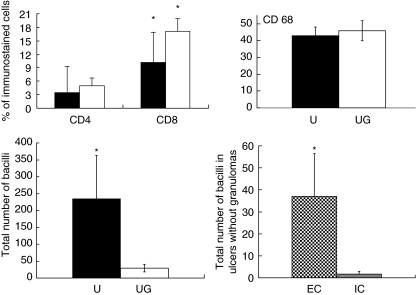
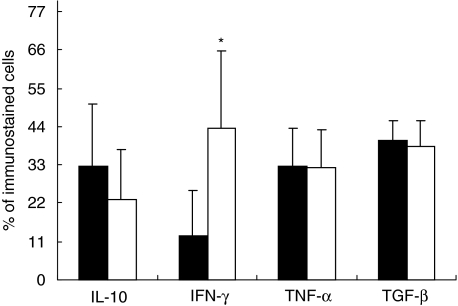
Buruli disease (BU) is a progressive necrotic and ulcerative disease of the skin and subcutaneous tissue caused by Mycobacterium ulcerans. BU is considered the third most common mycobacterial disease after tuberculosis and leprosy. Three clinical stages of the cutaneous lesions have been described in BU: pre-ulcerative, ulcerative and healed lesions. In this study we used immunohistochemistry and automated morphometry to determine the percentage of macrophages and of CD4/CD8 lymphocytes and their expression of interferon (IFN)-gamma, interleukin (IL)-10, tumour necrosis factor (TNF)-alpha and transforming growth factor (TGF)-beta. Expression of these cytokines was correlated with the inflammatory response evaluated by histopathology. All the studied BU ulcerative cases showed extensive necrosis and chronic inflammation. The most important feature was the presence or absence of granulomas co-existing with a mixed pro-inflammatory/anti-inflammatory cytokine balance. When granulomas were present significantly higher expression of IFN-gamma was seen, whereas in ulcerative lesions without granulomas there was increased expression of IL-10 and significantly higher bacillary counts. These features correlated with the chronicity of the lesions; longer-lasting lesions showed granulomas. Thus, granulomas were absent from relatively early ulcerative lesions, which contained more bacilli and little IFN-gamma, suggesting that at this stage of the disease strong suppression of the protective cellular immune response facilitates proliferation of bacilli.
Figures
References
-
- Asiedu K, Sherpbier R, Raviglione MC. WHO Global Buruli Ulcer Initiative Report. Geneva, Switzerland: World Health Organization; 2000. Boruli ulcer Mycobacterium ulcerans infection.
-
- van der Werf TS, van der Graff WTA, Tappero JW, Asiedu K. Mycobacterium ulcerans infection. Lancet. 1999;354:1013–18. - PubMed
-
- Meyers WM, Shelly WM, Connor DH, Meyers EK. Human Mycobacterium ulcerans infections developing at sites of trauma to skin. Am J Trop Med Hyg. 1974;23:919–23. - PubMed
-
- Marsollier L, Aubry J, Coutanceau E, et al. Colonization of the salivary glands of Naucoris cimicoides by Mycobacterium ulcerans requires host plasmatocytes and a macrolide toxin, mycolactone. Cell Microbiol. 2005;7:935–43. - PubMed
Publication types
MeSH terms
Substances
LinkOut - more resources
Full Text Sources
Medical
Research Materials
