


Phylogenetic comparisons suggest that distance from the locus control region guides developmental expression of primate beta-type globin genes
- PMID: 16488971
- PMCID: PMC1413942
- DOI: 10.1073/pnas.0511347103
Phylogenetic comparisons suggest that distance from the locus control region guides developmental expression of primate beta-type globin genes
Abstract
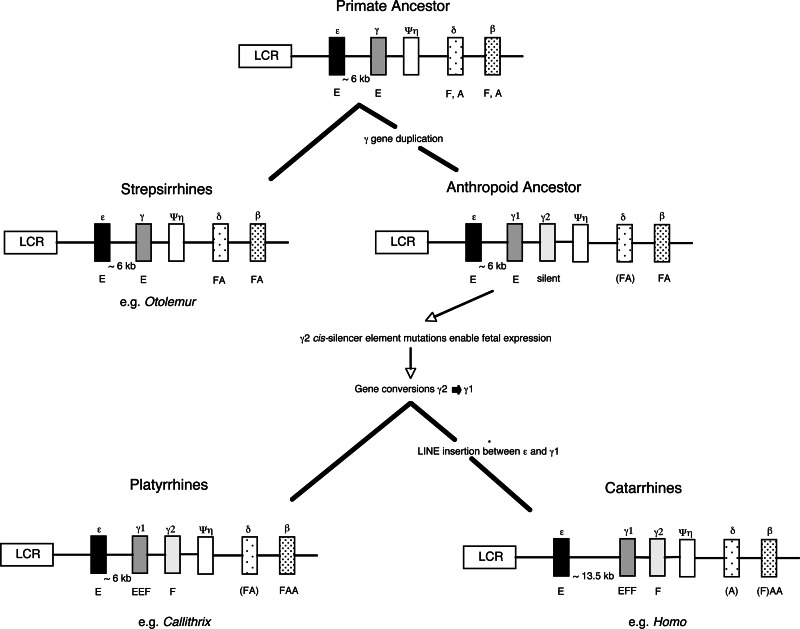
Phylogenetic inferences drawn from comparative data on mammalian beta-globin gene clusters indicate that the ancestral primate cluster contained a locus control region (LCR) and five paralogously related beta-type globin loci (5'-LCR-epsilon-gamma-psieta-delta-beta-3'), with epsilon and gamma expressed solely during embryonic life. A gamma locus tandem duplication (5'-gamma(1)-gamma(2)-3') triggered gamma's evolution toward fetal expression but by a different trajectory in platyrrhines (New World monkeys) than in catarrhines (Old World monkeys and apes, including humans). In platyrrhine (e.g., Cebus) fetuses, gamma(1) at the ancestral distance from epsilon is down-regulated, whereas gamma(2) at increased distance is up-regulated. Catarrhine gamma(1) and gamma(2) acquired longer distances from epsilon (14 and 19 kb, respectively), and both are up-regulated throughout fetal life with gamma(1)'s expression predominating over gamma(2)'s. On enlarging the platyrrhine expression data, we find Aotus gamma is embryonic, Alouatta gamma is inactive at term, and in Callithrix, gamma(1) is down-regulated fetally, whereas gamma(2) is up-regulated. Of eight mammalian taxa now represented per taxon by embryonic, fetal, and postnatal beta-type globin gene expression data, four taxa are primates, and data for three of these primates are from this laboratory. Our results support a model in which a short distance (<10 kb) between epsilon and the adjacent gamma is a plesiomorphic character that allows the LCR to drive embryonic expression of both genes, whereas a longer distance (>10 kb) impedes embryonic activation of the downstream gene.
Conflict of interest statement
Conflict of interest statement: No conflicts declared.
Figures
References
-
- Bunn H. F., Forget B. G. Hemoglobin: Molecular, Genetic, and Clinical Aspects. Philadelphia: Saunders; 1986.
-
- Collins F. S., Weissman S. M. Prog. Nucleic Acid Res. Mol. Biol. 1984;31:315–462. - PubMed
-
- Fraser P., Pruzina S., Antoniou M., Grosveld F. Genes Dev. 1993;7:106–113. - PubMed
-
- Grosveld F., van Assendelft G. B., Greaves D. R., Kollias G. Cell. 1987;51:975–985. - PubMed
-
- Hardison R., Slightom J. L., Gumucio D. L., Goodman M., Stojanovic N., Miller W. Gene. 1997;205:73–94. - PubMed
Publication types
MeSH terms
Substances
Grants and funding
LinkOut - more resources
Full Text Sources
Other Literature Sources
