Review
. 2006 Jan 21;12(3):363-71.
doi: 10.3748/wjg.v12.i3.363.

Stem cells and cancer: evidence for bone marrow stem cells in epithelial cancers

Affiliations
Review

Stem cells and cancer: evidence for bone marrow stem cells in epithelial cancers

Han-Chen Li et al. World J Gastroenterol. .

Abstract

Cancer commonly arises at the sites of chronic inflammation and infection. Although this association has long been recognized, the reason has remained unclear. Within the gastrointestinal tract, there are many examples of inflammatory conditions associated with cancer, and these include reflux disease and Barrettos adenocarcinoma of the esophagus, Helicobacter infection and gastric cancer, inflammatory bowel disease and colorectal cancer and viral hepatitis leading to hepatocellular carcinoma. There are several mechanisms by which chronic inflammation has been postulated to lead to cancer which includes enhanced proliferation in an endless attempt to heal damage, the presence of a persistent inflammatory environment creating a pro-carcinogenic environment and more recently a role for engraftment of circulating marrow-derived stem cells which may contribute to the stromal components of the tumor as well as the tumor mass itself. Here we review the recent advances in our understanding of the contributions of circulating bone marrow-derived stem cells to the formation of tumors in animal models as well as in human beings.


Figures
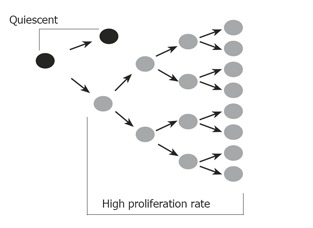
Figure 1
Figure 1
A proposed model for the cancer stem cell. The cancer stem cell replicates itself asymmetrically, thus maintaining one daughter stem cell identical to itself. This remains in a relatively quiescent state. The asymmetric division also produces another daughter cell with a high proliferative rate which rapidly divides to sustain the tumor mass.
Figure 2
Figure 2
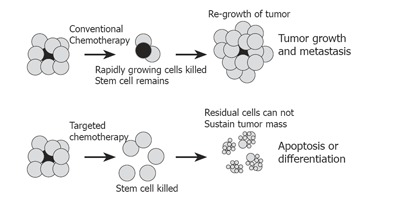
Conventional versus stem cell-targeted chemotherapy. Conventional chemotherapy and radiotherapy targets rapidly dividing cells, and may shrink tumor mass substantially. However, the stem cell (gray), which is relatively quiescent, is not affected. Regrowth of tumor from surviving stem cell leads to regrowth of tumor and treatment failure. Chemotherapy targeted at the stem cell would remove the source of new cell growth, and allow residual cells within the tumor to be targeted with chemotherapy, differentiating agents or therapy aimed at inducing apoptosis, thus successfully eliminating the tumor.
Figure 3
Figure 3
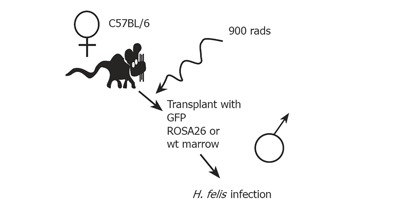
An experimental mouse model for bone marrow transplantation and H. felis-induced gastric carcinoma.
Figure 4
Figure 4
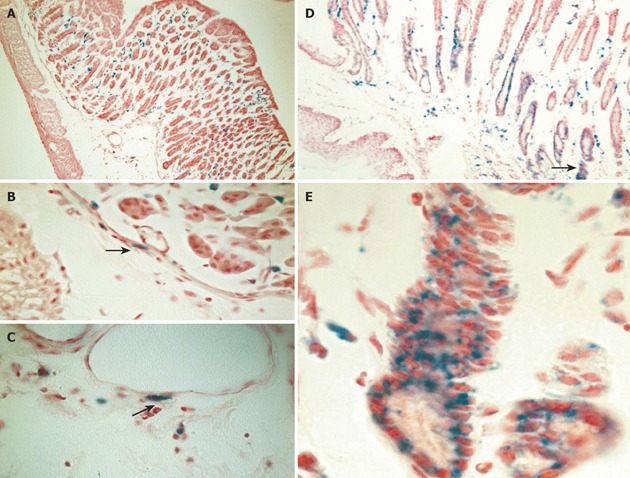
Engraftment of donor-derived ROSA-26 marrow by x-gal staining. A: Mice transplanted with ROSA 26 marrow and infected with H. felis for 4 wk had donor-derived leukocytes (blue) infiltrating the gastric mucosa, and no engraftment into gland structures. B and C: A higher power view reveals myocytes and myofibroblasts in the submucosal tissue adjacent to vascular structures (arrows). D: After 30 wk of infection, marked architectural distortion is seen with antralization and appearance of metaplastic glands. Entire gland structures are derived from donor marrow (blue staining). Gland shown in panel D (arrow) is shown at higher power in E.
Figure 5
Figure 5
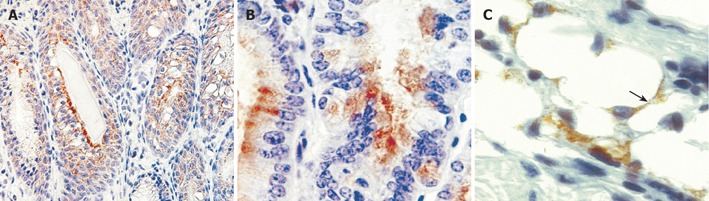
Immunohistochemistry for bacterial beta-galactosidase confirms uniform signal in gastrointestinal neoplasia. Mice developed severe dysplasia and intraepithelial neoplasia derived from donor marrow, 12-15 mo after infection with H. felis (A) and (B). Immunohistochemistry for bacterial beta-galactosidase demonstrates cytoplasmic staining in dysplastic glands. A population of adipocytes in the submucosa are also stained for beta-galactosidase (arrow).
Figure 6
Figure 6
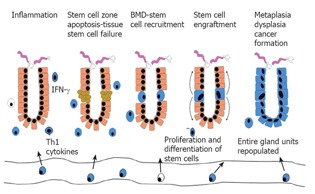
A new paradigm proposed for epithelial cancer.

References

    1. Balkwill F, Mantovani A. Inflammation and cancer: back to Virchow. Lancet. 2001;357:539–545. - PubMed
    1. Coussens LM, Werb Z. Inflammation and cancer. Nature. 2002;420:860–867. - PMC - PubMed
    1. Dvorak HF. Tumors: wounds that do not heal. Similarities between tumor stroma generation and wound healing. N Engl J Med. 1986;315:1650–1659. - PubMed
    1. Kuper H, Adami HO, Trichopoulos D. Infections as a major preventable cause of human cancer. J Intern Med. 2000;248:171–183. - PubMed
    1. Potten CS, Booth C, Hargreaves D. The small intestine as a model for evaluating adult tissue stem cell drug targets. Cell Prolif. 2003;36:115–129. - PMC - PubMed