Visual clutter causes high-magnitude errors
- PMID: 16494527
- PMCID: PMC1382012
- DOI: 10.1371/journal.pbio.0040056
Visual clutter causes high-magnitude errors
Abstract
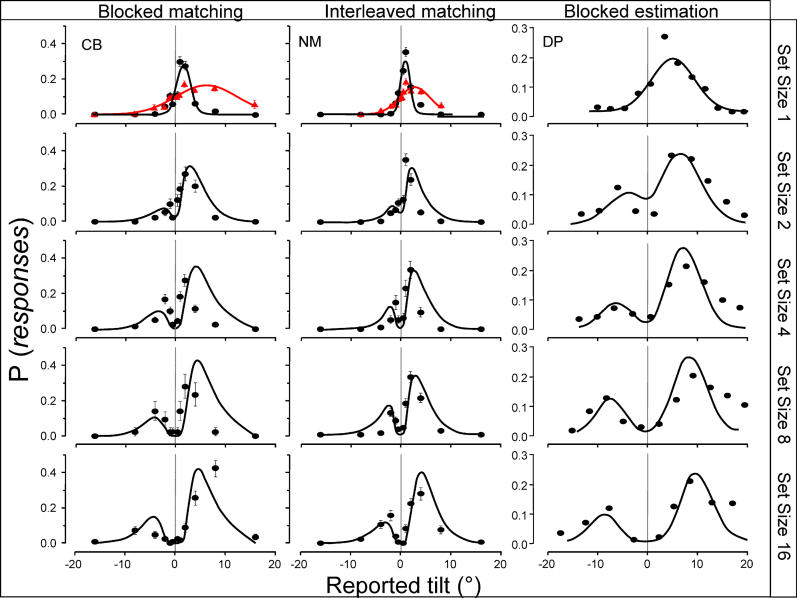
Perceptual decisions are often made in cluttered environments, where a target may be confounded with competing "distractor" stimuli. Although many studies and theoretical treatments have highlighted the effect of distractors on performance, it remains unclear how they affect the quality of perceptual decisions. Here we show that perceptual clutter leads not only to an increase in judgment errors, but also to an increase in perceived signal strength and decision confidence on erroneous trials. Observers reported simultaneously the direction and magnitude of the tilt of a target grating presented either alone, or together with vertical distractor stimuli. When presented in isolation, observers perceived isolated targets as only slightly tilted on error trials, and had little confidence in their decision. When the target was embedded in distractors, however, they perceived it to be strongly tilted on error trials, and had high confidence of their (erroneous) decisions. The results are well explained by assuming that the observers' internal representation of stimulus orientation arises from a nonlinear combination of the outputs of independent noise-perturbed front-end detectors. The implication that erroneous perceptual decisions in cluttered environments are made with high confidence has many potential practical consequences, and may be extendable to decision-making in general.
Figures




Comment in
-
When seeing is misleading: clutter leads to high-confidence errors.PLoS Biol. 2006 Mar;4(3):e77. doi: 10.1371/journal.pbio.0040077. Epub 2006 Feb 28. PLoS Biol. 2006. PMID: 20076542 Free PMC article. No abstract available.
References
-
- Levi DM, Klein SA, Aitsebaomo P. Detection and discrimination of the direction of motion in central and peripheral vision of normal and amblyopic observers. Vision Res. 1984;24:789–800. - PubMed
-
- Morgan MJ, Mason AJ, Solomon JA. Blindsight in normal subjects? Nature. 1997;385:401–402. - PubMed
-
- Verghese P. Visual search and attention: A signal detection theory approach. Neuron. 2001;31:523–535. - PubMed
-
- Wolfe J. Visual search. In: Pashler H, editor. Attention. London: University College London Press; 1996. pp. 13–74.
-
- Treisman AM, Gelade G. A feature-integration theory of attention. Cognit Psychol. 1980;12:97–136. - PubMed
Publication types
MeSH terms
LinkOut - more resources
Full Text Sources